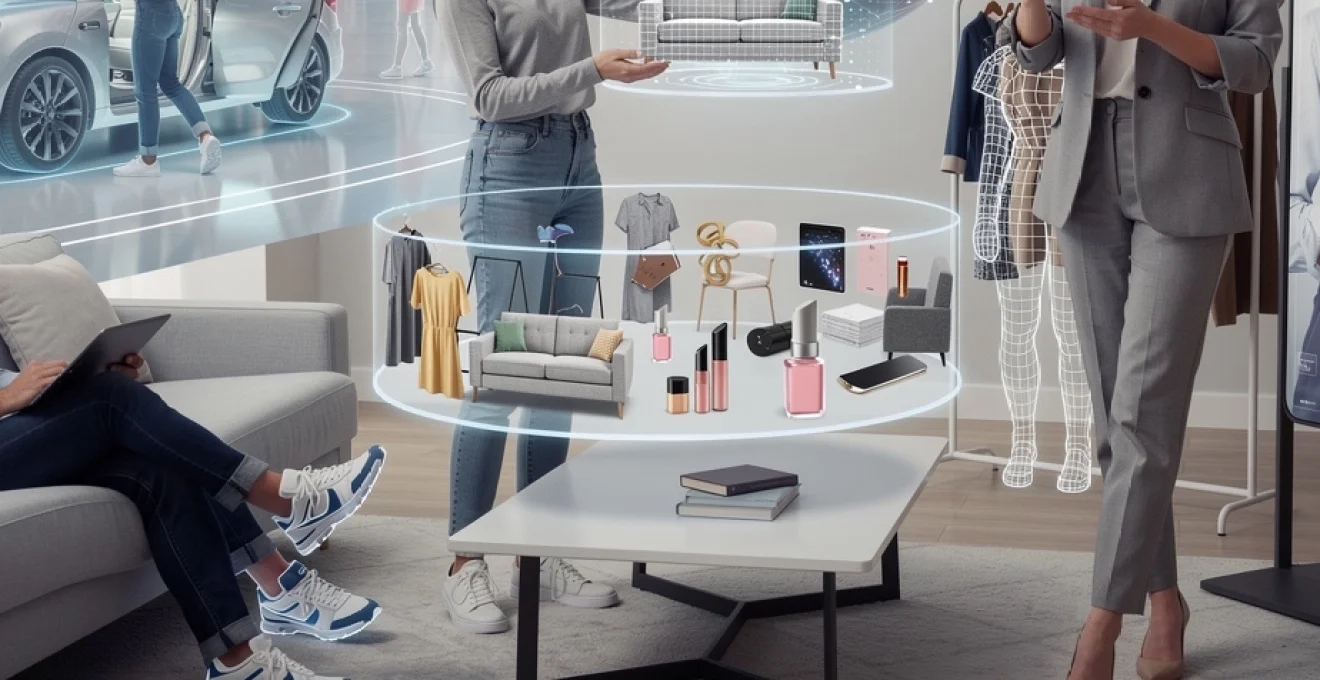
The evolution of digital retail has reached a transformative moment where virtual interactions mirror the tactile certainty of physical shopping. Immersive commerce—powered by augmented reality, virtual reality, and sophisticated 3D visualisation—addresses one of e-commerce’s most persistent challenges: the confidence gap between browsing and buying. Recent research indicates that 47% of consumers feel more connected to products through immersive technologies, whilst brands implementing these solutions report conversion increases of up to 30%. As consumer expectations continue to shift towards experiential digital environments, retailers face mounting pressure to deliver shopping experiences that combine convenience with the reassurance traditionally found only in brick-and-mortar stores. This technological revolution represents more than incremental improvement; it fundamentally reimagines how you discover, evaluate, and ultimately purchase products online.
Understanding immersive commerce technologies: AR, VR, and 3D visualisation platforms
Immersive commerce encompasses a spectrum of technologies designed to bridge the digital-physical divide in retail. At its foundation lies the principle that seeing is believing—when you can visualise a product in your actual environment or interact with it through sophisticated digital interfaces, purchase hesitation diminishes significantly. The technologies powering this transformation operate across different levels of immersion, each serving distinct purposes within the customer journey.
The convergence of these technologies creates what industry analysts describe as a “try it, trust it, buy it” paradigm. Rather than relying solely on static images and written descriptions, you gain access to multi-dimensional product experiences that answer questions before they’re even asked. This shift represents a fundamental change in digital commerce architecture, where experiential data replaces traditional product information as the primary decision-making tool.
Augmented reality product placement through WebAR and mobile applications
Augmented reality overlays digital content onto your real-world environment, creating a hybrid view that allows product evaluation within actual usage contexts. WebAR technology eliminates download barriers by delivering these experiences directly through mobile browsers, whilst dedicated applications offer enhanced functionality for frequent users. The accessibility of AR has expanded dramatically—61% of consumers now express greater likelihood to purchase from brands offering immersive technologies.
Modern AR implementations utilise device cameras and sophisticated spatial mapping algorithms to anchor virtual products with remarkable precision. You can walk around a digitally-placed sofa, observing how afternoon sunlight might interact with fabric textures, or view a potential wall colour from multiple angles throughout your living space. This contextual visualisation addresses the spatial uncertainty that previously drove returns and buyer’s remorse.
Virtual reality showrooms and metaverse retail experiences
Virtual reality creates fully immersive digital environments where you can explore curated retail spaces without geographical constraints. Unlike AR’s augmentation of existing spaces, VR transports you into entirely constructed showrooms, flagship stores, or even conceptual brand universes. These experiences prove particularly valuable for high-consideration purchases where extensive product comparison and environmental context matter significantly.
The emerging metaverse retail ecosystem extends VR’s capabilities by introducing persistent digital spaces where shopping becomes a social, exploratory activity. You might attend a virtual product launch with friends, examine items from impossible angles, or customise products in real-time whilst discussing options with sales representatives represented through realistic avatars. This approach combines the convenience of online shopping with the experiential richness of physical retail.
3D product configurators and photogrammetry rendering systems
Three-dimensional product visualisation forms the foundation upon which AR and VR experiences are built. Photogrammetry—the process of creating 3D models from multiple photographs—enables brands to digitise existing products with photorealistic accuracy. These models capture texture, reflectivity, and dimensional characteristics that allow you to examine products from any angle, zoom into materials, and understand scale relationships.
Product configurators leverage these 3D models to enable real-time customisation. You might adjust colour combinations, swap components, or add personalised elements whilst immediately visualising the results. This interactive configuration process addresses the 47% of consumers who would pay premium prices for products they can personalise using immersive technologies. The immediacy of visual feedback transforms customisation from an abstract exercise into a tangible design process.
Haptic feedback integration and multi-
multi-sensory digital interfaces
Whilst visual immersion remains central to immersive commerce, emerging interfaces are beginning to reintroduce the sense of touch and other sensory cues into digital shopping. Haptic feedback—delicate vibrations and resistance patterns delivered through smartphones, wearables, or specialised controllers—simulates physical interactions such as pressing a button, turning a dial, or feeling the click of a clasp. When combined with spatial audio and adaptive lighting, these multi-sensory digital interfaces make product interactions feel less abstract and more like handling the real thing.
In practice, this can mean subtle haptic cues when you rotate a 3D watch model, or differentiated vibration patterns that mimic various fabric weights in a fashion app. Although still early-stage for mainstream e-commerce, haptics and multi-sensory interfaces hint at a future where online browsing feels closer to standing in a flagship store. For retailers, the strategic opportunity lies in piloting these technologies in high-value categories—luxury accessories, consumer electronics, or performance equipment—where tactile reassurance can significantly elevate purchase confidence.
Eliminating purchase hesitation through virtual try-before-you-buy mechanisms
One of the most powerful promises of immersive commerce is its ability to address the “will it really work for me?” question that sits at the heart of purchase hesitation. Virtual try-before-you-buy mechanisms simulate real-world ownership without requiring physical inventory handling. This approach is particularly effective in categories historically plagued by high return rates—furniture, fashion, cosmetics, and automotive—where fit, style, or context are difficult to judge from static product pages.
By letting you project products into your environment, onto your body, or into realistic usage scenarios, these experiences compress the evaluation phase and reduce cognitive load. Instead of mentally visualising whether a sofa will overpower a room or a lipstick will suit your skin tone, you can see the outcome in seconds. For brands, the impact is twofold: higher conversion rates driven by increased certainty, and lower operational costs thanks to reduced returns and exchanges.
IKEA place and wayfair’s spatial AR: furniture visualisation case studies
Furniture and home décor highlight the strengths of spatial augmented reality, where dimensional accuracy and environmental context are mission-critical. IKEA Place and Wayfair’s AR tools allow you to position true-to-scale 3D models of sofas, tables, and storage units in your actual living space using a smartphone camera. These applications use plane detection and spatial mapping to understand floors, walls, and existing objects, anchoring digital furniture so it appears realistically grounded.
The benefits go beyond simple novelty. By walking around a virtual armchair in your own living room, you can judge proportions, clearance around doorways, and how colours interact with natural light. This drastically reduces uncertainty around size and aesthetics—two of the biggest drivers of furniture returns. Retailers also gain valuable behavioural data: which products are placed most often, which rooms they appear in, and how long users spend experimenting before making a purchase.
Virtual fitting rooms: zeekit, DressX, and body scanning technology
In fashion e-commerce, virtual fitting rooms tackle the perennial issues of fit, style, and silhouette. Solutions such as Zeekit and DressX use computer vision and body segmentation algorithms to map garments onto your body, either via uploaded photos or live camera feeds. More advanced systems incorporate 3D body scanning to create detailed avatars that reflect your actual measurements, posture, and body shape.
These technologies function like digital tailors, providing a realistic preview of how fabrics drape, where garments might cling, and how lengths will fall. For you, this reduces the guesswork associated with size charts and model photos that rarely match your own proportions. For retailers, virtual fitting rooms mean fewer “bracketing” orders—where customers buy multiple sizes with the intention of returning most of them—and more accurate size selection at checkout, directly improving profitability.
Cosmetics try-on solutions: L’Oréal’s ModiFace and perfect corp’s YouCam
Cosmetics have rapidly embraced immersive commerce because colour, finish, and undertone are notoriously hard to evaluate online. L’Oréal’s ModiFace and Perfect Corp’s YouCam use facial recognition, skin segmentation, and real-time rendering to overlay makeup products onto your live image. Lipsticks, foundations, eyeshadows, and even hair colours can be tested virtually, with lighting adjustments to mimic indoor, outdoor, or studio conditions.
This virtual cosmetics try-on experience is more than a digital mirror; it’s a guided discovery tool. Algorithms can recommend shades based on your skin tone, current trends, or previous purchases, then show the results on your face instantly. As a result, you gain the confidence of seeing multiple options before committing, while brands reduce costly returns triggered by colour mismatch. These immersive experiences also encourage experimentation, increasing basket sizes as you discover complementary products that work well together.
Automotive configurators: BMW ivisualiser and Mercedes-Benz MBUX AR
Automotive purchases involve complex, high-stakes decisions where configuration options can drastically alter both price and ownership experience. BMW’s iVisualiser and Mercedes-Benz’s MBUX AR extend immersive commerce into this realm by offering interactive vehicle configurators with life-size visualisations. Using AR, you can place a virtual car on your driveway, walk around it, and explore exterior colours, wheel options, and trim packages in context.
Inside the vehicle, VR and AR experiences simulate the driver’s seat, dashboard layout, and infotainment interactions. Features such as head-up displays, ambient lighting, and assisted driving modes can be demonstrated in realistic scenarios rather than abstract diagrams. This reduces uncertainty about whether specific options justify their cost and helps you build a configuration that genuinely matches your lifestyle. Dealers benefit from more informed customers arriving with pre-configured vehicles, shortening sales cycles and increasing satisfaction scores.
Personalised product discovery using computer vision and AI-powered recommendations
Immersive commerce doesn’t just make products more tangible; it also makes discovery smarter and more personal. Computer vision, machine learning, and behavioural analytics collaborate to transform how you find relevant items in an overwhelming sea of choice. Instead of scrolling through endless category pages, you can show the system what you like—through images, interactions, or previous purchases—and receive tailored suggestions in immersive formats.
This shift from keyword-based search to experience-based discovery aligns with how we naturally shop in physical stores, guided by visual cues and contextual hints. When you combine this with AR and 3D interfaces, product recommendations become less like static carousels and more like curated showrooms evolving in real time around your preferences. The result is a shopping journey that feels intuitive, efficient, and uniquely yours.
Visual search engines: pinterest lens and google lens shopping integration
Visual search engines such as Pinterest Lens and Google Lens let you use your camera instead of your keyboard to initiate product discovery. By capturing a photo of an item you like—a friend’s jacket, a restaurant chair, or a magazine layout—you can instantly surface visually similar products across multiple retailers. Advanced image recognition models analyse shapes, colours, patterns, and textures to understand what you’re interested in.
When integrated with e-commerce platforms, these tools turn real-world inspiration into shoppable experiences within seconds. Rather than guessing keywords like “green mid-century velvet armchair,” you simply point and tap. For retailers, visual search offers a powerful way to intercept high-intent shoppers at the exact moment desire is sparked, and route them to immersive product pages featuring 3D views, AR placement, or virtual try-on options.
Neural networks for style matching and contextual product suggestions
Beyond recognising objects, modern neural networks learn aesthetic patterns—what combinations of colours, cuts, and materials tend to appeal to specific user segments. Style-matching engines analyse your browsing history, saved items, and engagement with immersive experiences to build a dynamic taste profile. This goes far beyond basic “customers who bought this also bought” logic, instead predicting what looks you are likely to appreciate.
Imagine trying on a pair of trainers in AR and instantly seeing complementary outfits auto-generated around that choice, or placing a dining table in your room and receiving suggestions for chairs and lighting that match your décor. These contextual product suggestions feel more like working with an attentive stylist or interior designer than interacting with a recommendation algorithm. When done well, they increase cross-selling opportunities while still respecting your personal aesthetic boundaries.
Behavioural analytics through gaze tracking and interaction heatmaps
To refine immersive commerce experiences, retailers need to understand not only what you buy, but how you explore. Behavioural analytics tools adapted from gaming and UX research—such as gaze tracking and interaction heatmaps—reveal where attention is focused within 3D environments and AR scenes. In VR showrooms, for example, gaze direction and dwell time indicate which product zones attract the most interest and which displays go unnoticed.
These insights enable continuous optimisation of product placement, interface elements, and recommendation strategies. If data shows that customers frequently zoom in on stitching details or turn products to examine the back, retailers can prioritise higher-fidelity modelling in those areas. Over time, this creates a virtuous cycle: richer interactions feed more granular data, which in turn allows brands to design immersive shopping journeys that feel increasingly intuitive and personalised.
Reducing return rates through accurate spatial measurement and material simulation
High return rates remain one of e-commerce’s most expensive pain points, especially in fashion, furniture, and home improvement. Many of these returns stem from misaligned expectations: products that don’t fit the space, feel different to the touch, or fail to match perceived quality. Immersive commerce tackles these problems at their source by making digital representations behave more like their physical counterparts.
Accurate spatial measurement and realistic material simulation shift online shopping from “best guess” to evidence-based decision-making. When you can trust that a product’s size, texture, and behaviour under different lighting conditions match reality, the likelihood of unpleasant surprises plummets. For retailers, even modest reductions in return rates can translate into significant margin gains and sustainability benefits through less reverse logistics and waste.
Lidar technology and room scanning for dimensional accuracy
Many modern smartphones now incorporate LiDAR sensors—laser-based systems that measure distances with high precision. In immersive commerce, LiDAR enables detailed room scanning and object detection, generating accurate 3D maps of your environment. Furniture and home décor apps can then overlay products into these scans with centimetre-level accuracy, ensuring that dimensions and clearances are correctly represented.
This means you can verify, for instance, whether a wardrobe door will have enough swing space or if a new appliance will clear existing countertops and sockets. These seemingly small details often decide whether a purchase is kept or returned. By embedding precise spatial data into the product discovery journey, retailers help you make confident decisions and drastically reduce the number of items sent back due to sizing or fit issues.
Physically-based rendering for texture and material representation
Visual realism isn’t just about sharp images; it’s about how materials behave under light. Physically-based rendering (PBR) techniques use mathematical models to simulate how surfaces reflect, absorb, and scatter light, producing digital materials that closely mimic real-world counterparts. In immersive commerce, PBR ensures that leather looks supple rather than plastic, metal appears appropriately reflective, and fabrics convey their true weight and sheen.
For you as a shopper, this level of fidelity improves the ability to judge quality and suitability from a screen. You can differentiate between matte and glossy finishes, understand how a rug’s pile might catch the light, or assess whether a countertop surface matches existing fixtures. The closer these simulations come to reality, the less likely you are to feel misled when the product arrives, thereby lowering return propensity and building long-term trust in the brand.
Size recommendation algorithms and true fit technology
In apparel and footwear, size uncertainty is a primary driver of returns. Size recommendation engines, including platforms like True Fit, tackle this by combining brand-specific sizing data, garment measurements, and your own fit preferences. Some solutions ingest your historical purchase and return patterns across multiple retailers to understand not just your physical dimensions, but how you like clothes to fit—looser, tighter, longer, or cropped.
When integrated into immersive try-on experiences, these algorithms act like an intelligent store associate, quietly steering you away from sizes likely to disappoint. Instead of ordering three sizes “just in case,” you receive a clear, confidence-inspiring recommendation backed by data. Retailers see immediate benefits in fewer size-related returns, higher first-time fit accuracy, and improved customer satisfaction scores that reinforce loyalty over time.
Conversion rate optimisation through interactive 360° product presentations
Interactive 360° product presentations sit at the intersection of accessibility and immersion. They don’t require headsets or specialised apps; instead, they deliver rich, manipulable product views directly within standard web or mobile interfaces. By allowing you to rotate, zoom, and inspect items from every angle, these experiences bridge the gap between flat images and full AR or VR implementations.
From a conversion rate optimisation perspective, 360° views answer many of the micro-questions that stall purchases: What does the back look like? How thick is the sole? Where are the ports located? Studies consistently show that when shoppers can interact with products in this way, they spend more time on-page, add to cart at higher rates, and proceed to checkout with greater confidence. For brands, upgrading key SKUs with interactive presentations is often a relatively low-effort, high-impact step on the immersive commerce roadmap.
Building consumer trust with social commerce integration and user-generated immersive content
Trust is the ultimate currency in digital retail, and immersive commerce can amplify or undermine it depending on how experiences are framed. Social commerce integration and user-generated immersive content bring essential authenticity to advanced visualisation, ensuring that you see not only polished brand renderings but also real-world use cases from people like you. When customers share AR snapshots of furniture in their homes or record VR walkthroughs of products they love, immersive technology becomes a social proof engine rather than a mere marketing gimmick.
Shoppable social feeds, live commerce events, and influencer-led AR filters weave immersive discovery into familiar platforms where you already spend time. You might join a livestream where hosts demonstrate products using AR overlays, answer audience questions in real time, and pin interactive 3D models directly in the chat. This combination of transparency, interactivity, and community reduces perceived risk and accelerates decision-making. Ultimately, brands that invite their customers to co-create immersive content—and surface those experiences alongside their own—will be best positioned to build durable trust and long-term loyalty in an increasingly immersive e-commerce landscape.