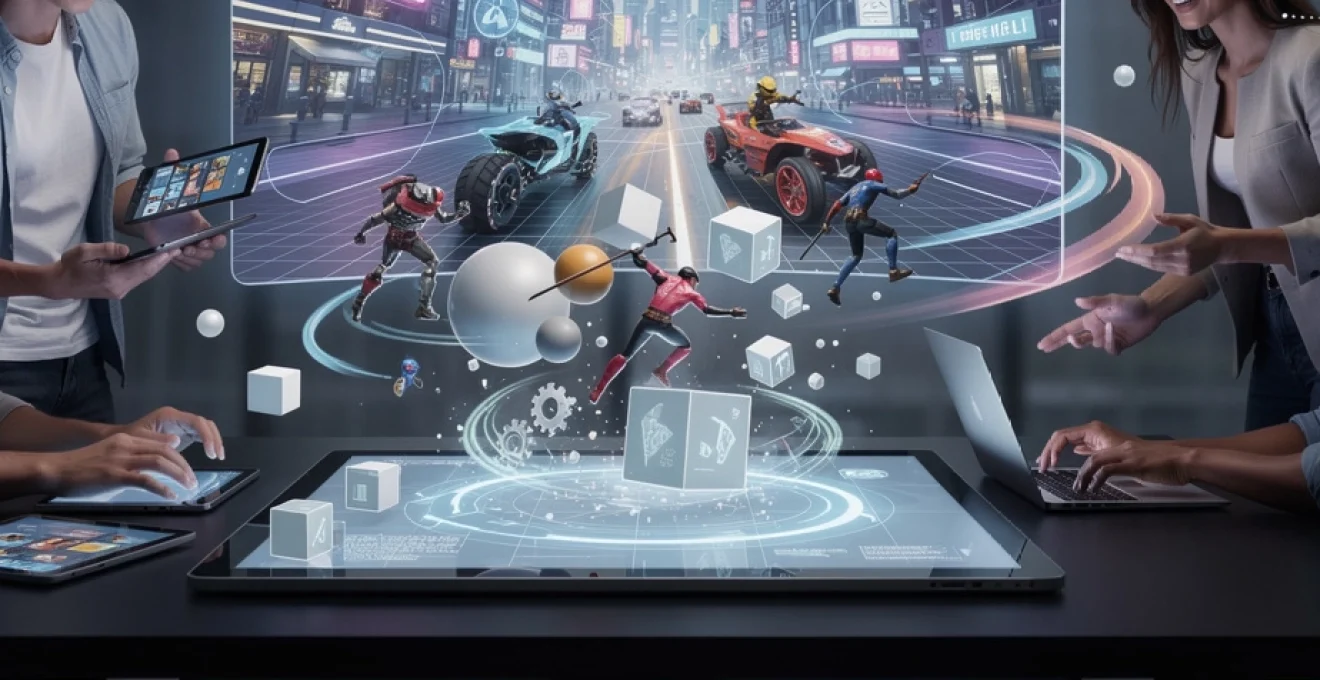
The digital entertainment landscape has undergone a seismic transformation over the past decade, evolving from passive consumption to dynamic, participatory experiences that blur the boundaries between creator and audience. Modern web technologies have democratised access to sophisticated interactive content, enabling developers to craft immersive environments that rival native applications in performance and visual fidelity. This revolution has been powered by advancements in browser capabilities, graphics rendering, real-time communication protocols, and intelligent personalisation systems that adapt to individual user preferences. Whether you’re exploring a browser-based multiplayer game, streaming an interactive film where your choices shape the narrative, or engaging with gesture-controlled interfaces on your mobile device, the web has become a platform for entertainment experiences that were once the exclusive domain of dedicated hardware and software ecosystems.
Webgl and three.js: powering immersive 3D environments in Browser-Based gaming
The foundation of modern interactive web entertainment rests upon the shoulders of WebGL, a JavaScript API that provides direct access to your device’s graphics processing unit without requiring plugins or third-party software. This technology has fundamentally changed what’s possible within a browser window, enabling developers to create visually stunning 3D environments that load instantly and run smoothly across devices. When you navigate to a browser-based game today, the sophisticated graphics you experience are being rendered in real-time using the same principles that power console and PC gaming, yet everything happens within the familiar environment of your web browser.
Real-time rendering techniques using WebGL 2.0 for Console-Quality graphics
WebGL 2.0 introduced capabilities that brought browser-based rendering significantly closer to the quality standards established by dedicated gaming platforms. The specification includes support for multiple render targets, 3D textures, and transform feedback—technical features that enable developers to implement advanced visual effects like volumetric lighting, realistic shadows, and post-processing filters. These rendering techniques allow for dynamic lighting calculations that respond to in-game events, creating atmospheres that shift and evolve based on player actions. The performance improvements in WebGL 2.0 also enable higher polygon counts and more detailed textures, meaning that character models and environmental assets can display the level of detail you’d expect from contemporary gaming experiences.
Three.js framework implementation in platforms like PlayCanvas and babylon.js
While WebGL provides the low-level access to graphics hardware, frameworks like Three.js abstract much of the complexity, allowing developers to focus on creative implementation rather than mathematical calculations for matrix transformations and shader compilation. Three.js has become the de facto standard for web-based 3D development, offering a comprehensive scene graph system, built-in loaders for various 3D file formats, and an extensive library of materials and geometries. Platforms such as PlayCanvas and Babylon.js have built upon these foundations, providing complete development environments with visual editors, asset management systems, and optimisation tools. These frameworks have lowered the barrier to entry for creating professional-quality interactive experiences, enabling smaller studios and independent developers to compete with established entertainment companies.
Gpu-accelerated physics engines: cannon.js and ammo.js integration
Realistic physics simulation adds a crucial layer of believability to interactive web experiences. Libraries like Cannon.js and Ammo.js provide sophisticated collision detection, rigid body dynamics, and constraint systems that make objects in virtual environments behave according to natural physical laws. Cannon.js offers a pure JavaScript implementation that’s lightweight and suitable for less computationally intensive applications, while Ammo.js—a WebAssembly port of the Bullet physics engine—delivers performance levels approaching native implementations. When you interact with objects in a browser-based game and they respond with realistic weight, momentum, and collision responses, these physics engines are working in concert with the rendering pipeline to create a coherent, believable experience. The integration of these systems with WebGL frameworks allows for complex interactions like ragdoll character animations, destructible environments, and realistic vehicle handling that respond immediately to your input.
Shader programming with GLSL for photorealistic material rendering
The visual quality that distinguishes exceptional interactive experiences from mediocre ones often comes down to material rendering—how surfaces reflect light, display texture, and respond to environmental conditions. Shader
programming with GLSL (OpenGL Shading Language) enables this level of realism directly in the browser. By writing custom vertex and fragment shaders, developers can implement physically based rendering (PBR) workflows that mimic how light interacts with metals, plastics, fabrics, and translucent materials. Techniques such as normal mapping, ambient occlusion, reflection probes, and screen-space reflections contribute to scenes where surfaces respond convincingly to changing lighting conditions. In practice, this means water that ripples and refracts, glass that distorts the environment behind it, and character skins that exhibit subtle subsurface scattering. When combined with HDR environments and tone mapping, GLSL shaders help browser-based entertainment deliver photorealistic 3D graphics that feel indistinguishable from native titles to most users.
Progressive web applications transforming mobile entertainment accessibility
As audiences shift increasingly toward mobile devices, Progressive Web Applications (PWAs) have emerged as a powerful way to deliver interactive entertainment without the friction of app store downloads. PWAs behave like native apps—complete with home screen icons, push notifications, and full-screen experiences—yet they run entirely in the browser. For streaming platforms and browser-based gaming portals, this approach reduces acquisition costs and makes it easier for users to jump into content with a single tap. In practice, PWAs help entertainment brands reach users on low-end devices and in markets where bandwidth is limited, while still offering responsive, high-fidelity experiences.
Service workers and Offline-First architecture in gaming PWAs
The backbone of any robust entertainment PWA is the service worker, a background script that intercepts network requests and manages caching strategies. By adopting an offline-first architecture, gaming PWAs can preload critical assets—such as core game logic, UI elements, and audio—so that players can continue interacting even when connectivity drops. This is particularly important for casual games and interactive storytelling experiences that users visit in short bursts throughout the day. With intelligent caching policies, developers can ensure fast load times on repeat visits, reduce data usage, and create a smoother user experience in regions with unstable connections. For players, this translates to entertainment that simply works whenever they have a free moment, rather than being gated by network quality.
Webassembly performance optimisation for CPU-Intensive interactive media
While JavaScript remains central to web development, some interactive entertainment workloads—like physics simulations, pathfinding, or video processing—benefit from near-native performance. WebAssembly (Wasm) addresses this by allowing code compiled from languages like C, C++, or Rust to run in the browser at speeds close to native execution. Many modern browser games and interactive media tools now offload their most CPU-intensive tasks to WebAssembly modules, leaving JavaScript to orchestrate UI and game logic. The result is smoother gameplay, higher frame rates, and the ability to support more complex mechanics without overwhelming mobile CPUs. For studios looking to port existing native titles to the web, Wasm provides a pragmatic path to reuse existing codebases while embracing browser-based distribution.
App shell model implementation: case study of stadia and xbox cloud gaming
The app shell model is a core design pattern in high-performance PWAs, separating the static UI framework from dynamic content. In the context of cloud gaming experiences such as Stadia’s web client or Xbox Cloud Gaming’s browser interface, the app shell loads instantly and provides navigation, session management, and player controls, while the actual game stream is delivered via low-latency video. This architecture minimises perceived load time and keeps interactions responsive even as heavy media streams in the background. For users, it feels similar to launching a native app: core controls appear immediately, recent games are visible, and only the live content is fetched on demand. Developers benefit from this separation by being able to iterate on UI independently of the streaming infrastructure, ensuring consistent branding and faster feature deployment.
Indexeddb and cache API for seamless Cross-Session user experiences
Beyond performance, PWAs must maintain continuity across sessions so that interactive experiences feel persistent. Technologies like IndexedDB and the Cache API enable secure client-side storage of user preferences, save states, and pre-fetched assets. A browser-based game can store progression data locally, then sync it with the cloud when connectivity is available, ensuring that players never lose their place. Likewise, interactive video apps can remember where you stopped watching or which interactive branch you selected previously. This combination of local persistence and intelligent caching helps entertainment providers deliver personalised, low-friction experiences that users can dip in and out of without ever feeling lost.
Real-time multiplayer infrastructure: WebSockets and WebRTC protocol integration
Real-time multiplayer has become a defining feature of modern interactive web entertainment, from cooperative puzzle games to large-scale competitive arenas. Achieving low-latency communication in the browser relies heavily on WebSockets and WebRTC, two complementary technologies that enable continuous data exchange. While HTTP-based polling once dominated web interactivity, it simply can’t match the responsiveness required for synchronous play. By leveraging full-duplex connections and peer-to-peer channels, developers can synchronise player actions, game state, and even voice or video chat with minimal delay, making web-based multiplayer feel as immediate as its native counterparts.
Socket.io and colyseus framework for Low-Latency state synchronisation
Frameworks like Socket.io and Colyseus simplify the complexity of building real-time backends on top of WebSockets. Socket.io offers a flexible event-driven API that falls back gracefully when WebSockets are unavailable, ensuring compatibility across older browsers and networks. Colyseus, designed specifically for multiplayer games, provides room-based architecture and state synchronisation mechanisms that keep clients aligned with the authoritative server. Instead of sending full game states on every tick, Colyseus can transmit patches that represent only the changes, significantly reducing bandwidth usage. For developers, these frameworks remove much of the boilerplate associated with connection management and focus attention on game design and user experience.
Peer-to-peer data channels using WebRTC in Browser-Based multiplayer games
While client–server models remain common, WebRTC opens the door to peer-to-peer (P2P) architectures that can further reduce latency and server load. WebRTC’s data channels allow browsers to communicate directly, exchanging game events, positional updates, or collaborative editing operations without routing everything through a central server. This is particularly useful for small-group experiences like digital board games, collaborative music creation tools, or co-op puzzle titles where network topologies are simpler. Additionally, WebRTC supports encrypted audio and video streams, enabling integrated voice chat that feels native to the experience. When implemented carefully, P2P networking can make web-based multiplayer feel more responsive while also cutting infrastructure costs.
Server reconciliation and Client-Side prediction algorithms
Even with fast protocols, network latency is an unavoidable reality, especially for players connecting from different regions. To keep interactive web experiences feeling smooth, developers rely on client-side prediction and server reconciliation algorithms. The client immediately simulates the result of user input—like moving a character or firing a projectile—without waiting for server confirmation, then later corrects the state if the authoritative server disagrees. This approach, used for years in competitive shooters and real-time strategy games, is increasingly common in browser-based titles. When tuned properly, it hides network delays from the player, creating the illusion of instant response while still preserving fairness and consistency across all clients.
TURN and STUN server configuration for NAT traversal in web gaming
For WebRTC to establish P2P connections, it must navigate the complex reality of routers, firewalls, and network address translation (NAT). STUN (Session Traversal Utilities for NAT) servers help clients discover their public-facing IP addresses, while TURN (Traversal Using Relays around NAT) servers relay traffic when direct connections fail. Correctly configuring STUN/TURN infrastructure is essential for browser-based multiplayer games that rely on WebRTC, particularly when targeting global audiences with diverse network environments. While this layer of networking may feel invisible to end users, it directly affects connection reliability, matchmaking success rates, and overall session quality. In effect, robust NAT traversal is part of the invisible plumbing that makes seamless, interactive web entertainment possible.
Gestural interfaces and Touch-Based interaction design patterns
As touchscreens have become the primary interface for many users, gestural controls now play a central role in interactive web entertainment. Swipes, pinches, long presses, and multi-finger gestures allow users to manipulate virtual environments in intuitive ways, often making experiences feel more tactile and immersive. Designing for touch goes beyond simply replacing mouse clicks; it requires careful consideration of thumb reach, screen real estate, and the ergonomics of sustained interaction. When done well, gestural interfaces can make browser-based games and interactive stories feel as natural as flipping through a book or moving physical objects on a table.
Hammer.js and pointer events API for Multi-Touch gesture recognition
Libraries like Hammer.js and the native Pointer Events API give developers powerful tools for interpreting complex touch input. Hammer.js abstracts low-level touch data into high-level gestures—such as pan, pinch, and rotate—making it easier to build responsive controls for 2D and 3D interfaces. The Pointer Events specification unifies mouse, touch, and stylus input, enabling a single event model across multiple device types. For entertainment experiences that must run on everything from desktops to tablets and phones, this unified approach simplifies code and reduces edge cases. You can, for example, design a racing game where steering works equally well with a mouse drag, a finger swipe, or a stylus tilt, all using the same interaction logic.
Haptic feedback implementation via vibration API on mobile devices
Visual and audio cues are powerful, but subtle haptic feedback can elevate interactive web experiences by adding a physical dimension to digital events. The Vibration API allows compatible mobile devices to provide short, patterned vibrations in response to specific actions—like scoring a goal, taking damage, or making a crucial choice in an interactive narrative. While the API is intentionally limited for privacy and battery reasons, thoughtful use of haptics can make interactions feel more satisfying and grounded. Think of it as the digital equivalent of feeling a page turn or a button click; the brief physical confirmation helps reinforce user intent and strengthens emotional engagement.
Gyroscope and accelerometer data integration for Motion-Controlled experiences
Many smartphones and tablets include gyroscopes and accelerometers, which open the door to motion-based interaction patterns in the browser. By accessing these sensors through web APIs, developers can build experiences where tilting the device steers a vehicle, aims a camera, or controls a character’s balance. When combined with WebGL-powered 3D scenes, motion controls can make users feel as though they are physically moving within the environment, much like a handheld window into a virtual world. Of course, motion-based interfaces must be designed with comfort and accessibility in mind; providing alternative control schemes and sensitivity options ensures that entertainment remains inclusive while still embracing the playful possibilities of device sensors.
Adaptive streaming technologies revolutionising interactive video content
Interactive video has moved far beyond simple play and pause buttons, evolving into experiences where viewers can make choices, navigate branching narratives, and influence outcomes in real time. Under the hood, adaptive streaming technologies make sure that this interactivity remains fluid even on congested networks. By dynamically adjusting bitrate and resolution based on available bandwidth and device capabilities, platforms can deliver high-quality video with minimal buffering. When timing is critical—such as presenting decision points in an interactive film or synchronising overlays with live events—these streaming optimisations are essential for maintaining immersion.
MPEG-DASH and HLS protocol implementation in netflix interactive specials
Standards like MPEG-DASH and HLS (HTTP Live Streaming) are the workhorses behind modern adaptive video delivery. Services such as Netflix rely on these protocols for their interactive specials, where different video segments are stitched together in response to viewer choices. Each branch of the story is encoded into small chunks at multiple quality levels, allowing the player to fetch the appropriate segment just in time while adapting to network conditions. From the viewer’s perspective, the experience feels seamless: a choice is made, and the next scene flows without obvious loading screens. This combination of adaptive streaming and interactive logic turns what was once passive viewing into a genuinely participatory form of digital entertainment.
Bitrate adaptation algorithms for seamless quality transitions
Behind every smooth interactive stream is a bitrate adaptation algorithm continuously monitoring playback conditions. By measuring buffer health, recent download speeds, and error rates, the player can decide whether to request higher- or lower-quality segments. More advanced approaches incorporate predictive models that anticipate bandwidth fluctuations and preemptively adjust quality to avoid stalls. In interactive entertainment, where user choices may trigger jumps to different segments or require overlays at specific timestamps, these algorithms must be especially resilient. Well-tuned adaptation helps ensure that interactive overlays, subtitles, and UI elements remain in sync with the video, preventing jarring stutters that could break immersion at a crucial decision moment.
Video.js and shaka player: Open-Source solutions for interactive streaming
Open-source players like Video.js and Shaka Player provide a flexible foundation for building interactive streaming experiences on the web. Both support MPEG-DASH and HLS, DRM integration, and a wide range of custom plugins or UI components. Developers can layer interactive features—such as clickable hotspots, branching overlays, or real-time polls—on top of these players using JavaScript, without reinventing the core playback logic. This modular approach accelerates experimentation: you can prototype new interactive formats, run A/B tests on different decision structures, and integrate analytics that reveal how viewers engage with interactive elements. As a result, even small teams can deliver sophisticated interactive video entertainment that scales to millions of users.
Artificial intelligence and machine learning in personalised web entertainment
As interactive web experiences grow richer, users increasingly expect them to feel personal—tailored to their tastes, habits, and even moods. Artificial intelligence (AI) and machine learning (ML) play a pivotal role in meeting these expectations, powering everything from content recommendations to adaptive difficulty systems in games. In many cases, this intelligence now runs directly in the browser, preserving privacy while reducing server load and latency. The result is a new era of personalised digital entertainment where what you see, hear, and play can evolve dynamically based on your behaviour.
Tensorflow.js for Browser-Based neural network inference
TensorFlow.js brings machine learning capabilities straight into the browser, enabling neural network inference without any native dependencies. Developers can load pre-trained models to perform real-time tasks such as gesture recognition, emotion analysis from webcam input, or difficulty adjustment based on player performance. Because computation happens client-side, sensitive data—like raw video or audio—never leaves the user’s device, an important consideration in an era of increasing privacy awareness. In entertainment contexts, this means games that learn your play style, music visualisers that react intelligently to your movements, or interactive stories that adapt their pacing based on how engaged you appear.
Collaborative filtering algorithms powering content recommendation engines
When you discover a new show, game, or interactive experience that feels perfectly aligned with your interests, there is often a recommendation engine working behind the scenes. Collaborative filtering algorithms analyse patterns across large user populations—what people watch, play, or click on—and infer which items you’re likely to enjoy. On the web, these systems can operate in real time, updating recommendations as soon as you complete a level, skip a video, or rate a piece of content. For entertainment platforms, effective recommendations are more than a convenience; they are a key driver of engagement and retention. Well-tuned algorithms keep users exploring, discovering new interactive experiences instead of drifting away when they finish a single title.
Natural language processing with ML5.js for conversational gaming interfaces
Natural language processing (NLP) is reshaping how we interact with digital entertainment, moving beyond buttons and menus toward conversational interfaces. Libraries like ML5.js, built on top of TensorFlow.js, make it easier to integrate NLP models into web experiences using approachable, high-level APIs. Developers can create browser-based games where you talk to non-player characters, issue commands in plain language, or shape the narrative through dialogue rather than pre-defined options. Imagine an interactive mystery where you interrogate suspects by typing or speaking your questions, and the system responds contextually based on intent detection and entity recognition. By blending NLP with other web technologies, creators can design entertainment that feels less like navigating an interface and more like inhabiting a living, responsive world.