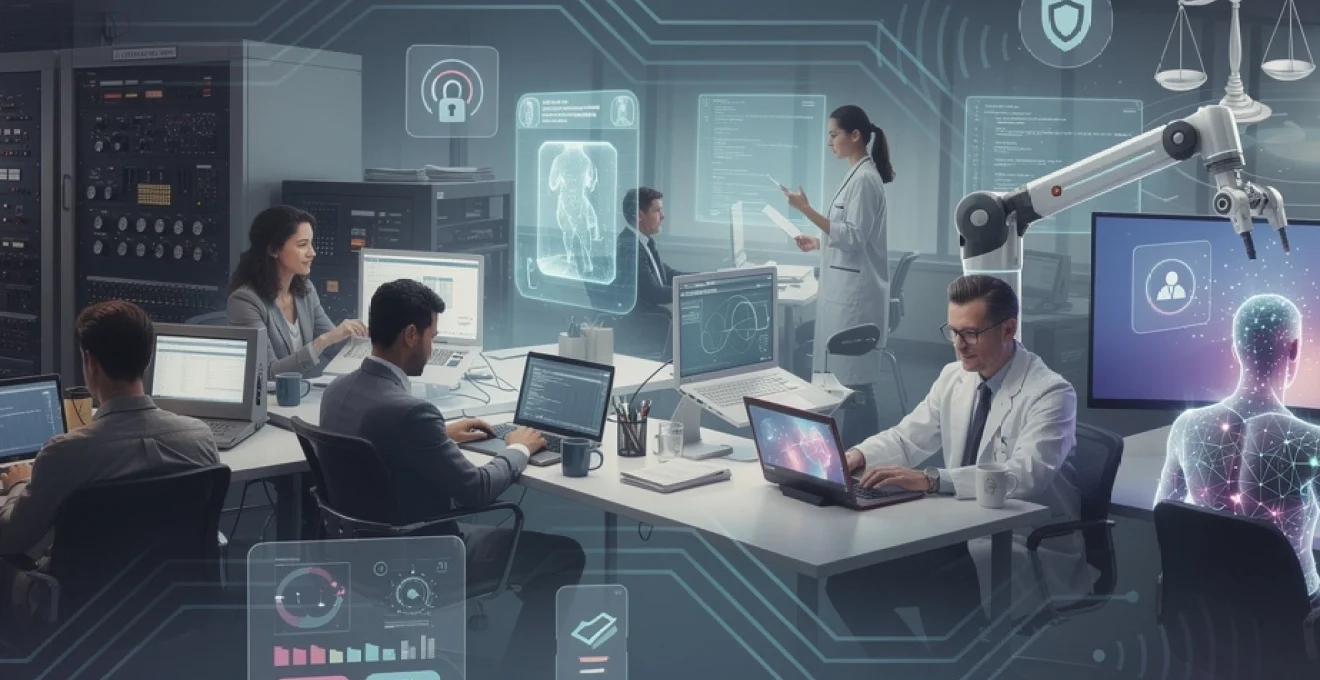
# The Evolution of Human-Machine Collaboration in Digital Environments
The relationship between humans and machines has undergone a profound transformation since the advent of digital computing. What began as rudimentary command-response interactions has evolved into sophisticated partnerships where artificial intelligence augments human capabilities in ways previously confined to science fiction. Today, you interact with intelligent systems dozens of times daily—from autocomplete suggestions in your email to algorithmic content curation on social platforms—often without conscious awareness of the underlying computational processes. This evolution represents not merely technological advancement but a fundamental reimagining of how humans and machines can work together to solve complex problems, enhance productivity, and unlock creative potential across virtually every domain of professional and personal life.
Understanding this progression matters because the trajectory of human-machine collaboration shapes the future of work, creativity, and decision-making. As organizations increasingly integrate artificial intelligence into core operations, the distinction between human and machine contributions blurs, creating hybrid workflows that leverage the complementary strengths of both. The question is no longer whether machines will augment human capabilities, but rather how thoughtfully designed systems can maximize collaborative intelligence while addressing ethical concerns around autonomy, bias, and transparency.
From ENIAC to neural networks: tracing computational partnership paradigms
The journey from early computing machinery to contemporary AI systems reveals a consistent pattern: each technological leap has redefined the boundaries of what machines can accomplish while simultaneously reshaping human roles in the collaboration. This historical perspective illuminates not only technological milestones but also the shifting conceptual frameworks through which society understands human-machine relationships. The evolution has been neither linear nor predetermined, but rather marked by punctuated equilibria—periods of incremental refinement interrupted by revolutionary paradigm shifts that fundamentally altered interaction possibilities.
Batch processing and punch card interfaces in early computing systems
In the nascent era of digital computing, human-machine interaction followed a strictly regimented protocol. Operators translated computational problems into machine-readable punch cards, submitted them to mainframe systems like the ENIAC or UNIVAC, and waited hours or days for results. This batch processing model established a master-servant relationship where machines executed precisely defined instructions without deviation or interpretation. The human role centred on problem formulation, algorithm design, and result interpretation—machines merely calculated. Yet even within these constraints, pioneering computer scientists recognized that effective collaboration required standardized programming languages and error-checking protocols. The development of FORTRAN in 1957 and COBOL in 1959 represented early attempts to create more intuitive interfaces between human intent and machine execution, translating mathematical or business logic into formats computers could process.
This era established fundamental principles that persist today: the importance of precise specification, the challenge of debugging, and the recognition that interface design significantly impacts productivity. Punch cards constrained what users could reasonably attempt, but within those limitations, computational thinking emerged as a distinct cognitive skill. Programmers learned to decompose complex problems into sequential operations, anticipate edge cases, and optimize for computational efficiency—mental models that continue to shape how you approach problem-solving in data-intensive domains.
Command-line interfaces and the birth of interactive computing
The introduction of timesharing systems in the 1960s revolutionized human-computer interaction by enabling real-time dialogue. Instead of submitting jobs and awaiting batch processing, users could type commands at a terminal and receive immediate responses. This shift from asynchronous to synchronous interaction fundamentally altered the collaborative dynamic. UNIX, developed at Bell Labs in 1969, exemplified the power of this paradigm with its philosophy of small, composable tools that users could chain together to accomplish complex tasks. The command-line interface demanded literacy in syntax and semantics, creating a high barrier to entry but offering unprecedented flexibility to those who mastered it.
Interactive computing fostered a more iterative, exploratory relationship with machines. Rather than meticulously planning entire programs before execution, you could test hypotheses, observe outcomes, and refine approaches in tight feedback loops. This responsiveness accelerated learning and experimentation, though it also introduced new challenges around session management and resource allocation. The emergence of programming languages like C and scripting languages like AWK empowered users to customize their computing environments extensively, blurring the line between software consumers and creators. Command-line interfaces remain prevalent in technical fields today precisely because they preserve this flexibility and composability, even as graphical alternatives
offered lower barriers for casual users. In many ways, the command line became the first true medium for human–machine collaboration in digital environments: you described what you wanted in terse, structured language, and the system responded in real time, enabling a conversational loop that foreshadowed today’s chat-based interfaces and AI assistants.
Graphical user interfaces: xerox PARC and the desktop metaphor revolution
The next major paradigm shift in human-machine collaboration arrived with graphical user interfaces (GUIs). Research at Xerox PARC in the 1970s introduced concepts like overlapping windows, icons, menus, and pointing devices that transformed interaction from abstract commands into visual, spatial manipulation. The “desktop metaphor” recast computing as managing documents, folders, and tools on a virtual workspace, allowing non-technical users to collaborate with machines without learning arcane syntax. Apple’s Macintosh and later Microsoft Windows mainstreamed these ideas, making direct manipulation the default mode of interaction.
GUIs dramatically broadened who could participate in digital work. Tasks that once required specialized operators—text layout, spreadsheet modeling, image editing—became accessible to knowledge workers and creatives across industries. At the same time, this new interaction style introduced its own cognitive demands: users now had to interpret visual hierarchies, recognize icons, and navigate nested menus. Designers responded with usability heuristics, consistency principles, and standardized components, laying the foundation for modern user experience (UX) practice and metrics-driven interface optimization.
Natural language processing breakthroughs with IBM watson and siri
While GUIs made computing more visual and intuitive, they still required users to adapt to the machine’s representational logic. Natural language interfaces promised the inverse: systems that adapt to human communication patterns. Early chatbots and voice systems were brittle, but milestones like IBM Watson’s 2011 “Jeopardy!” victory and Apple’s launch of Siri that same year demonstrated that large-scale natural language processing (NLP) could support more fluid collaboration. For the first time, mainstream users could ask complex questions in everyday language and receive contextually relevant responses in seconds.
These systems were far from perfect—misrecognitions, limited domain coverage, and opaque decision-making frequently frustrated users—but they shifted expectations. Instead of learning the right menu path or command, you could simply ask, “What’s on my calendar this afternoon?” or “Show me revenue by region for Q3.” This conversational model underpins today’s generative AI tools and voice assistants, where the boundary between “user interface” and “dialogue partner” continues to blur. As NLP models scale and incorporate multimodal inputs, human-machine collaboration increasingly resembles a collaborative discussion rather than a series of isolated commands.
Contemporary Human-Computer interaction frameworks in Web-Based ecosystems
As work and everyday life have migrated into browsers and mobile apps, web-based ecosystems have become the primary arena for human-machine collaboration. The modern web is no longer a static publishing medium; it’s a dynamic environment where interfaces adapt in real time, microservices coordinate behind the scenes, and AI models quietly personalize content. Understanding today’s interaction frameworks helps you design digital environments where humans and machines complement each other rather than compete for control.
Responsive design patterns and progressive web applications
Responsive design emerged in the early 2010s to address a simple but profound challenge: users increasingly accessed the same digital services across screens of wildly different sizes and capabilities. Rather than building separate websites and apps, responsive frameworks use fluid grids, flexible images, and media queries to adapt layouts to the viewport. For human-machine collaboration, this ensures that AI-driven features—dashboards, recommendation panels, interactive forms—remain usable whether you’re on a 5-inch phone or a 34-inch monitor. Progressive Web Applications (PWAs) extend this idea, blending web reach with native-like capabilities such as offline access, push notifications, and background sync.
From a collaboration standpoint, PWAs enable continuous interaction with intelligent systems across contexts. A field technician can update a maintenance checklist offline, with data syncing once connectivity returns; a sales manager can review AI-generated forecasts during a flight and push decisions to a CRM later. For organizations, adopting responsive patterns and PWAs is less about aesthetics and more about sustaining uninterrupted human-machine workflows that follow people wherever they work.
Microinteractions and affordance theory in digital interface design
If responsive design is about the big picture, microinteractions focus on the smallest meaningful units of interaction: a button hover, a loading animation, a “typing…” indicator in a chat window. These seemingly minor details carry crucial information about system state, feedback, and affordances—what actions are possible at any given moment. Drawing from affordance theory, effective digital products signal how they can be used through subtle visual and behavioral cues rather than explicit instructions. A draggable handle, a shimmering call-to-action, or a ghosted button all communicate the boundaries of collaboration between user and system.
Why does this matter for human-machine collaboration in digital environments? Because microinteractions are often where trust and comprehension are built or broken. When an AI system is processing your query, a clear progress indicator reduces uncertainty. When a recommendation is updated in real time based on your filters, a smooth transition animation helps you map cause to effect. Thoughtfully crafted microinteractions make AI behavior legible, reducing cognitive load and helping users feel in control—even when complex models are operating behind the scenes.
Voice user interfaces: amazon alexa and google assistant integration
Voice user interfaces (VUIs) extend the conversational paradigm into the ambient environment. Devices like Amazon Echo and Google Nest have normalized interacting with cloud-based intelligence through spoken commands, often without any visual interface at all. For many users, asking a smart speaker to set a timer, control lights, or play music feels more natural than navigating an app. In enterprise contexts, voice assistants are beginning to support hands-free access to dashboards, knowledge bases, and workflow automation, particularly in logistics, healthcare, and field service.
However, designing effective VUIs requires rethinking interaction patterns from the ground up. Without visible menus or buttons, systems must guide users through prompts, confirmations, and error recovery using only language and tone. Context awareness—recognizing who is speaking, what they’ve asked before, and the current task—becomes critical. When done well, voice interfaces turn machines into conversational partners that fade into the background, enabling you to focus on the task rather than the tool. When done poorly, they become frustrating bottlenecks that highlight the gap between human expectations and machine understanding.
Haptic feedback systems and multimodal interaction architectures
Beyond sight and sound, haptic feedback adds a tactile dimension to human-machine collaboration. From the subtle vibration confirming a mobile tap to advanced force feedback in surgical robotics, haptics provide immediate, embodied cues about system state and success. In digital environments, this can be as simple as a gentle buzz when you reach the edge of a slider, or as complex as simulating tissue resistance in a training simulator. These cues shorten the feedback loop, enabling faster error detection and more confident interaction.
Multimodal interaction architectures integrate visual, auditory, and haptic channels into cohesive experiences. For example, a driver-assistance system might combine a visual lane departure warning, an auditory chime, and a steering wheel vibration to signal risk. In knowledge work, multimodal cues can help you prioritize attention: an urgent notification might trigger a distinct sound and highlight, while routine updates remain quiet. As machine intelligence becomes more pervasive, multimodality helps maintain a healthy balance between awareness and overload, ensuring that AI assistance supports rather than distracts from human cognition.
Machine learning augmentation in professional workflows
While early human-computer interaction focused on how we issue commands, today’s frontier concerns what the system can proactively contribute. Machine learning augmentation shifts machines from passive tools to active collaborators that suggest, predict, and automate. Instead of replacing professionals, these systems embed into existing workflows, taking on narrow, repeatable tasks so humans can focus on interpretation, strategy, and relationship-building. The question for most teams is no longer “Should we use AI?” but “Where in our workflow does AI add the most leverage?”
Github copilot and AI-Assisted code generation technologies
GitHub Copilot and similar AI-assisted coding tools exemplify human-machine collaboration in software engineering. Powered by large language models trained on vast code repositories, these systems autocomplete functions, suggest refactors, and even generate boilerplate tests based on docstrings or comments. Surveys from GitHub suggest that developers using Copilot feel up to 55% more productive on routine tasks, while also reporting higher satisfaction when focusing on complex problems. Instead of painstakingly writing every line, you can describe intent and let the AI propose implementation options.
Yet effective collaboration here is not about blind acceptance. Skilled developers treat Copilot like a junior pair-programmer: helpful for scaffolding and exploration, but subject to review and modification. You might use AI-generated snippets to prototype APIs quickly, then refine them for security, performance, and maintainability. This dynamic reinforces a broader pattern: when AI takes over syntactic labor, human expertise shifts toward semantic judgment—understanding why code behaves a certain way, not just how to type it faster.
Predictive analytics platforms: tableau and power BI integration
In data analytics, platforms like Tableau and Microsoft Power BI have evolved from static reporting tools into interactive decision-support environments. Built-in machine learning capabilities—such as anomaly detection, trend forecasting, and natural language query (“Ask Data” or “Q&A”)—allow non-technical stakeholders to explore insights without writing SQL or Python. You can ask, “Which customer segments drove revenue growth last quarter?” and receive not only a chart but suggested breakdowns and outliers to investigate.
These predictive analytics platforms embody the promise of augmented intelligence: humans define the business question, machines surface patterns and probabilistic forecasts, and decisions emerge from an iterative conversation with the data. However, this also introduces new responsibilities. Analysts must understand model assumptions, confidence intervals, and the risk of spurious correlations. Without that literacy, there’s a danger of over-trusting sleek dashboards that conceal underlying uncertainty. The most effective teams pair domain experts with data scientists, using BI tools as shared canvases for collaborative reasoning.
Robotic process automation with UiPath and automation anywhere
Robotic Process Automation (RPA) platforms such as UiPath and Automation Anywhere automate repetitive, rules-based digital tasks: copying data between systems, reconciling records, generating routine reports. Rather than integrating at the API level, RPA bots often mimic human actions at the user interface, which makes them particularly attractive for legacy environments. In finance, HR, and customer support, organizations report reclaiming thousands of hours annually by delegating low-value tasks to bots, freeing staff to handle exceptions and higher-level analysis.
However, sustainable RPA requires more than simply recording macros. If you automate a broken process, you may amplify its inefficiencies. Successful teams treat RPA as an opportunity to map workflows end to end, identify decision points suitable for machine handling, and design escalation paths for ambiguous cases. Increasingly, RPA integrates machine learning models—classifying documents, extracting entities, or predicting next-best actions—creating hybrid pipelines where deterministic rules and probabilistic intelligence coexist. In this ecosystem, humans become orchestrators, overseeing fleets of digital workers and intervening where nuance or ethics demand.
Computer vision applications in medical diagnostics and radiology
In medicine, computer vision systems trained on millions of images now match or exceed human experts in detecting certain conditions, from diabetic retinopathy to early-stage lung nodules. In radiology, AI tools can pre-screen CT scans, highlight suspicious regions, and prioritize cases that require urgent review. Rather than replacing clinicians, these systems act as “second readers,” reducing missed findings and helping manage rising imaging volumes as populations age and screening protocols expand.
Real-world deployments underscore the importance of viewing these tools as collaborative aids, not autonomous authorities. Radiologists must understand false positive and false negative profiles, calibrate their trust accordingly, and retain ultimate responsibility for diagnosis. Hospitals need workflows where AI suggestions are transparently logged, auditable, and explainable enough to withstand clinical and legal scrutiny. When designed as partners, computer vision systems enhance diagnostic accuracy and consistency; when treated as black boxes, they risk eroding both clinician confidence and patient trust.
Collaborative intelligence: Human-AI Co-Creation systems
The most exciting frontier of human-machine collaboration lies in co-creation: systems where humans and AI jointly produce content, designs, and decisions that neither could achieve alone. Rather than automating existing tasks, these tools open new creative and analytical possibilities. They function less like tools and more like collaborators—offering suggestions, challenging assumptions, and iterating in response to feedback. How do we design workflows where this “collaborative intelligence” leads to better outcomes rather than confusion or dependency?
Generative pre-trained transformers in content production pipelines
Generative Pre-trained Transformers (GPTs) have rapidly become central to content production pipelines in marketing, journalism, software documentation, and education. These models can draft articles, summarize research, propose headlines, and localize messaging for different audiences in seconds. Instead of starting from a blank page, writers can begin from a reasonably coherent draft and focus their energy on refinement, fact checking, and tone alignment. This is analogous to having an always-available junior copywriter who can generate endless variations on demand.
To harness GPTs effectively, teams are developing new editorial workflows. Prompt libraries capture institutional voice; guardrails and style guides shape outputs; human reviewers enforce accuracy and ethical standards. In practice, the most productive use cases are those where you combine human domain expertise with model fluency: for example, using AI to generate first-pass product descriptions, then having product managers refine nuanced benefits and regulatory claims. The result is not just faster production, but often more diverse ideation, as models surface angles you might not have considered.
DALL-E and midjourney: neural Network-Driven visual asset generation
In visual design, systems like DALL-E and Midjourney enable rapid exploration of concepts through text-to-image generation. Creative teams can sketch out mood boards, storyboards, and branding directions by iterating on prompts rather than painstakingly compositing assets from scratch. This shifts the designer’s role from pixel-level execution to high-level art direction: choosing which generated images to pursue, adjusting prompts, and integrating outputs into cohesive visual systems that respect brand guidelines and cultural sensitivities.
However, neural visual generators raise complex questions around authorship, intellectual property, and training data provenance. Designers must balance the efficiency of AI-generated imagery with responsible sourcing and originality. One practical approach is to use these tools for early-stage ideation and internal communication, then translate promising directions into bespoke assets created by human artists. In this model, AI acts as a catalyst for creativity, much like rough thumbnail sketches, rather than a final production engine.
Algorithmic Decision-Support in clinical healthcare environments
Beyond content and design, collaborative intelligence is reshaping decision-making in high-stakes domains like healthcare. Clinical decision-support systems aggregate electronic health records, lab results, and medical literature to suggest diagnoses, flag contraindications, or recommend treatment pathways. These tools can surface subtle correlations that individual clinicians might miss under time pressure, such as early signs of sepsis or atypical drug interactions. When embedded into electronic health record interfaces, they become ever-present advisors at the point of care.
Yet collaboration here must be carefully calibrated. Overly aggressive alerts can lead to “alarm fatigue,” where clinicians begin to ignore recommendations. Conversely, overly deferential designs risk under-utilization. Effective systems explain why they are surfacing an alert, provide confidence intervals, and allow clinicians to give feedback—accepting, modifying, or rejecting suggestions. This creates a learning loop where both human and machine models improve over time, fostering mutual trust rather than blind reliance.
Human-in-the-loop machine learning and active learning strategies
At the infrastructure level, human-in-the-loop machine learning formalizes collaboration by embedding human judgment directly into model training and refinement. In active learning setups, algorithms identify the most informative data points—those where the model is uncertain or where errors would be most costly—and route them to human experts for labeling or review. This targeted feedback dramatically reduces annotation workload compared to labeling every example, while improving model performance where it matters most.
For organizations, adopting human-in-the-loop strategies means treating subject-matter experts as ongoing partners in model development, not just one-time annotators. Domain experts can flag edge cases, propose new classes, and define “red lines” where automated decisions must always be escalated. In effect, the machine learns not only patterns in data but also the organization’s tolerance for risk, ambiguity, and error. This approach is particularly powerful in regulated industries, where compliance and accountability are as important as raw accuracy.
Cognitive ergonomics and user experience optimisation metrics
As human-machine collaboration deepens, cognitive ergonomics—the study of how systems align with human mental capabilities and limitations—becomes a strategic concern. Even the most advanced AI will fail if its outputs are delivered in ways that overload users, slow them down, or obscure critical information. UX optimization in digital environments is no longer just about aesthetics; it’s about engineering interaction patterns that respect attention, memory, and decision-making constraints, backed by measurable metrics.
Fitts’s law and hick’s law application in interface architecture
Fitts’s Law and Hick’s Law offer practical, mathematically grounded guidance for interface architecture. Fitts’s Law relates the time to acquire a target (like a button) to its size and distance, suggesting that frequently used controls—especially those triggering AI-driven actions—should be larger and more accessible. Hick’s Law states that decision time increases logarithmically with the number of choices, implying that overwhelming users with options slows collaboration. In AI-rich interfaces, where suggestions and alternative paths multiply, these principles are crucial.
For example, a predictive analytics dashboard might offer dozens of possible filters and chart types. Applying Hick’s Law, you could surface a small set of “smart defaults” based on user role and past behavior, relegating advanced options to secondary menus. Similarly, Fitts’s Law suggests placing critical actions, such as “Approve,” “Escalate,” or “Request Explanation,” in prominent, easy-to-hit locations. By aligning interface geometry with human motor and cognitive patterns, you reduce friction and make it easier for users to engage with AI assistance fluidly.
Cognitive load theory and information architecture principles
Cognitive Load Theory distinguishes between intrinsic load (inherent task complexity), extraneous load (imposed by poor design), and germane load (effort invested in learning). In collaborative digital environments, we cannot always reduce intrinsic complexity—interpreting a radiology scan or managing a global supply chain is inherently demanding. But we can minimize extraneous load by structuring information clearly, using progressive disclosure, and matching visual hierarchies to user goals.
Information architecture plays a central role here. Grouping related data, using consistent labeling, and avoiding unnecessary modality switches (for example, bouncing between multiple dashboards) helps preserve working memory for actual problem-solving. When integrating machine learning outputs—risk scores, recommendations, confidence levels—designers should ask: “What is the minimum information the user needs at this moment to make a good decision?” Anything beyond that can be deferred, collapsed, or made available on demand. This discipline keeps human attention focused where it yields the greatest collaborative value.
A/B testing frameworks: optimizely and google optimize methodologies
While cognitive ergonomics provides theory, experimentation platforms such as Optimizely and, historically, Google Optimize provide empirical validation. A/B testing allows teams to compare interface variants—different layouts, copy, recommendation placements—and measure their impact on engagement, task completion, and error rates. In the context of human-machine collaboration, this means you can quantitatively assess whether a new AI-powered feature actually helps users or simply adds noise.
Robust experimentation requires more than toggling colors. You might test whether surfacing AI explanations increases trust and adoption, or whether simplifying recommendation panels improves decision speed without harming accuracy. Over time, organizations can build experimentation cultures where hypotheses about collaboration are continually tested and refined. This data-driven approach to UX optimization ensures that as AI capabilities evolve, the surrounding human interface evolves in lockstep, grounded in real-world behavioral evidence rather than intuition alone.
Ethical frameworks and governance models for autonomous systems
As machines assume more autonomous roles in digital environments—from approving transactions to triaging patients—the ethical stakes of human-machine collaboration rise. Governance models must ensure that autonomy enhances, rather than undermines, human values such as privacy, fairness, accountability, and dignity. Technical excellence alone is no longer sufficient; organizations need explicit frameworks that define how AI systems should behave, who is responsible when things go wrong, and what safeguards protect affected individuals.
GDPR compliance and data privacy in machine learning pipelines
The EU’s General Data Protection Regulation (GDPR) has become a global reference point for data privacy, imposing strict requirements on how personal data is collected, processed, and stored. For machine learning pipelines, this translates into obligations around data minimization, purpose limitation, and user consent. You must be able to explain why specific data fields are necessary for a model, how long they will be retained, and under what legal basis they are processed. Individuals also have rights to access, rectify, and in some cases erase their data, which complicates model training and logging strategies.
Practically, GDPR-compliant ML involves techniques such as pseudonymization, access controls, differential privacy, and federated learning, where models train on decentralized data without centralizing raw records. Organizations also need robust documentation—data protection impact assessments, records of processing activities—and cross-functional collaboration between data scientists, legal teams, and security engineers. Treating privacy as a design constraint, rather than an afterthought, leads to architectures that respect user autonomy while still enabling powerful collaborative analytics.
Algorithmic bias mitigation: Fairness-Aware machine learning techniques
Algorithmic bias occurs when models systematically disadvantage certain groups, often reflecting historical inequities present in training data. In hiring, lending, healthcare, and criminal justice, such biases can entrench or even amplify discrimination. Fairness-aware machine learning techniques aim to detect, quantify, and mitigate these effects. Methods range from pre-processing data (rebalancing or reweighting samples), to in-processing constraints (optimizing for both accuracy and fairness metrics), to post-processing adjustments (calibrating decision thresholds across groups).
However, technical fixes alone are insufficient. Teams must first define what “fair” means in their context—equal opportunity, demographic parity, individual fairness—and acknowledge that these definitions can conflict. Transparent documentation of fairness trade-offs, stakeholder involvement (especially from affected communities), and ongoing monitoring are essential. When you treat fairness as a continuous governance process rather than a one-time compliance checkbox, human-machine collaboration becomes a lever for reducing, rather than reproducing, systemic bias.
Explainable AI and interpretability standards in critical applications
In safety-critical and regulated domains, black-box models that deliver accurate but inscrutable outputs are increasingly unacceptable. Explainable AI (XAI) seeks to bridge this gap by providing human-understandable rationales for model decisions: feature importance scores, example-based explanations, counterfactual scenarios (“If this variable were different, the decision would change”), and simplified surrogate models. Regulators and professional bodies are beginning to articulate interpretability standards, particularly where decisions affect rights, access to services, or physical safety.
From a collaboration perspective, explanations serve two purposes: they help users calibrate their trust in the system, and they provide a basis for contesting or correcting errors. For instance, if a loan applicant sees that a decision heavily depended on an outdated address, they can provide updated documentation. Designing explanation interfaces requires close attention to cognitive load and domain literacy—too much technical detail can confuse rather than clarify. The goal is not to turn every user into a data scientist, but to provide enough insight for meaningful oversight and recourse.
IEEE and ISO standards for Human-Centred AI development
To embed ethical considerations into the fabric of technology development, standards bodies like IEEE and ISO are publishing guidelines and frameworks for human-centred AI. IEEE’s “Ethically Aligned Design” and emerging ISO/IEC standards on AI management systems emphasize principles such as transparency, accountability, safety, and human agency. They encourage organizations to establish governance structures—ethics review boards, incident reporting mechanisms, lifecycle risk assessments—that parallel those in more mature engineering disciplines like aviation or medical devices.
Adhering to these standards is not just about avoiding regulatory penalties; it can also be a strategic differentiator. Clients and users increasingly favor products that demonstrate responsible AI practices, from clear consent flows to robust redress mechanisms. By aligning development processes with human-centred standards, you position human-machine collaboration as a relationship of trust rather than surveillance or exploitation. In the long run, this trust is what will determine whether autonomous systems are embraced as partners—or resisted as threats—in the evolving digital landscape.