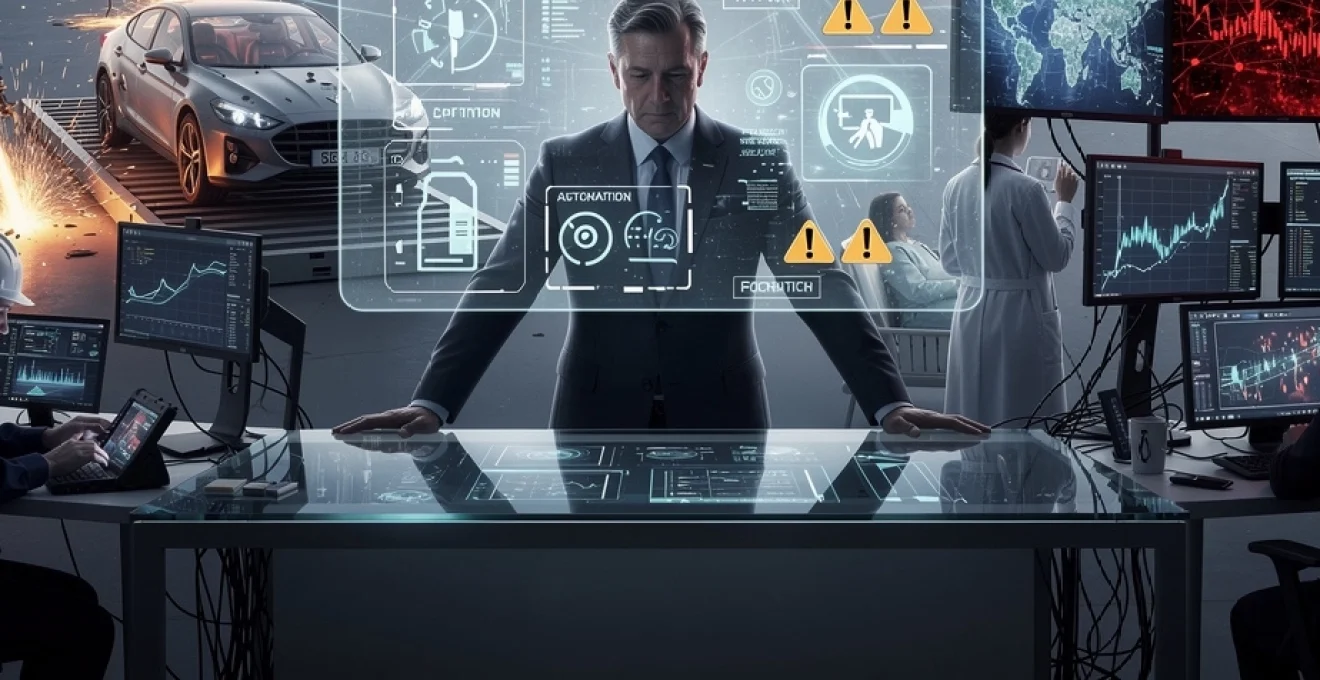
The relentless march towards automation has transformed industries worldwide, promising increased efficiency, reduced costs, and enhanced productivity. However, beneath this technological revolution lies a complex web of risks that organisations and societies are only beginning to understand. From catastrophic system failures in critical infrastructure to the erosion of essential human skills, automation’s darker side reveals vulnerabilities that could undermine the very benefits it was designed to deliver.
The paradox of automation lies in its dual nature: while it eliminates human error in routine tasks, it simultaneously introduces new categories of risk that can have far-reaching consequences. These risks manifest across multiple dimensions, from technical failures and cybersecurity vulnerabilities to socioeconomic disruption and regulatory challenges. Understanding these risks becomes crucial as we navigate an increasingly automated world where the stakes continue to rise.
Critical system failures in Over-Automated manufacturing environments
Manufacturing environments represent some of the most automation-intensive sectors, where the promise of increased efficiency has led to unprecedented levels of technological integration. However, this integration has also created complex interdependencies that can cascade into catastrophic failures when systems malfunction. The concentration of automated processes without adequate human oversight has proven to be a recipe for disaster in several high-profile cases.
Boeing 737 MAX MCAS software override incidents
The Boeing 737 MAX crisis exemplifies how over-reliance on automated systems can lead to tragic consequences when human pilots are unable to understand or override faulty automation. The Manoeuvring Characteristics Augmentation System (MCAS) was designed to automatically adjust the aircraft’s pitch based on sensor data, but when faulty sensors provided incorrect information, the system repeatedly pushed the aircraft’s nose down.
The design philosophy behind MCAS reflected a dangerous assumption: that automation could handle complex flight situations better than experienced pilots. This approach failed catastrophically because it removed human judgement from critical decision-making processes whilst simultaneously failing to adequately inform pilots about the system’s operation. The result was two fatal crashes that claimed 346 lives and grounded the entire 737 MAX fleet worldwide.
Investigation revealed that pilots were given insufficient training on the new automated system, and the aircraft’s design prioritised automation over human control. When the system malfunctioned, pilots found themselves fighting against automation they didn’t fully understand, highlighting the critical importance of maintaining human oversight in automated systems.
Tesla autopilot emergency braking system malfunctions
Tesla’s Autopilot system has experienced numerous incidents where the automated emergency braking system either failed to activate when needed or activated inappropriately, causing accidents. These incidents reveal the limitations of current automated systems in interpreting complex real-world scenarios that human drivers would navigate intuitively.
The technology relies heavily on sensors and algorithms to interpret road conditions, but struggles with scenarios that fall outside its programming parameters. Phantom braking incidents, where the system suddenly brakes without any apparent obstacle, have led to rear-end collisions and highlighted the unpredictable nature of automated decision-making in dynamic environments.
These malfunctions demonstrate how automation can create new categories of risk whilst attempting to eliminate traditional ones. The system’s inability to communicate its reasoning to human operators compounds the problem, leaving drivers uncertain about when to trust or override the automated systems.
Knight capital group High-Frequency trading algorithm catastrophe
In August 2012, Knight Capital Group’s trading algorithms went haywire due to a software deployment error, executing millions of unintended trades within 45 minutes. The automated system bought high and sold low repeatedly, generating a loss of approximately $440 million and nearly bankrupting the company.
The incident occurred when new software was deployed to Knight’s trading systems, but one server retained old code that interpreted new order types incorrectly. The automated system began flooding the market with erroneous orders at a rate of millions per minute, demonstrating how quickly automated systems can spiral out of control when safeguards fail.
This catastrophe illustrates the amplification effect of automation: whilst human traders might make occasional errors, automated systems can execute thousands of erroneous transactions before anyone notices the problem. The speed advantage that makes automated trading attractive also becomes its greatest liability during system failures.
Fukushima nuclear plant automated safety system breakdown
The Fukushima D
aiichi nuclear plant disaster in 2011 exposed the limits of automated safety systems in the face of compound, real-world crises. The plant relied on automated shutdown and cooling mechanisms that were designed for predictable failure modes, but the earthquake–tsunami combination exceeded design assumptions. When the tsunami flooded backup generators and electrical systems, automated controls could no longer operate critical cooling pumps, and there was no robust manual fallback to manage the unfolding emergency.
Automation at Fukushima had been optimised for efficiency and routine safety, not for extreme resilience. Operators found themselves in a rapidly deteriorating situation with limited real-time visibility, damaged sensors, and control interfaces that assumed underlying power and communication systems would always be available. The result was a cascading failure that led to core meltdowns, hydrogen explosions, and long-term environmental contamination. Fukushima underscores that in highly automated, safety-critical environments, designers must plan for automation failure as seriously as they plan for equipment failure.
Human skill atrophy and workforce deskilling consequences
As automation takes over more complex tasks, an unintended side effect is the gradual erosion of human expertise. When systems handle navigation, diagnosis, analysis, or coding, professionals can lose the deep, experiential knowledge that once allowed them to intervene effectively when things go wrong. This « use it or lose it » phenomenon is subtle at first but can become a serious risk factor in highly automated industries.
Human skill atrophy does not just affect individuals; it reshapes entire professions and training pipelines. If new entrants grow up in environments where automation does most of the thinking, they may never develop the manual or cognitive skills their predecessors had. In an emergency, we then depend on people to perform tasks they have rarely practised, much like asking someone to fly a plane manually after years of relying on autopilot. The paradox is clear: the more we automate, the more critical it becomes to preserve core human competencies.
Air traffic controller manual navigation competency decline
Modern air traffic management systems are heavily automated, with sophisticated tools for routing, separation, and conflict detection. While these systems increase efficiency, they can also encourage air traffic controllers to rely on computer-generated solutions instead of exercising manual navigation skills. When automation fails or radar and communication systems degrade, controllers must revert to procedural control methods that demand fast mental calculations and strong spatial awareness.
Regulators and airlines have raised concerns that these manual competencies are not being used frequently enough to remain sharp. In rare but high-stakes situations—such as radar outages or cyber incidents—controllers may find themselves managing complex traffic flows with skills they have not practised in years. To mitigate this automation risk, some air navigation service providers have reintroduced scenario-based training that simulates degraded modes of operation, ensuring controllers rehearse « back to basics » techniques before real-world crises occur.
Medical practitioner diagnostic intuition degradation
Diagnostic decision-support tools, AI imaging systems, and automated triage algorithms are reshaping clinical practice. These systems can flag anomalies, suggest likely diagnoses, and even recommend treatment plans, often with impressive accuracy. Yet as clinicians grow accustomed to automated recommendations, there is a risk that their own diagnostic intuition and pattern-recognition skills begin to dull over time.
Medical judgement is built on years of exposure to edge cases, ambiguous symptoms, and patient narratives that do not fit textbook patterns. When automation filters and pre-digests much of this information, junior doctors in particular may see fewer opportunities to develop that deep, experiential knowledge. If an AI tool misclassifies an image or overrules a subtle but important clinical sign, a deskilled practitioner may be less likely to challenge it. Addressing this requires deliberate training that asks: how do we use AI as a second opinion, not a first and only opinion?
Financial analyst critical thinking erosion through AI dependency
In finance, advanced analytics platforms and AI-driven research tools can generate forecasts, sentiment scores, and investment recommendations within seconds. While these tools reduce manual workload, they can also tempt analysts to accept outputs at face value instead of interrogating underlying assumptions. Over time, the craft of building models, stress-testing scenarios, and challenging consensus views can fade, replaced by a « black box says so » mentality.
This erosion of critical thinking is especially dangerous during market shocks or unprecedented events when historical data is a poor guide. Automated trading strategies and AI risk models can all point in the same direction, amplifying volatility and systemic risk. To counter this, firms need to embed practices where analysts routinely reverse-engineer AI outputs, compare them against independent reasoning, and document where human judgement diverges from automation. In other words, we want augmentation of financial analysts, not their quiet replacement.
Software developer problem-solving capability regression
With the rise of AI code assistants and low-code platforms, software developers can now generate functional code snippets, entire functions, or even application scaffolds with minimal manual input. This undeniably boosts productivity, but it can also reduce the frequency with which developers grapple with algorithmic design, debugging, and optimisation at a deep level. Like using a calculator for every calculation, over time you may lose the instinct for when the answer « looks wrong ».
If developers become habituated to accepting auto-generated code, two risks emerge. First, subtle security vulnerabilities or performance issues may slip through because no one fully understands the generated logic. Second, when a complex system fails in production, teams may struggle to diagnose the root cause, lacking the problem-solving muscles to untangle intricate code paths. Encouraging code reviews, pair programming, and periodic « no-assistant » sprints can help keep core engineering skills alive even in an age of heavy automation.
Cybersecurity vulnerabilities in hyperconnected automated systems
As organisations interconnect industrial control systems, IoT devices, and cloud platforms, the attack surface of automated environments grows dramatically. Convenience and efficiency often lead to shortcuts in segmentation, authentication, and patch management. The result is a landscape where a single compromised endpoint can provide a gateway into safety-critical automation infrastructure.
Cyberattacks on automated systems can have consequences far beyond data loss or financial theft. When malicious actors gain control of industrial automation, they can manipulate physical processes, disrupt critical services, and cause environmental or human harm. We are no longer just protecting information; we are defending the integrity of power grids, pipelines, transport networks, and even vehicles that now function as rolling computers.
Stuxnet worm industrial control system exploitation
The Stuxnet worm, discovered in 2010, is one of the most prominent examples of malware targeting industrial automation. Designed to infiltrate supervisory control and data acquisition (SCADA) systems and programmable logic controllers (PLCs), it specifically manipulated centrifuge speeds in Iran’s nuclear facilities while reporting normal readings to operators. This combination of stealth and physical sabotage highlighted how deeply embedded automation had become in industrial processes.
Stuxnet spread through seemingly innocuous vectors, such as infected USB drives, exploiting zero-day vulnerabilities in Windows systems and then propagating within isolated networks. Once inside, it leveraged detailed knowledge of Siemens control hardware to alter behaviour at a granular level. For organisations worldwide, the lesson was stark: even « air-gapped » industrial control networks are not immune, and overconfidence in automation security can mask significant systemic vulnerabilities.
Colonial pipeline ransomware attack on SCADA networks
In 2021, the Colonial Pipeline ransomware attack demonstrated how cyber incidents targeting automation-supporting IT systems can have large-scale physical consequences. Although the malware primarily affected business networks, the company pre-emptively shut down pipeline operations due to uncertainty about the extent of compromise. This conservative but necessary response disrupted fuel supplies across large swathes of the eastern United States.<p
The incident revealed how tightly coupled operational technology (OT) and information technology (IT) have become in modern infrastructure. Automated scheduling, billing, and monitoring systems are interwoven with the SCADA networks that directly control valves, pumps, and sensors. Without clear segmentation and well-rehearsed incident response plans, a breach in one domain can force shutdowns in the other. For critical infrastructure operators, treating automation security as an afterthought is no longer an option.
Ukraine power grid cyberattack through automation infrastructure
The cyberattacks on Ukraine’s power grid in 2015 and 2016 were among the first confirmed instances of hackers causing large-scale power outages. Attackers gained remote access to distribution company networks, took over SCADA systems, and manually opened breakers to cut power to hundreds of thousands of customers. They also disabled backup power to control centres and corrupted firmware on critical equipment, complicating restoration efforts.
These incidents exploited the very automation features meant to streamline grid operations, turning remote-control capabilities into tools of disruption. The attacks underscored that cyber-physical threats are no longer hypothetical and that adversaries are willing to invest in understanding the minutiae of industrial automation protocols. To defend against similar threats, power companies worldwide have been reassessing their reliance on remote access, improving network segmentation, and investing in continuous monitoring of OT environments.
Jeep cherokee remote vehicle hacking via uconnect system
In 2015, security researchers demonstrated a remote hack of a Jeep Cherokee via its Uconnect infotainment system, gaining control over steering, brakes, and transmission. By exploiting vulnerabilities in the vehicle’s cellular-connected entertainment unit, they pivoted into the car’s internal network, which was insufficiently segmented from safety-critical control systems. The demonstration, which led to a major recall, shocked both the automotive industry and the public.
This case showed that modern vehicles, packed with automated driving aids and connected services, can be compromised from afar if security is not designed in from the start. The risk is not limited to a single brand or model; any automated system that combines connectivity, complex software, and physical control is a potential target. As cars, trucks, and even industrial vehicles become more autonomous, cybersecurity must become as fundamental as mechanical safety testing.
Economic displacement and labour market disruption patterns
Beyond technical and security risks, automation has profound implications for employment and the broader economy. Studies from the OECD and McKinsey estimate that between 14% and 30% of current jobs could be automated in whole or in part over the next two decades, with routine, predictable tasks most at risk. While automation can create new roles and industries, the transition is rarely smooth or evenly distributed.
Workers in sectors such as manufacturing, retail, logistics, and customer service face a higher likelihood of job displacement. As we saw with the rise of high-frequency trading and AI-based customer support, entire categories of work can shrink rapidly once automated systems achieve scale. The danger is not just unemployment, but underemployment and widening wage inequality between those who can complement automation and those whose tasks are easily replaced by it.
Patterns emerging across countries show that women, young people, and part-time workers are often disproportionately exposed to automation risk, especially in clerical and service roles. Regional disparities also appear, with communities dependent on a single industry—like transport or low-skill manufacturing—being particularly vulnerable. If we ignore these patterns, we risk deepening social fractures and fuelling political backlash against technology itself.
Regulatory framework gaps and compliance challenges in automated industries
Regulation frequently lags behind innovation, and automation is no exception. Existing safety, labour, and product liability laws were largely written for a world where human decision-makers were clearly identifiable and accountable. In highly automated industries, responsibilities are often diffused across software vendors, integrators, data providers, and operators, creating grey areas when accidents or failures occur.
Consider autonomous vehicles, algorithmic trading, or AI-supported medical devices: in each case, regulators are still wrestling with questions such as who is liable when an automated system makes a harmful decision, how to audit machine-learning models, and how to ensure transparency without exposing trade secrets. Without clear, modernised frameworks, companies face uncertainty about compliance obligations, and the public may lose trust in automated services.
Another challenge lies in cross-border operations. Automation platforms and cloud-based control systems often operate globally, but regulatory oversight remains national or regional. This mismatch can encourage « jurisdiction shopping » or leave gaps where no authority has clear responsibility. To manage the risks of automation effectively, regulators need new tools—such as algorithmic impact assessments, mandatory incident reporting for automated system failures, and standards for human–machine interface design.
Strategic risk mitigation approaches for automation implementation
If automation can so easily become a risk instead of an advantage, how do we harness its benefits without courting disaster? The answer lies in treating automation projects as socio-technical transformations rather than purely technical upgrades. This means designing systems where human judgement, organisational processes, and technological safeguards work together, rather than assuming software alone can manage complexity.
One practical approach is to adopt a « human in the loop » or « human on the loop » model for critical decisions. Automated systems can handle routine monitoring and execution, but humans retain authority to approve, veto, or override high-impact actions. Organisations can also invest in resilience engineering, asking not just « How do we prevent failures? » but « How do we recover quickly and safely when failures inevitably occur? »
- Conduct thorough risk assessments that explicitly consider automation failure modes, cyber threats, and human skill atrophy, not just baseline efficiency gains.
- Design training programmes that maintain and test manual competencies, using realistic simulations of degraded or failed automation scenarios.
- Implement strong cybersecurity hygiene for automated systems, including network segmentation, regular patching, and continuous monitoring of OT and IT environments.
- Engage workers early in automation initiatives, offering reskilling and upskilling pathways so they can move into roles that complement new technologies.
- Collaborate with regulators and industry bodies to shape emerging standards, ensuring compliance requirements are understood and integrated from the outset.
Ultimately, when we view automation as a powerful but fallible tool, rather than an infallible replacement for humans, we are better positioned to manage its risks. By keeping humans in the loop, preserving critical skills, and building robust governance and security around automated systems, we can tilt the balance back towards automation as an advantage instead of a liability. The goal is not to slow technological progress, but to make sure it unfolds on terms that enhance, rather than endanger, our shared future.