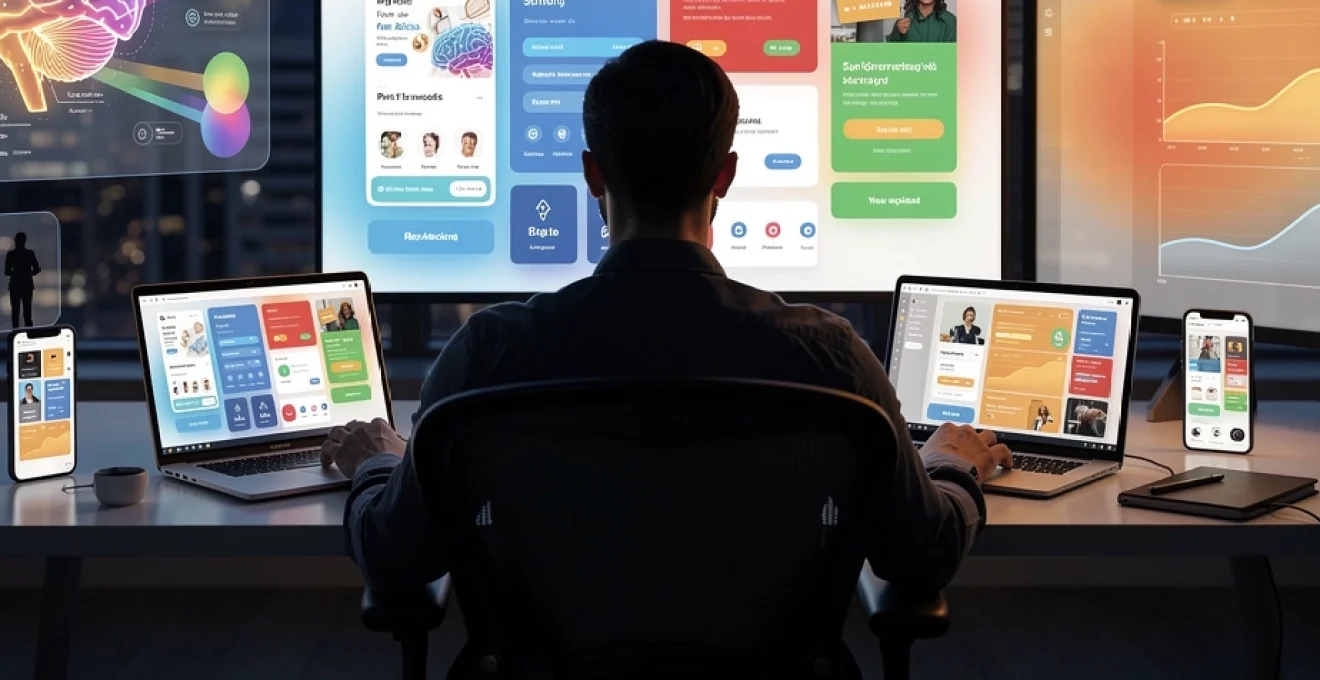
In an era where digital interfaces dominate human-computer interactions, the strategic application of colour psychology has emerged as a critical factor in determining user engagement and message effectiveness. Every pixel displayed on screen carries the potential to influence emotions, guide behaviour, and reinforce brand messaging through carefully orchestrated chromatic choices. Understanding the intricate relationship between colour perception and psychological response enables designers to craft digital experiences that resonate deeply with their intended audiences.
The power of colour extends far beyond aesthetic appeal, functioning as a sophisticated communication tool that operates on both conscious and subconscious levels. Research indicates that colour recognition increases brand awareness by up to 80%, whilst appropriate colour selection can boost conversion rates by as much as 24%. These statistics underscore the fundamental importance of colour psychology in digital message reinforcement, where milliseconds of user attention must be captured and converted into meaningful engagement.
Neurological foundations of colour perception in digital interface design
The human visual system processes colour information through complex neurological pathways that have evolved over millions of years to interpret environmental cues and trigger appropriate responses. Understanding these biological foundations provides designers with the scientific framework necessary to make informed colour decisions that align with natural human perception patterns. The brain’s colour processing mechanisms operate through multiple interconnected systems, each contributing to the overall psychological impact of digital colour schemes.
Trichromatic theory applications in Screen-Based media
The trichromatic theory, originally proposed by Thomas Young and later refined by Hermann von Helmholtz, explains how human colour vision operates through three types of cone cells sensitive to different wavelengths of light. In digital design contexts, this theory translates into practical applications for RGB colour spaces, where red, green, and blue components combine to create the entire visible spectrum on electronic displays. Modern screen technologies leverage this biological reality by manipulating these three primary wavelengths to produce millions of distinct colour variations.
Digital designers must understand that colour perception varies significantly based on the balance between these three cone cell responses. For instance, colours that appear vibrant and attention-grabbing often stimulate multiple cone types simultaneously, creating a more intense neurological response than monochromatic schemes. This principle explains why complementary colour combinations—those positioned opposite each other on the colour wheel—generate such powerful visual impact in digital interfaces.
Opponent process theory impact on digital colour contrast
The opponent process theory, developed by Ewald Hering, describes how the human visual system processes colour through three opponent channels: red-green, blue-yellow, and black-white. This neurological mechanism significantly influences how users perceive colour relationships within digital interfaces, particularly regarding contrast and readability. Understanding opponent processing helps designers create colour schemes that work harmoniously with natural visual perception rather than fighting against it.
Digital applications of opponent process theory become evident in interface design decisions such as text colour selection, background choices, and interactive element highlighting. For example, the widespread use of blue hyperlinks on white backgrounds leverages the blue-yellow opponent channel to create maximum contrast whilst remaining visually comfortable. Similarly, error messages often employ red text because the red-green opponent system naturally draws attention to potential dangers or warnings.
Wavelength response variations across different display technologies
Different display technologies—including LCD, OLED, LED, and E-ink—reproduce colours through varying methods that can significantly impact colour perception and psychological response. LCD displays rely on backlighting and colour filters, which may produce cooler colour temperatures that unconsciously promote focus and alertness. OLED technology, conversely, generates warmer, more saturated colours that can create stronger emotional responses and enhance brand memory formation.
The technical characteristics of display technologies also influence colour accessibility considerations. High-contrast ratios available in OLED displays enable more dramatic colour schemes, whilst the blue light emission patterns of LED screens may require careful consideration when designing interfaces intended for extended use. Understanding these variations ensures that colour psychology strategies remain effective across diverse viewing environments and device types.
Cultural colour associations in global digital marketing campaigns
Cultural context profoundly influences colour perception and psychological response, creating significant challenges and opportunities for global digital marketing initiatives. Whilst some colour associations appear universal—such as red’s connection to urgency or blue’s association with trust—many chromatic meanings vary dramatically across cultural boundaries. For instance, white symbolises purity
in many Western contexts yet represents mourning or loss in several East Asian traditions. Consequently, a global digital campaign that uses white as the dominant interface colour for a celebration might resonate in Europe but feel jarring in parts of India, China, or Japan. Marketers planning cross-border product launches must therefore conduct cultural colour audits, reviewing how primary and accent colours will be perceived in each key market. This process often leads to region-specific colour variants that keep the core brand palette intact while adapting sensitive hues such as red, white, or black.
Successful global platforms frequently employ chromatic flexibility to navigate these cultural nuances. A financial services app, for instance, may retain its signature blue to signal trust worldwide but adapt supporting colours—such as choosing gold or red for prosperity in East Asia and green for stability in Middle Eastern markets. By combining universal psychological colour cues with local cultural expectations, digital marketers can craft campaigns that feel both globally consistent and locally relevant. Ultimately, cultural colour associations should be treated as a strategic variable, not an afterthought, in international digital messaging.
Strategic colour implementation in user experience architecture
As we move from neurological and cultural theory into practical execution, the focus shifts to user experience architecture—the structural blueprint that determines how users navigate and interpret digital environments. Colour plays a pivotal role in this architecture by signalling priority, indicating interactivity, and visually connecting related interface elements. When used with intention, colour psychology can reduce cognitive load, increase task completion rates, and reinforce the core digital message at every interaction point.
Strategic colour implementation in UX design requires aligning business goals, brand identity, and user needs within a cohesive chromatic system. Rather than treating colour as decoration, we treat it as an information layer that works alongside typography, layout, and motion. This perspective encourages teams to document colour decisions in design systems, ensuring that call-to-action styles, alert states, and navigation cues remain consistent across websites, mobile apps, and marketing landing pages.
Call-to-action button optimisation using high-conversion colour schemes
Call-to-action (CTA) buttons are often the most commercially important elements in a digital interface, and colour is one of the strongest levers we have to optimise their performance. Studies in conversion rate optimisation regularly show that high-contrast CTA colours increase click-through rates by double-digit percentages, particularly when they stand out clearly from the surrounding interface. The key is not to choose a universally “best” colour—because none exists—but to select a hue that contrasts strongly with your base palette while remaining aligned with your brand personality.
For example, a predominantly blue fintech dashboard might employ a saturated orange or green for its primary CTA to create an immediate focal point, leveraging opponent process contrast for rapid detection. Designers should also consider semantic consistency: using one dedicated colour for primary actions such as “Sign up” or “Buy now,” and a different, more muted colour for secondary actions like “Learn more.” By maintaining consistent CTA colour semantics, we help users learn, almost subconsciously, which actions represent the highest value decisions.
To refine CTA button colours further, data-driven experimentation is essential. You might test subtle variations in hue, brightness, or saturation to find the combination that delivers the highest conversion without feeling aggressive or off-brand. In some contexts, simply increasing the perceived “warmth” of a CTA colour—moving from a cool teal to a warmer turquoise, for instance—can humanise the interaction and increase click willingness. We can think of CTA colour optimisation like tuning a musical instrument: small adjustments can dramatically alter the emotional resonance of the final performance.
Navigation hierarchy enhancement through chromatic visual weight distribution
Navigation systems rely on clear hierarchy to keep users oriented, and colour is a primary tool for signalling that hierarchy at a glance. By assigning different chromatic “weights” to primary, secondary, and tertiary navigation elements, we guide users toward the most important paths through the interface. Heavier, more saturated colours typically denote primary navigation items, while lighter tints or neutral tones support secondary links that are useful but not mission-critical.
Consider a complex SaaS platform with multiple modules: using a single accent colour to mark all top-level navigation items creates a unified mental model, while reserved secondary colours can differentiate contextual filters or in-page tabs. The user’s eye naturally gravitates toward the strongest colour contrast, so designers can orchestrate the visual journey by carefully placing high-saturation hues only where they want immediate attention. In this sense, colour functions like stage lighting, illuminating the main actors (key navigation items) and keeping the background cast in softer tones.
Chromatic visual weight also helps resolve the tension between discoverability and simplicity. Too many brightly coloured elements compete for attention, increasing cognitive load and slowing decision-making. By deliberately restricting strong colours to a few high-priority navigation zones, we create a calmer, more legible experience that still surfaces essential paths when users need them. Asking yourself “Does this element truly deserve colour emphasis?” before applying an accent is a simple yet powerful UX discipline.
Brand identity reinforcement via consistent colour system implementation
Brand identity in digital environments is built as much through colour consistency as through logos or typography. A well-defined colour system—spanning primary, secondary, and neutral palettes—ensures that every screen, from onboarding flows to error states, feels unmistakably “on-brand.” When users repeatedly encounter the same core hues in emails, landing pages, and product interfaces, they form durable associations between those colours and the brand’s values, tone, and promise.
To achieve this level of consistency, organisations increasingly rely on design systems and component libraries that encode colour rules into reusable patterns. Tokens such as color-primary, color-success, and color-warning are defined once and implemented across all platforms, reducing the risk of ad-hoc colour decisions that dilute brand recognition. This approach also simplifies collaboration between marketing teams and product teams, who can work from a shared chromatic vocabulary rather than negotiating colours on a campaign-by-campaign basis.
From a psychological perspective, consistent colour usage helps build trust by signalling reliability and attention to detail. Imagine if a banking app suddenly changed the colour of its confirmation messages from green to red between updates; even if the functionality remained intact, users might feel a subtle sense of unease. By contrast, brands that maintain stable, well-considered colour systems convey professionalism and predictability—qualities that are crucial in sectors like finance, healthcare, and enterprise software.
Accessibility compliance through WCAG 2.1 colour contrast standards
Colour psychology in digital design must extend beyond aesthetics and marketing outcomes to encompass accessibility and inclusivity. The Web Content Accessibility Guidelines (WCAG) 2.1 specify minimum contrast ratios between text and background colours to ensure legibility for users with visual impairments, including colour vision deficiencies. At a minimum, body text should meet a contrast ratio of 4.5:1, while large text and UI elements should meet at least 3:1 to be considered accessible.
Designers can treat these WCAG colour contrast standards as guardrails that shape, rather than limit, creative expression. By starting palette development with accessible pairings—dark text on light backgrounds or vice versa—we reduce the need for compromises late in the design process. Crucially, we must avoid relying on colour alone to convey critical information; pairing colour cues with icons, patterns, or text labels ensures that alerts, errors, and statuses remain understandable for users with colour blindness or low vision.
Accessible colour design also supports broader business objectives. Interfaces that are easier to read and interpret reduce user errors, support longer session durations, and expand the potential customer base to include people who might otherwise be excluded. In this way, adhering to WCAG 2.1 is not just a compliance exercise but a strategic investment in user trust and long-term engagement. When we design for the edges—those with the most challenging visual needs—we often improve the experience for everyone.
Platform-specific colour psychology applications
Although colour psychology principles remain consistent at a human level, their application must adapt to the unique constraints and behaviours of different digital platforms. A colour scheme that performs well on a desktop web dashboard may fall short on a mobile app, where screen size, ambient light, and interaction patterns differ dramatically. Similarly, social media feeds, email campaigns, and immersive VR environments each impose distinct chromatic demands on designers.
On mobile devices, for example, high ambient light and smaller touch targets often require stronger contrast and simplified colour palettes to maintain usability. In social media advertising, where users scroll rapidly, bold accent colours that contrast against platform defaults (such as Facebook’s blue or Instagram’s off-white feed) can help sponsored content stand out without feeling intrusive. Meanwhile, in dark-mode interfaces, designers must rethink traditional “light background, dark text” assumptions, adjusting saturation and brightness to avoid eye strain while preserving emotional impact.
Platform-specific constraints also influence how colour supports interaction states. Hover effects that work well on desktop UIs do not exist on touch devices, so mobile patterns rely more on colour changes, shadows, and animations to signal taps and active states. In emerging platforms such as augmented reality (AR) or mixed reality (MR), colour must negotiate with real-world environments, demanding adaptable palettes that remain legible against unpredictable backgrounds. Across all these contexts, the core question remains: how can colour best reinforce the intended digital message within the realities of the platform where it appears?
Conversion rate optimisation through evidence-based colour testing
While theory provides a strong foundation, the most effective colour strategies in digital messaging are ultimately validated through empirical testing. Conversion rate optimisation (CRO) treats colour as a hypothesis to be tested rather than a static decision, using controlled experiments to measure how different chromatic choices influence user behaviour. Instead of debating which shade of green “feels” more trustworthy, teams can run structured tests to determine which option drives higher sign-ups, purchases, or engagement.
Evidence-based colour testing typically combines quantitative methods—such as A/B testing and multivariate experiments—with qualitative insights from user interviews or usability sessions. This mixed-methods approach helps explain not only what colour variant performs better but also why users may respond differently. Over time, organisations can build internal benchmarks and heuristics, such as “warm accent colours outperform cool accents for promotional CTAs” or “muted success states reduce anxiety in error-prone workflows,” which guide future design decisions.
A/B testing methodologies for colour variant performance analysis
A/B testing remains the most widely used methodology for comparing colour variants in digital environments. In a standard experiment, two versions of an interface element—such as a CTA button, banner, or form highlight—are shown to different, randomly selected user groups. By keeping all other variables constant and changing only the colour, teams can isolate its impact on key metrics like click-through rate, form completion, or revenue per visitor.
When designing A/B tests for colour psychology, it is important to define clear hypotheses and success criteria in advance. For instance, you might hypothesise that “a high-contrast orange CTA will drive at least a 10% increase in trial sign-ups compared to the current navy CTA.” Tests should run long enough to accumulate sufficient data across different days of the week and traffic sources, reducing the risk of skewed results. Additionally, segmenting outcomes by device type, geography, or traffic channel can uncover nuanced patterns—for example, certain colour variants might perform better on mobile than desktop, or in one region compared to another.
Beyond simple A/B comparisons, multivariate testing can explore how colour interacts with other design variables such as copy, size, or placement. However, the more variations introduced, the larger the sample size required to reach reliable conclusions. For teams with moderate traffic, focusing on a small number of well-chosen colour experiments often yields more actionable insights than attempting to test every possible shade at once. As with any scientific process, disciplined iteration and careful documentation are crucial.
Heatmap analytics integration for colour-driven user behaviour tracking
Heatmap analytics provide a powerful visual complement to numerical conversion data, revealing how users interact with colour-coded elements across entire pages or screens. Click maps, scroll maps, and move maps can show whether brightly coloured CTAs truly attract attention, or whether other, unintentionally prominent hues are stealing focus. In this sense, heatmaps act like an X-ray for your colour strategy, exposing where the eye and cursor are naturally drawn.
For instance, a landing page might feature a red promotional badge that, according to heatmap data, receives more clicks than the primary “Get started” button. This insight may suggest that the button colour lacks sufficient salience or that the red badge is unintentionally signalling a more important action. By adjusting the chromatic balance—perhaps toning down the badge and amplifying the CTA colour—designers can realign attention with the intended conversion path.
Integrating heatmap tools into an ongoing optimisation workflow encourages teams to treat colour psychology as a living system rather than a one-time decision. After each major redesign or campaign launch, reviewing heatmaps helps verify whether colour emphasis aligns with strategic priorities. Over time, patterns emerge: areas with consistent under-engagement may indicate colours that blend too much into the background, while hotspots might reveal opportunities to simplify, consolidate, or redirect user focus for improved clarity.
Statistical significance measurement in chromatic design experiments
To ensure that observed differences in performance between colour variants are not the result of random chance, we rely on statistical significance. In practical terms, this means calculating whether the performance uplift—such as a higher click-through rate on a green CTA compared to a blue one—is large enough and based on enough data to be considered reliable. Tools for A/B testing usually provide built-in significance calculators, but understanding the underlying logic helps teams interpret results more critically.
Designers and marketers should pay attention to factors such as sample size, confidence level (commonly set at 95%), and test duration when evaluating colour experiments. Ending a test too early because one colour appears to be “winning” can lead to false positives, particularly when traffic is low or user behaviour fluctuates during promotions and seasonal peaks. Conversely, continuing to test tiny variations that yield negligible differences may waste time and resources without meaningful impact on overall conversion rates.
By treating statistical significance as a threshold for decision-making, organisations avoid overreacting to anecdotal outcomes—such as a temporary spike in performance during a specific campaign. A disciplined approach might involve setting minimum effect sizes (for example, a 5% uplift in conversions) and only shipping colour changes that meet or exceed those thresholds with sufficient confidence. This transforms colour psychology from a subjective debate into a measurable, repeatable optimisation practice.
Industry case studies in digital colour psychology implementation
Real-world case studies illustrate how different industries harness colour psychology to reinforce digital messages and drive measurable business outcomes. In the e-commerce sector, retailers frequently use warm accent colours—such as red, orange, or coral—for “Add to cart” buttons, creating a subtle sense of urgency and excitement around purchase decisions. Fashion brands may contrast this with calmer backgrounds and neutral product photography, allowing the product itself to remain the hero while the CTA provides a clear, emotionally charged next step.
In healthcare and wellness platforms, designers often lean on blues and greens to convey calm, stability, and holistic wellbeing. Patient portals, telemedicine dashboards, and mental health apps commonly pair soft blue interfaces with green success states, reassuring users during potentially stressful interactions like test result viewing or appointment scheduling. The psychological aim is to reduce anxiety and encourage trust in the digital experience, which in turn supports higher engagement and adherence to treatment plans.
Financial services and fintech products face a unique challenge: they must communicate both innovation and security. Many resolve this by combining deep blues and cool neutrals—anchoring trust and professionalism—with sparing use of more energetic accent colours for investment opportunities, promotional offers, or educational nudges. Meanwhile, entertainment and streaming platforms frequently embrace bold, saturated palettes to stimulate curiosity and excitement; think of the way red, purple, or neon hues are used to frame recommendations, previews, and limited-time releases. Across these diverse sectors, one pattern remains consistent: colour choices are most effective when they are tightly aligned with the emotional state a brand wants to evoke at each step of the user journey.
Emerging technologies and colour psychology integration
As emerging technologies reshape digital experiences, the role of colour psychology continues to evolve. In immersive environments such as virtual reality (VR) and augmented reality (AR), colour must operate in three dimensions, interacting with depth, motion, and real-world lighting conditions. Designers can use ambient colour washes to set emotional tone in virtual spaces—cool blues for focus and calm, warm ambers for comfort and sociability—while employing brighter accent colours to guide navigation or highlight interactive objects in 3D scenes.
Artificial intelligence and adaptive interfaces also open new possibilities for personalising colour in real time. Imagine a productivity app that subtly shifts its palette toward cooler tones during periods of intense concentration, then warms up as deadlines approach to gently increase arousal and alertness. Or consider a global news platform that adjusts its interface colours to match user-selected themes, time of day, or even biometric signals such as heart rate. These context-aware, data-driven colour systems have the potential to deepen user engagement by aligning visual environments with individual preferences and situational needs.
At the same time, emerging technologies introduce ethical questions around colour manipulation and psychological influence. As algorithms become more capable of optimising colour for engagement metrics, we must ask: are we using colour to help users make better decisions, or merely to keep them hooked? Responsible design practice requires transparency, user control, and a commitment to long-term wellbeing. When we integrate colour psychology into next-generation interfaces—whether in AR glasses, smart vehicles, or adaptive learning platforms—the goal should be to reinforce digital messages that respect users’ autonomy while supporting clarity, comfort, and meaningful connection.