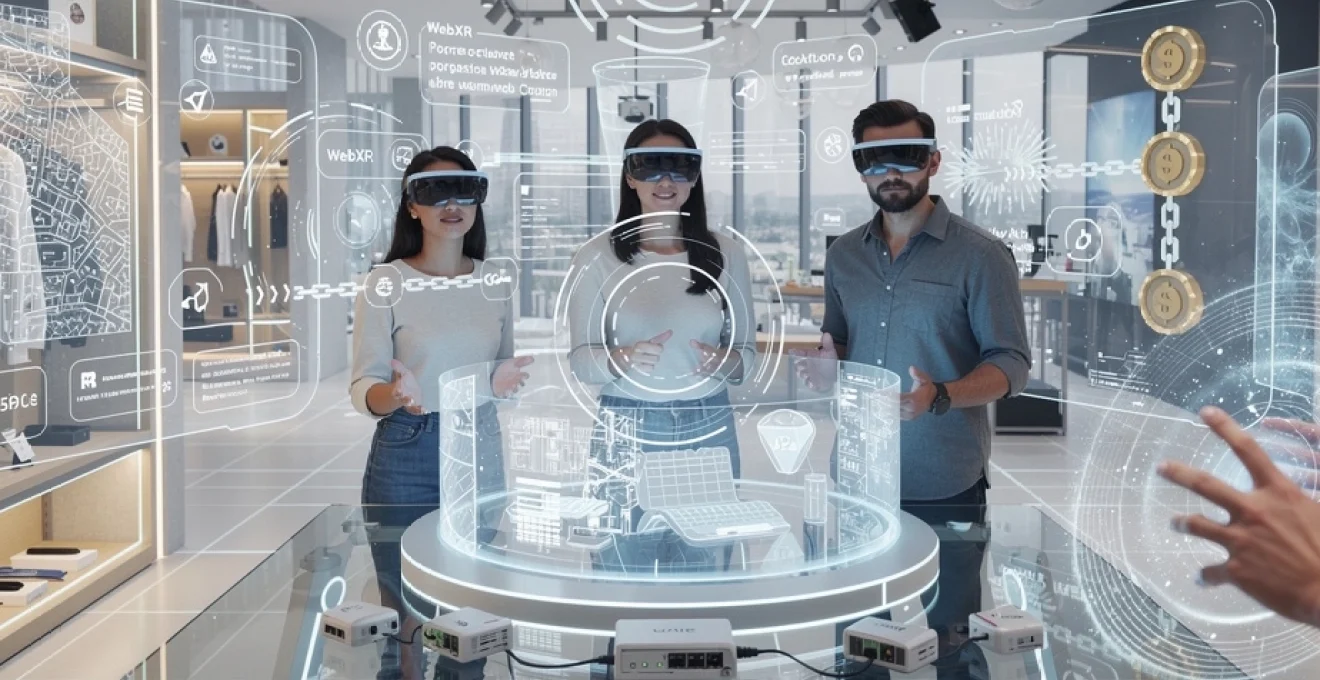
The boundary between physical reality and digital environments is dissolving at an unprecedented pace. As exponential technologies collide and converge, we’re witnessing the emergence of what industry experts call « phygital » experiences—seamless integrations where the tangible world and virtual spaces merge to create entirely new interaction paradigms. This transformation isn’t merely about adding digital overlays to physical objects; it represents a fundamental shift in how you experience, interact with, and understand your environment. From retail stores that recognize your preferences the moment you enter, to manufacturing floors where virtual twins guide real-world assembly, the convergence of these realms is reshaping every industry sector.
What makes this convergence particularly compelling is the simultaneous maturation of multiple enabling technologies. Extended reality platforms, Internet of Things ecosystems, spatial audio systems, computer vision algorithms, blockchain networks, and 5G infrastructure are no longer developing in isolation. Instead, they’re creating a technological mesh where each advancement amplifies the capabilities of the others. This synergistic effect is accelerating disruption across sectors at a rate that even seasoned technology forecasters find challenging to predict. The result is an emerging landscape where your physical actions trigger digital consequences, and virtual interactions manifest tangible outcomes in the real world.
Extended reality (XR) technologies bridging physical and digital realms
Extended reality technologies serve as the primary interface layer between physical and digital worlds, offering you immersive experiences that range from subtle augmentations to complete virtual immersion. The spectrum of XR—encompassing augmented reality (AR), mixed reality (MR), and virtual reality (VR)—provides different degrees of immersion depending on your use case and context. Global spending on XR technology reached $20.4 billion in recent years, with projections indicating exponential growth as hardware costs plummet and software capabilities expand. Major technology companies including Microsoft, Meta, Apple, and Google are investing heavily in developing XR platforms that will define how you interact with information and environments in the coming decade.
The transition from tethered, PC-dependent headsets to standalone mobile devices represents a critical inflection point for XR adoption. Early VR systems required cumbersome connections to powerful computers, restricting your movement and limiting practical applications. Today’s standalone headsets like the Meta Quest series and emerging Apple Vision devices integrate processing power, sensors, and displays into single units that you can transport anywhere. This dematerialization phase makes XR increasingly accessible, transforming it from a specialized tool for early adopters into a mainstream consumer technology. As Philip Rosedale, creator of Second Life and co-founder of High Fidelity, observes, we’re still « in the middle of landing the airplane » of these new devices, with fundamental shifts in form factor and capability occurring rapidly.
Mixed reality spatial computing with microsoft HoloLens 2 and magic leap
Microsoft’s HoloLens 2 leads the enterprise mixed reality market by addressing the critical limitation of earlier devices: restricted field of view. By implementing microelectromechanical systems (MEMS) display technology with laser-driven waveguides, HoloLens 2 has doubled its predecessor’s field of view while maintaining a 47 pixel per degree resolution. This achievement brings the viewing experience closer to natural human vision, which spans approximately 120 degrees horizontally. When you wear HoloLens 2, holographic content integrates seamlessly with your physical environment, enabling applications from surgical guidance to complex mechanical assembly. The device’s eye-tracking capabilities not only enable foveated rendering—conserving processing power by rendering high resolution only where you’re looking—but also facilitate user identification and personalized lens adjustments.
Magic Leap’s approach to mixed reality prioritizes lightweight comfort and extended wear periods, targeting enterprise applications in manufacturing, healthcare, and design visualization. The Magic Leap 2 offers a comparable field of view to HoloLens 2 but with different trade-offs in resolution, weight distribution, and processing architecture. Both platforms demonstrate how mixed reality transcends simple digital overlays, instead creating what researchers call « mirror worlds »—persistent alternative dimensions that can blanket physical spaces with interactive digital content. Imagine your office transforming into a lakeside setting or a classroom where every surface becomes an interactive learning tool. These mirror worlds require precise spatial understanding and real-time rendering capabilities that are only now becoming technically feasible at consumer-accessible price points.
Volumetric
Volumetric capture systems extend this concept by reconstructing full 3D representations of people and objects, rather than simply projecting flat overlays into your space. Using multi-camera rigs and depth sensors, these systems record subjects from dozens of angles simultaneously, then fuse those streams into dynamic 3D meshes that you can walk around, scale, or reposition in mixed reality. When combined with photogrammetry—algorithms that infer geometry from overlapping 2D images—you get highly realistic « digital humans » and environments that respond naturally to lighting and perspective. For training, remote collaboration, or live events, volumetric capture transforms passive video into interactive, spatial content that feels present in your physical world.
Photogrammetry integration is particularly powerful for enterprises that need to digitize existing spaces or product catalogs at scale. Instead of manually modeling every asset, you can capture warehouses, showrooms, or manufacturing lines using off-the-shelf cameras and then process them into detailed 3D environments. These volumetric and photogrammetric assets can be streamed into HoloLens 2 or Magic Leap applications, giving field technicians, designers, or retail associates an accurate digital replica of their context. As processing pipelines become more automated and cloud-based, volumetric capture is shifting from a high-end studio capability to a standard step in creating next-gen mixed reality experiences.
SLAM algorithms for real-time environment mapping
Underpinning almost every compelling mixed reality experience is simultaneous localization and mapping, or SLAM. SLAM algorithms continuously estimate where a device is in space while building a map of the environment around it, fusing inputs from cameras, depth sensors, and inertial measurement units. In practice, this means your headset or mobile device can recognize walls, tables, and other surfaces in real time, anchoring holograms so they stay locked to the physical world as you move. Without robust SLAM, digital content tends to drift or jitter, breaking immersion and limiting practical use in industrial or retail settings.
Modern SLAM pipelines increasingly leverage neural networks to improve robustness in challenging environments with low light, reflective surfaces, or moving objects. For example, semantic SLAM layers object recognition on top of geometric mapping, so the system doesn’t just know there is a flat plane, but that it is a « desk » or « shelf. » This contextual understanding allows mixed reality applications to adapt behavior dynamically—placing instructions near the correct machine, or ensuring safety notices only appear in hazardous zones. As compute moves closer to the edge and custom vision accelerators become standard in XR devices, we can expect near-instantaneous mapping that makes phygital interfaces feel as stable and reliable as physical signage.
Webxr standards and progressive web applications
While high-end headsets capture the headlines, the WebXR standard is quietly democratizing access to extended reality through the browser. WebXR provides a common API that lets developers build immersive experiences once and deploy them across VR headsets, AR-capable smartphones, and even desktop browsers without separate native apps. For you as a user, this means that scanning a QR code in a store, opening a link in an email, or visiting a product page can instantly launch an interactive XR experience, no app store download required. This frictionless access is critical if phygital commerce and training are to scale beyond pilots and early adopters.
Progressive web applications (PWAs) augment WebXR by bringing app-like capabilities—offline caching, push notifications, home screen installation—to browser-delivered experiences. A retailer might use a PWA with WebXR to offer AR product visualization that works on any modern smartphone, while an industrial firm could deploy a browser-based mixed reality checklist that technicians access through shared tablets on the factory floor. Because PWAs update centrally, you can roll out new features, safety procedures, or promotions instantly across your phygital touchpoints. As WebXR gains broader support and WebGPU unlocks higher-fidelity graphics in the browser, the line between native XR apps and web-based experiences will continue to blur.
Internet of things (IoT) ecosystems enabling phygital interactions
If XR is the visual and spatial interface of the phygital era, the Internet of Things is its sensory nervous system. IoT devices—ranging from simple RFID tags to complex industrial sensors—bridge the gap between digital intent and physical state, providing the real-time data that makes experiences adaptive and context-aware. In practical terms, IoT ecosystems allow environments, products, and infrastructure to « speak » to your applications, so that what you see in augmented reality or on a dashboard accurately reflects what is happening in the physical world. This tight feedback loop is what transforms static digital overlays into dynamic, responsive phygital interactions.
Modern IoT architectures rely on a mix of cloud, edge, and on-device processing to manage the sheer volume and velocity of telemetry. As billions of endpoints come online, the challenge is not only connecting and securing them, but orchestrating their data so that extended reality interfaces, AI models, and analytics systems can act in milliseconds rather than minutes. Done well, this orchestration lets you move from reactive monitoring to predictive and even autonomous operations, where your physical spaces intelligently anticipate user needs and operational constraints.
Edge computing architecture with AWS IoT greengrass
Edge computing addresses one of the biggest constraints in phygital experiences: latency. When sensor data and control logic have to traverse long network paths to centralized clouds, even small delays can degrade XR responsiveness or disrupt real-time automation. AWS IoT Greengrass brings compute, messaging, and machine learning inference closer to where data is generated—on gateways, industrial PCs, or even smart cameras. By deploying Lambda functions and containerized workloads at the edge, you can process events locally, send only summarized insights to the cloud, and keep critical systems running even if connectivity is intermittent.
Consider a connected retail environment where shelf sensors, cameras, and beacons feed data into a Greengrass-enabled edge node. Rather than streaming every frame or sensor reading to the cloud, the node can run local computer vision models to detect out-of-stock items, trigger dynamic pricing updates, or notify associates through AR headsets in real time. In manufacturing, edge nodes can analyze vibration or temperature patterns with on-device ML models, immediately alerting technicians through mixed reality overlays when anomalies occur. This architecture not only reduces bandwidth and cloud costs but also enhances privacy by keeping sensitive data on-premises whenever possible.
RFID and NFC integration in retail environments
Radio-frequency identification (RFID) and near-field communication (NFC) are among the most mature yet underutilized technologies in phygital retail. RFID tags enable rapid, non-line-of-sight scanning of inventory, while NFC chips allow close-range, secure interactions via smartphones or wearables. When integrated with XR interfaces and store analytics, these technologies unlock real-time visibility into product location, status, and provenance. Imagine walking through a store where your AR glasses quietly query nearby RFID readers, highlighting items in your size that are in stock, or suggesting complementary products based on your profile.
NFC, on the other hand, excels at deliberate, tap-based interactions that signal intent. A shopper might tap their phone on a product label to bring up sustainability data, customer reviews, or personalized offers rendered as an AR overlay. At checkout, the same tap can combine identity verification, loyalty redemption, and payment into a single gesture. For retailers, embedding RFID and NFC into fixtures and packaging provides a low-cost way to anchor digital content to physical goods, creating persistent phygital experiences that extend from in-store browsing to post-purchase engagement at home.
Digital twin implementation using azure IoT suite
Digital twins take IoT data one step further by building living, virtual replicas of physical assets, spaces, or even entire organizations. Azure Digital Twins, part of the broader Azure IoT Suite, lets you model complex environments—factories, campuses, supply chains—as graph-based systems where each node represents an asset with properties, relationships, and behaviors. This abstraction allows you to simulate scenarios, test « what if » changes, and visualize real-time state through dashboards or XR interfaces. For example, a logistics operator can see a 3D twin of a warehouse, complete with pallet positions, temperature zones, and robot routes, all updated live from IoT sensors.
When combined with HoloLens 2 or MR devices, these digital twins become powerful phygital control rooms. Supervisors can walk the factory floor while seeing color-coded overlays showing machine health, energy consumption, or safety thresholds directly on the equipment. Engineers can rehearse layout changes or new workflows in the twin before committing to physical alterations, reducing downtime and risk. Because Azure Digital Twins integrates with analytics, security, and DevOps services across the Azure ecosystem, you can embed twin-based insights into broader business processes, from predictive maintenance scheduling to capacity planning.
Sensor fusion technologies for contextual awareness
Individual sensors provide snapshots of reality; sensor fusion combines them into a coherent, high-fidelity understanding of context. By merging data from accelerometers, gyroscopes, cameras, microphones, BLE beacons, and environmental probes, sensor fusion algorithms can infer not just where a user is, but what they are doing and what surrounds them. In phygital experiences, this deeper contextual awareness is essential to avoid overwhelming you with irrelevant information. For instance, a smart building might suppress non-urgent alerts in your AR view while you’re presenting, then resume notifications as you leave the room, guided by sensor-fused activity recognition.
From a technical perspective, sensor fusion often involves Kalman filters, Bayesian estimators, and increasingly, deep learning models trained on multimodal datasets. These approaches smooth noisy signals, compensate for individual sensor weaknesses, and extract higher-level features such as gestures, occupancy patterns, or emotional tone. In retail, fusing footfall analytics, shelf-weight data, and camera insights can reveal micro-behaviors like product comparison or hesitation, enabling more empathetic phygital interventions. The challenge is to balance rich contextualization with stringent privacy and ethics standards, ensuring that users understand and consent to how their environments and behaviors are being interpreted.
Spatial audio engineering and haptic feedback systems
Visual overlays tend to dominate conversations about the convergence of physical and digital worlds, but sound and touch are just as critical for convincing, comfortable experiences. Spatial audio and haptic feedback engage your auditory and tactile senses to anchor virtual events in the real world, reducing cognitive dissonance and enhancing presence. When you hear a virtual colleague’s voice coming from their actual position in your room, or feel a subtle pulse when you « touch » a digital button floating over a control panel, your brain is far more likely to accept the phygital environment as coherent. These modalities also play a key role in accessibility, providing alternative channels for guidance and feedback.
Engineering these sensations requires precise modeling of how sound waves propagate in 3D spaces and how the human body perceives vibration and force. As devices shrink and move closer to your skin—through wearables, XR headsets, and even mid-air haptic arrays—the opportunity to design nuanced, context-aware feedback grows. The goal is not sensory overload, but subtle, informative cues that fade into the background until you need them, much like the gentle click of a well-designed mechanical switch.
Ambisonics and binaural rendering techniques
To create convincing 3D audio, XR platforms increasingly rely on ambisonics and binaural rendering. Ambisonics captures or synthesizes a full-sphere sound field, representing not just left and right channels but audio arriving from above, below, and behind you. Binaural rendering then takes that encoded sound field and filters it through head-related transfer functions (HRTFs) that mimic how your ears, head, and torso shape incoming sound. The result, when played back over headphones, is a sonic illusion where you can close your eyes and still pinpoint the location of virtual objects or speakers in your physical space.
In phygital applications, this spatial audio can guide you through complex tasks or environments without cluttering your visual field. An assembly worker might hear step-by-step instructions that seem to emanate from the next component to pick, while a museum visitor hears layered stories that shift as they move between exhibits. Because ambisonic audio can be rotated and reoriented in real time, developers can align soundfields with SLAM-based spatial maps, ensuring that virtual sources remain fixed in your environment as you turn your head. As tools for personalized HRTFs improve, we can expect even more precise localization customized to your unique physiology.
Ultrahaptics mid-air tactile feedback solutions
Haptic feedback has traditionally depended on direct contact—vibrating controllers, actuated gloves, or force-feedback devices. Ultrahaptics (now part of Ultraleap) introduces a different approach: mid-air haptics that use focused ultrasound to create perceivable points of pressure on your skin without any wearable hardware. By steering arrays of ultrasonic transducers, the system can generate shapes, textures, and motion patterns that you feel as if something is touching your hand, even though the air between you and the device is empty. This capability is particularly valuable in hygienic or public environments where shared physical interfaces are undesirable.
Integrating mid-air haptics into phygital experiences lets you « touch » digital objects that appear in front of you through AR glasses or kiosks. Picture an automotive showroom where you can run your hand along the contours of a virtual dashboard, or a medical simulation where students feel the resistance of virtual tissue as they practice procedures. Combined with hand-tracking cameras, Ultrahaptics systems can deliver precise, localized feedback synchronized to your gestures, closing the loop between what you see, hear, and feel. The design challenge lies in crafting haptic vocabularies—consistent patterns for confirmation, error, urgency—that users quickly learn to interpret without conscious effort.
Unity spatial audio SDK implementation
On the development side, engines like Unity provide spatial audio SDKs that abstract much of the complexity involved in 3D sound rendering. These toolkits let you attach audio sources to objects in your scene, define their spatial behavior (occlusion, reverberation, Doppler effects), and mix them into an ambisonic or binaural output that tracks head movement. For teams building phygital applications, Unity’s spatial audio pipeline integrates tightly with XR frameworks, physics engines, and animation systems, ensuring that audio cues remain synchronized with visual events and real-world interactions.
Pragmatically, this means you can prototype and iterate on audio-driven interactions quickly, testing how different soundscapes affect user focus, comfort, and task performance. For example, you might discover that subtle positional cues are more effective than visual arrows for guiding users in a warehouse, or that layered ambient sounds make virtual objects feel « anchored » in large physical spaces. As Unity and similar platforms add support for advanced formats, real-time ray-traced acoustics, and AI-generated soundscapes, spatial audio will become an increasingly powerful lever for shaping how users navigate and interpret phygital environments.
Computer vision and neural networks powering phygital commerce
At the heart of phygital commerce is the ability to see and understand the physical world through machines. Computer vision and neural networks provide this capability, transforming camera feeds into structured insights about products, people, and behaviors. For retailers and brands, these systems enable everything from automated checkout and loss prevention to personalized recommendations and AR product visualization. For you as a consumer, they promise shopping journeys where you no longer browse static catalogs, but interact with living, adaptive digital layers superimposed on shelves, mannequins, and your own body.
These capabilities don’t come without challenges—bias in recognition models, privacy concerns around surveillance, and regulatory scrutiny are all intensifying. Yet when deployed with transparency and consent, vision-driven phygital experiences can reduce friction, surface relevant information at the right moment, and bridge the gap between online discovery and in-store decision-making. The key is to treat computer vision not as an all-seeing eye, but as a tool for augmenting human judgment and creativity.
Object detection with YOLO and TensorFlow models
Object detection frameworks like YOLO (You Only Look Once) and TensorFlow-based models are workhorses of real-time visual understanding in retail and logistics. Trained on millions of labeled images, these convolutional neural networks can recognize products, packaging types, and even shopper actions such as reaching or picking. Deployed on smart cameras at the edge or within mobile apps, they can automatically track stock levels, detect misplaced items, or trigger dynamic signage when specific products are in view. Because YOLO prioritizes speed, it is particularly suited for scenarios where you need instant responses, such as guiding a customer in AR as they walk down an aisle.
In practice, many enterprises fine-tune pre-trained models on their own product imagery to handle brand-specific packaging, seasonal variations, or private-label lines. Edge accelerators and optimized runtimes like TensorRT make it feasible to run these models on low-power devices, avoiding the latency and bandwidth costs of cloud-only inference. When combined with SLAM and sensor fusion, object detection can also help XR systems understand the context around you—knowing that a certain surface is not just a plane, but a shelf containing specific SKUs with associated pricing and promotions.
Visual search integration via google lens API
Visual search flips the traditional query paradigm: instead of typing a product name, you simply point your camera and let AI infer your intent. Google Lens and similar APIs analyze scenes to identify objects, text, and landmarks, returning search results, purchase options, or contextual information. Embedding these capabilities into phygital commerce journeys allows customers to move fluidly between physical discovery and digital exploration. You might scan a pair of shoes in-store to see online reviews, alternative colors, or secondhand availability, with AR overlays guiding you to where those variants are located nearby.
For brands and retailers, leveraging visual search APIs can extend the reach of your product data and content without building full-stack vision systems from scratch. By tagging your catalog with rich metadata and structured schema, you increase the chances that visual queries resolve to your offerings. Integrated with progressive web apps or native XR experiences, visual search can also power features like « shop the look »—where capturing an outfit or room suggests a curated list of matching items you can buy, both online and in the nearest physical store.
Facial recognition systems in physical retail spaces
Facial recognition sits at the controversial intersection of personalization and privacy in phygital retail. Technically, these systems can identify or verify individuals as they enter a store, enabling seamless loyalty recognition, age-restricted sales, or tailored offers displayed on nearby screens. They can also aggregate demographic statistics to inform merchandising and staffing. However, the same capabilities raise serious concerns about surveillance, consent, and algorithmic bias, with regulators and the public increasingly skeptical of pervasive facial tracking in public spaces.
Forward-looking organizations are therefore treading carefully, often favoring anonymous, aggregate analytics over individual identification, or using on-device biometric verification that never leaves the user’s smartphone. Where facial recognition is deployed, clear signage, opt-in mechanisms, and strict data retention policies are essential to maintain trust. Technically, advances in privacy-preserving machine learning—such as federated learning and differential privacy—offer paths to extract insights from facial data without centralizing or deanonymizing it. The broader lesson is that not every technically possible phygital capability is socially or ethically acceptable, and governance must evolve alongside innovation.
AR try-on solutions using MediaPipe framework
One of the most tangible benefits of phygital commerce for consumers is AR try-on—previewing how products will look on you or in your home before buying. Google’s MediaPipe framework provides building blocks for real-time hand, face, and body tracking on commodity devices, enabling accurate overlay of virtual glasses, makeup, jewelry, or apparel in live camera feeds. Because MediaPipe models are optimized for mobile CPUs and GPUs, they can run directly on smartphones and tablets, avoiding the need for specialized hardware or high-bandwidth streaming.
Retailers and beauty brands are using these capabilities to reduce return rates, increase shopper confidence, and create more playful, shareable experiences. For example, a cosmetics app might let you test dozens of lipstick shades in seconds, while a furniture retailer shows how a new sofa fits with your existing décor. The technical challenge lies in balancing realism with performance—ensuring that virtual items respond correctly to lighting, occlusion, and movement without draining battery or introducing lag. As body-tracking models become more robust across diverse skin tones, body types, and environments, AR try-on will shift from a novelty to an expected feature of phygital shopping journeys.
Blockchain and NFTs creating persistent digital-physical assets
As interactions span both physical and digital realms, questions of ownership, authenticity, and provenance become more complex. Blockchain technologies and non-fungible tokens (NFTs) offer a way to anchor digital-physical assets—a limited-edition sneaker with a linked digital twin, a concert ticket that unlocks an XR experience, or a piece of furniture whose repair history follows it across owners—in tamper-resistant ledgers. While the NFT hype cycle has cooled, the underlying idea of verifiable, programmable ownership remains highly relevant to next-gen experiences. When you buy a phygital product, you are increasingly buying not just a physical object, but ongoing access, services, and community membership encoded in smart contracts.
From a consumer standpoint, this can provide greater confidence that what you’re purchasing is genuine and ethically sourced, while also unlocking secondary markets where value flows back to creators. For brands, blockchain-backed phygital assets enable new business models, such as dynamic royalties, access tiers, or loyalty rewards that persist even as items change hands. The challenge, as always, is to hide the complexity of wallets, gas fees, and protocols behind intuitive user experiences that feel as seamless as tapping a contactless card.
Smart contracts on ethereum for phygital authentication
Smart contracts on platforms like Ethereum allow rules and logic about asset ownership to execute automatically once predefined conditions are met. In a phygital context, a smart contract might record the minting of an NFT linked to a physical product’s serial number, manage transfers when the item is resold, and verify authenticity when scanned by an NFC reader or AR app. Because these contracts run on decentralized infrastructure, no single party can quietly alter provenance records or counterfeit the associated digital certificates.
To make this work in practice, manufacturers embed secure chips or tamper-evident tags into products at the point of production, binding them cryptographically to on-chain records. When you scan the item in-store or at home, the app queries the smart contract to confirm that the physical identifier matches the blockchain entry, surfacing provenance details, repair histories, or exclusive digital content. Layer-2 networks and sidechains help address scalability and cost concerns, allowing high-volume use cases like fashion or consumer electronics to operate without incurring prohibitive transaction fees.
POAP protocol for event-based digital collectables
Proof of Attendance Protocol (POAP) offers a lightweight approach to phygital engagement by issuing NFTs as souvenirs of participation in events, both physical and virtual. Attendees might scan a QR code at a conference session, tap an NFC tag at a pop-up installation, or complete a challenge in an XR experience to claim a unique badge recorded on-chain. Over time, your POAP collection becomes a verifiable timeline of experiences—concerts attended, communities joined, courses completed—that can unlock gated content, discounts, or status within brand ecosystems.
For organizers and marketers, POAPs provide a low-friction way to build loyalty that extends beyond a single campaign. Because these tokens live in your wallet rather than a proprietary database, they can be recognized across platforms and applications, forming the backbone of interoperable phygital identity. The key to meaningful deployment is to ensure that POAPs carry real utility—priority access, governance rights, or curated experiences—rather than being mere digital trinkets destined to be ignored.
Decentralised identity verification with polygon ID
Decentralized identity solutions like Polygon ID address one of the thorniest issues in phygital experiences: how to verify who you are without exposing more personal data than necessary. Built on zero-knowledge proofs, Polygon ID lets you prove statements about your identity—such as being over 18, holding a certain membership, or having attended a certified training—without revealing the underlying attributes or relying on a central authority. In practice, this means you could access age-gated AR content in a store or unlock employee-only XR tools on a factory floor by presenting a cryptographic credential, not a photocopied passport.
For businesses, decentralized identity reduces the liability of storing sensitive customer information while still enabling personalized, compliant experiences. Credentials can be issued by trusted institutions—employers, schools, event organizers—and then reused across multiple contexts at your discretion. When combined with blockchain-backed assets and smart contracts, Polygon ID-style systems pave the way for a phygital world where access rights, reputation, and ownership are portable, user-controlled, and verifiable without constant recourse to centralized databases.
5G network infrastructure and low-latency streaming protocols
All of these next-gen experiences depend on fast, reliable connectivity. 5G network infrastructure, with its higher bandwidth, lower latency, and support for massive device density, provides the backbone for real-time phygital interactions at scale. Where 4G struggles with dense deployments of XR headsets, IoT sensors, and video streams, 5G can support thousands of devices per square kilometer while maintaining responsive performance. For you as a user, this translates into smoother AR overlays in crowded venues, more stable volumetric video streams, and collaborative XR sessions that feel as immediate as being in the same room.
From an architecture perspective, 5G is more than a faster radio interface. It introduces capabilities like network slicing and native support for edge computing that let operators and enterprises tailor connectivity to the specific needs of XR, IoT, and AI workloads. As these features roll out, connectivity will increasingly be treated as a programmable resource—something your phygital applications can request and adapt to dynamically, rather than a fixed, best-effort pipe.
Multi-access edge computing (MEC) deployment strategies
Multi-Access Edge Computing (MEC) brings cloud-like compute and storage into the radio access network, placing servers just one or two hops away from end users. For latency-sensitive phygital use cases—multi-user XR collaboration, real-time analytics on camera streams, or interactive holographic concerts—MEC can shave tens of milliseconds off round trips, making the difference between immersion and motion sickness. Telecom operators and hyperscalers are partnering to offer MEC platforms where you can deploy containerized services that process data locally, synchronize state across regions, and offload heavy rendering or AI inference from end devices.
Effective MEC deployment strategies start with identifying which parts of your phygital workloads genuinely require ultra-low latency or data locality, and which can remain in central clouds. Rendering volumetric avatars for a virtual meeting might sit at the edge, while recording sessions for later analysis runs in a core region. Over time, we can expect orchestration systems to automatically relocate microservices based on demand, cost, and quality-of-service constraints, giving your applications the best of both worlds without manual tuning.
Webrtc for real-time phygital collaboration
WebRTC has become the de facto standard for real-time, peer-to-peer audio and video communication on the web, and it’s now expanding into the phygital realm. Its low-latency, browser-native capabilities make it ideal for powering collaborative XR sessions, remote assistance, and live commerce where multiple participants need to see, hear, and sometimes share spatial context with each other. By streaming camera feeds, depth maps, or lightweight scene descriptions over WebRTC, developers can create experiences where a remote expert annotates your field of view in AR, or friends co-browse a virtual showroom while chatting as if they were side by side.
Because WebRTC handles NAT traversal, encryption, and adaptive bitrate out of the box, it significantly reduces the friction of building secure, cross-platform phygital communication tools. When combined with WebXR and PWAs, it enables end-to-end browser-based pipelines: click a link, grant camera and motion sensor access, and instantly join a shared mixed reality environment without installing anything. The main design challenge is managing bandwidth and computational load, especially on mobile devices, so that rich spatial data does not overwhelm networks or batteries.
Network slicing for XR application performance
Network slicing allows 5G operators to carve a single physical network into multiple virtual slices, each with its own performance guarantees and policies. For XR and phygital applications, this means you can reserve dedicated capacity with defined latency, jitter, and reliability characteristics, rather than competing with best-effort traffic. A stadium hosting an immersive concert might provision a slice specifically for volumetric video and AR overlays, ensuring that thousands of attendees get consistent quality even as they share the airwaves with social media uploads and point-of-sale systems.
Enterprises can also benefit by partnering with carriers to create private or semi-private slices for factories, campuses, or retail chains, aligning connectivity with safety-critical workflows and customer experiences. Over time, applications themselves may signal their requirements to the network in real time—requesting a high-priority slice during a remote surgery or collaborative design session, then relinquishing it when demand subsides. Achieving this vision will require tight integration between application developers, device OEMs, and network operators, but the payoff is a connectivity fabric tuned for the demands of truly converged physical-digital worlds.