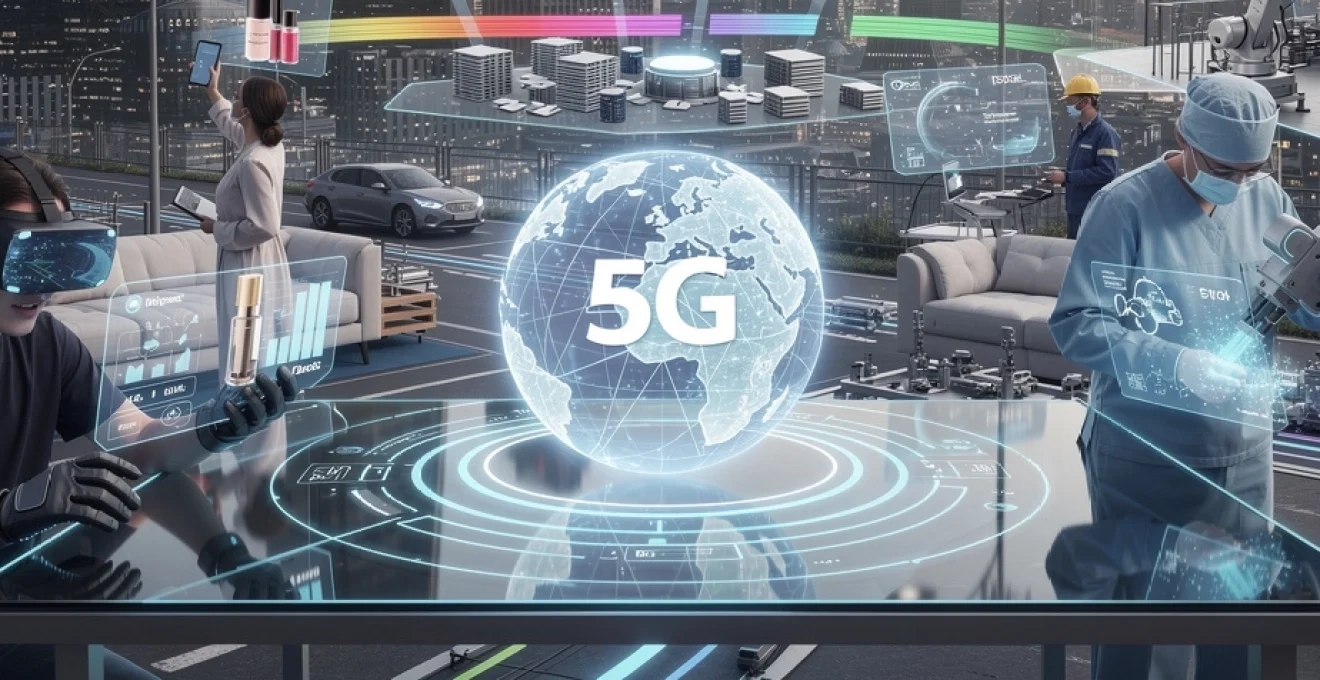
The digital landscape stands at the precipice of a revolutionary transformation. 5G technology has emerged as more than just an incremental upgrade from its predecessor—it represents a fundamental shift in how digital experiences are conceived, delivered, and consumed. With ultra-low latency capabilities, massive device connectivity potential, and unprecedented data throughput, 5G networks are reshaping the very foundation of real-time digital interactions across industries.
From autonomous vehicles making split-second decisions to surgeons performing delicate operations from thousands of miles away, the demands for instantaneous digital response have never been more critical. Traditional 4G networks, despite their remarkable achievements, simply cannot match the stringent requirements of modern real-time applications. The milliseconds that once seemed negligible now determine the difference between success and failure in mission-critical scenarios.
This technological leap forward affects every sector of the digital economy. Entertainment platforms are delivering immersive virtual reality experiences without buffering, manufacturing facilities are implementing real-time quality control systems, and healthcare providers are expanding telemedicine capabilities to previously unreachable populations. The convergence of 5G with edge computing, artificial intelligence, and Internet of Things technologies is creating an ecosystem where digital experiences feel truly instantaneous and seamlessly integrated into daily life.
5G network architecture and Ultra-Low latency performance metrics
The architectural revolution of 5G networks fundamentally reimagines how data flows through telecommunications infrastructure. Unlike previous generations that relied heavily on centralised processing, 5G implements a distributed approach that brings computational power closer to end users. This edge-first philosophy significantly reduces the physical distance data must travel, creating the foundation for ultra-low latency experiences that were previously impossible to achieve at scale.
Performance metrics for 5G networks demonstrate remarkable improvements over 4G LTE technology. Where 4G typically achieves latency figures between 30-50 milliseconds, 5G networks consistently deliver sub-10 millisecond latency, with theoretical minimums reaching as low as 1 millisecond under optimal conditions. These improvements aren’t merely theoretical—real-world deployments across major metropolitan areas have consistently demonstrated latency reductions of 75-80% compared to existing 4G infrastructure.
Millimetre wave spectrum utilisation in dense urban deployments
Millimetre wave (mmWave) spectrum represents one of 5G’s most significant technological advances, operating in frequency bands between 24-40 GHz. This high-frequency spectrum provides enormous bandwidth capacity—up to 2 GHz per channel—enabling data transmission speeds that can exceed 10 Gbps under ideal conditions. However, mmWave deployment requires careful consideration of propagation characteristics, as these signals experience significant attenuation when encountering physical obstacles.
Urban environments present unique challenges for mmWave implementation. Buildings, vehicles, and even atmospheric conditions can dramatically impact signal quality and coverage areas. Network operators address these challenges through dense small cell deployments, strategically positioning transmitters every 200-500 metres to ensure consistent coverage. This infrastructure-intensive approach requires substantial capital investment but delivers unparalleled performance for real-time applications in high-density areas.
Edge computing integration with Multi-Access edge computing (MEC) infrastructure
Multi-Access Edge Computing represents a paradigm shift in how processing power is distributed throughout telecommunications networks. By deploying computational resources at cell tower locations and regional data centres, MEC infrastructure reduces the round-trip time for data processing from hundreds of milliseconds to single digits. This proximity-based approach proves essential for applications requiring immediate response, such as autonomous vehicle coordination and industrial automation systems.
The integration of edge computing with 5G networks creates a powerful synergy. Processing tasks that traditionally required transmission to distant cloud servers can now be handled locally, dramatically reducing latency whilst maintaining the sophisticated computational capabilities needed for complex real-time applications. This distributed processing model also enhances network resilience by reducing dependency on centralised infrastructure that could become bottlenecks during high-demand periods.
Network slicing capabilities for Application-Specific performance guarantees
Network slicing technology allows operators to create virtualised network segments optimised for specific use cases and performance requirements. Each slice functions as an independent network with dedicated resources, quality of service parameters, and security policies. This capability proves crucial for ensuring that mission-critical applications receive guaranteed
priority access to bandwidth, ultra-low latency, and assured reliability. For example, an automotive manufacturer might run autonomous driving communications on a ultra-reliable low-latency communication (URLLC) slice, while infotainment services use a separate enhanced mobile broadband slice. By logically isolating traffic in this way, operators can prevent bandwidth-hungry consumer applications from impacting mission-critical real-time services, even when both share the same physical infrastructure.
From a business perspective, network slicing unlocks new service models and monetisation opportunities. Enterprises can contract bespoke slices tailored to their real-time digital experiences, with service-level agreements specifying maximum latency, jitter, and packet loss. This shift from best-effort connectivity to guaranteed performance transforms 5G from a commodity network into a platform for differentiated digital services, particularly in sectors like healthcare, logistics, and smart manufacturing.
Beamforming technology and massive MIMO implementation standards
Beamforming and Massive Multiple-Input Multiple-Output (Massive MIMO) technologies are central to the performance gains we associate with 5G. Rather than broadcasting signals uniformly in all directions, beamforming focuses radio energy into highly directional beams that track individual users or devices. This targeted approach improves signal strength, reduces interference, and enhances the stability of real-time digital experiences, especially in congested environments such as stadiums or transport hubs.
Massive MIMO builds on this by deploying dozens, or even hundreds, of antenna elements at each base station. By dynamically coordinating these antennas, 5G networks can serve many users simultaneously, each with optimised throughput and latency. Current 3GPP standards (Release 15 and beyond) define how these technologies interoperate to support advanced 5G features, including multi-user MIMO and coordinated multipoint transmission. The result is a radio environment where real-time applications—from AR navigation to live cloud gaming—receive consistent, high-quality connectivity even when thousands of devices compete for bandwidth.
Real-time gaming and interactive media transformation through 5G
Few domains showcase the impact of 5G on real-time digital experiences as clearly as gaming and interactive media. Latency-sensitive activities such as competitive multiplayer games, cloud-rendered graphics, and live interactive streams depend on split-second responsiveness. With 5G’s enhanced mobile broadband and URLLC capabilities, these experiences become more immersive, more accessible, and far less constrained by local hardware limitations.
As bandwidth and latency barriers fall, processing tasks increasingly shift from the device to the cloud or network edge. This transition allows richer graphics, larger game worlds, and more complex interactions without requiring high-end consoles or PCs in the user’s home. For content creators and media platforms, 5G connectivity opens new formats—from interactive shows to multi-perspective live events—that respond to viewer input in real time. The line between player and spectator blurs, creating a more participatory digital culture.
Cloud gaming platforms: google stadia and NVIDIA GeForce now latency optimisation
Cloud gaming platforms such as Google Stadia and NVIDIA GeForce Now illustrate how 5G transforms real-time gameplay. Instead of rendering graphics on local hardware, these services process game logic and visuals in remote data centres, streaming the resulting video to users much like a movie. The challenge is that any delay between player input and on-screen response can break immersion, particularly in fast-paced genres like shooters or racing games.
5G addresses this through a combination of higher bandwidth and reduced latency, especially when paired with edge computing. By placing game servers closer to major population centres, providers can cut round-trip times to the 10–20 millisecond range, approaching the responsiveness of local consoles. Adaptive bitrate streaming, predictive input algorithms, and transport protocols optimised for wireless networks further refine the experience. For players, this means console-quality gaming on smartphones and tablets, even over mobile networks, without the traditional compromises associated with cloud gaming on 4G.
Augmented reality applications in retail: IKEA place and sephora virtual artist
Retail is another sector where 5G-enabled real-time AR experiences are reshaping customer expectations. Applications like IKEA Place allow users to visualise furniture at scale in their homes, while Sephora Virtual Artist overlays cosmetics on live video of a user’s face. These experiences rely on accurate tracking, high-resolution graphics, and continuous communication with cloud-based AI models—requirements that strain older networks.
With 5G, AR data—such as 3D object models, facial mapping, or environmental scans—can be processed and streamed far more efficiently. Edge servers can handle computationally intensive tasks like object recognition or lighting estimation, returning results quickly enough to keep overlays stable and lifelike. As a result, retail brands can roll out more complex AR catalogues, multi-user AR showrooms, and personalised recommendations that update in real time as customers interact with products. For shoppers, this feels less like browsing a static catalogue and more like engaging with a digital showroom layered seamlessly onto the physical world.
Virtual reality streaming: oculus quest and HTC vive wireless performance
Virtual Reality is particularly sensitive to latency because any delay between head movement and visual update can cause discomfort or motion sickness. Wireless VR headsets such as Oculus Quest and HTC Vive in wireless mode depend on rapid delivery of high-resolution video frames, often at 90 Hz or higher, to maintain immersion. On Wi-Fi or 4G, bandwidth constraints and jitter can cause artefacts, dropped frames, or compression that degrades the experience.
5G’s high throughput and low-latency characteristics significantly improve wireless VR streaming, especially when combined with local edge rendering. Instead of tethering to a powerful PC, a headset can offload rendering to a nearby edge server or cloud GPU, receiving a compressed stream with minimal delay. This approach reduces the weight and cost of headsets while enabling more graphically demanding VR environments. In practical terms, users gain freedom of movement and higher visual fidelity, making enterprise VR training, remote collaboration, and immersive entertainment more viable at scale.
Interactive live streaming: twitch and YouTube gaming sub-20ms response times
Interactive live streaming platforms like Twitch and YouTube Gaming are evolving from one-way broadcasts into participatory environments. Features such as real-time polls, audience-triggered events, and interactive overlays demand rapid two-way data exchange between viewers, streamers, and backend services. On traditional networks, latency of 5–15 seconds is common, limiting the scope for genuine interactivity.
By leveraging 5G connectivity and low-latency streaming protocols, platforms can push end-to-end delays down towards the sub-20 millisecond range for specific interactive features. This does not mean the entire video stream arrives in 20 ms, but control signals, chat messages, and interaction triggers can be processed almost instantly. Imagine a live concert where you vote on the next song and see the result on stage within a heartbeat, or an esports tournament where viewers influence in-game conditions in real time. As these capabilities mature, content creators gain powerful new tools to engage audiences and monetise live digital experiences.
Industrial internet of things (IIoT) and Mission-Critical applications
Beyond entertainment, 5G is a cornerstone of the Industrial Internet of Things and mission-critical systems. In these environments, real-time data is not just convenient—it is essential for safety, efficiency, and regulatory compliance. Whether coordinating robot fleets on factory floors or orchestrating energy distribution across smart grids, organisations need deterministic network behaviour rather than best-effort connectivity.
The combination of URLLC, massive machine-type communications, and network slicing allows 5G to meet stringent industrial requirements. Compared with legacy fieldbuses or Wi-Fi-based solutions, 5G offers wider coverage, greater device density, and better mobility support. For decision-makers, this raises an important question: how can existing operational technology integrate with these new capabilities without disrupting critical processes? The answer lies in carefully planned pilot projects, hybrid architectures, and close collaboration between IT and OT teams.
Autonomous vehicle communication: Vehicle-to-Everything (V2X) protocol implementation
Autonomous and connected vehicles depend on Vehicle-to-Everything (V2X) communication to exchange information with other cars, infrastructure, and pedestrians. Standards such as Cellular V2X (C-V2X) leverage 5G networks to support low-latency, high-reliability messaging about road conditions, traffic signals, and potential hazards. In a complex urban environment, a fraction of a second can mean the difference between a smooth lane change and a collision.
5G V2X implementations enable cooperative perception, where vehicles share sensor data to extend each other’s situational awareness beyond line of sight. For instance, a car could receive an alert about a sudden brake event several vehicles ahead or a pedestrian stepping into the road at the next intersection. Network slices dedicated to automotive traffic ensure that these messages are prioritised, even when consumer data loads peak. As pilots in Europe, China, and North America expand, we move closer to road networks where vehicles function as coordinated nodes in a real-time digital ecosystem.
Smart manufacturing: siemens digital factory and bosch industry 4.0 solutions
In smart factories, 5G-enabled IIoT platforms from companies such as Siemens and Bosch support highly flexible, data-driven production lines. Wireless connectivity for sensors, actuators, and autonomous mobile robots reduces reliance on fixed cabling, making it easier to reconfigure layouts as product mixes change. Real-time data from machines can be analysed at the edge to detect anomalies, predict maintenance needs, and optimise throughput on the fly.
Siemens’ Digital Factory initiatives and Bosch’s Industry 4.0 solutions demonstrate how 5G can underpin closed-loop control systems with millisecond-level responsiveness. For example, machine vision cameras connected over 5G can inspect products in real time, triggering immediate adjustments when defects are detected. This is akin to giving a production line a nervous system that reacts instantly to stimuli rather than waiting for periodic human checks. The result is higher quality, less downtime, and a more agile manufacturing environment capable of mass customisation.
Remote surgery applications: haptic feedback systems and telemedicine platforms
Telemedicine has existed for years, but 5G elevates it to a new level by supporting real-time remote surgery and advanced diagnostics. Surgeons operating robotic instruments thousands of kilometres away must receive immediate visual and haptic feedback; any noticeable lag can compromise precision. 5G’s URLLC capabilities, often combined with dedicated slices and MEC, provide the low and stable latency required for such procedures.
Haptic feedback systems, which transmit tactile sensations back to the surgeon, particularly benefit from 5G’s consistency. When pressure or resistance changes are conveyed without perceivable delay, remote operations can approach the fidelity of in-person surgery. Meanwhile, telemedicine platforms can stream ultra-high-resolution imaging to specialists, enabling collaborative diagnosis in real time. For rural or underserved regions, these advancements can dramatically expand access to specialised care without the need for patients to travel long distances.
Smart grid management: real-time energy distribution and load balancing
Modern power grids are evolving into smart, highly instrumented networks that rely on real-time data to balance supply and demand. 5G connects distributed energy resources—such as solar panels, wind farms, and battery storage systems—with control centres that orchestrate energy flows. By continuously monitoring consumption patterns and grid conditions, operators can react quickly to fluctuations, reducing the risk of blackouts and making better use of renewable sources.
Real-time digital experiences in the energy sector extend to consumer-facing applications as well. Smart meters and connected home devices can respond dynamically to price signals or grid stress, adjusting consumption in near real time. For example, an electric vehicle could automatically delay charging during a peak demand event, then resume when renewable generation is high. This level of coordination requires secure, low-latency communication across millions of endpoints—precisely the type of scenario 5G was designed to support.
Enhanced mobile broadband applications in enterprise environments
Enterprises are also capitalising on 5G’s enhanced mobile broadband to transform how employees work and how services are delivered. Private 5G networks deployed within corporate campuses, ports, or logistics hubs provide dedicated capacity and predictable performance, often outperforming traditional Wi-Fi in coverage and reliability. These networks can support bandwidth-intensive activities such as real-time video analytics, immersive training, and collaborative design.
For knowledge workers, 5G enables high-quality video conferencing, virtual desktops, and cloud-based applications with minimal latency, even on the move. Design teams can work with large CAD models streamed from central repositories, while field engineers use AR headsets to receive real-time guidance from remote experts. In many ways, 5G turns the enterprise network into an always-on, high-speed fabric that follows employees wherever they go, rather than confining advanced capabilities to fixed office locations.
Network security implications for Ultra-Reliable Low-Latency communications (URLLC)
As 5G supports more mission-critical real-time digital experiences, the security stakes increase dramatically. URLLC traffic often carries sensitive control signals for autonomous systems, medical devices, or critical infrastructure. Any compromise—whether through data tampering, eavesdropping, or denial-of-service attacks—can have immediate physical consequences. Security mechanisms must therefore be robust without introducing latency that undermines URLLC performance.
5G standards incorporate enhanced encryption, mutual authentication, and integrity protection, but implementation details vary between operators and vendors. Edge computing adds another layer of complexity, as data is processed closer to users across a distributed landscape of micro data centres. To manage this, enterprises need a holistic approach that includes zero-trust architectures, rigorous identity and access management, and continuous monitoring for anomalous behaviour. In practice, this means designing security in from the outset rather than bolting it on later—a mindset shift for many organisations accustomed to treating connectivity as a lower-risk domain.
Future convergence: 6G research and Beyond-5G technology roadmap
While 5G is still in the rollout and optimisation phase, research communities are already exploring what comes next. Early visions of 6G suggest terahertz-frequency communication, even lower latency—possibly approaching microsecond scales—and deeper integration with AI at every layer of the network. Where 5G focuses on connecting devices and enabling real-time digital experiences, 6G aims to blend physical, digital, and biological systems into a more unified fabric.
Beyond-5G roadmaps highlight convergence between satellite constellations, terrestrial 5G/6G networks, and local connectivity solutions to deliver truly ubiquitous coverage. For users, this could mean seamless real-time interactions whether in dense cities, at sea, or in remote rural areas. For developers and enterprises, the challenge will be to design applications flexible enough to exploit these evolving capabilities without locking into transient technologies. By understanding 5G’s impact today and keeping an eye on emerging standards, we can better prepare for a future where real-time digital experiences are not the exception but the default mode of interaction.