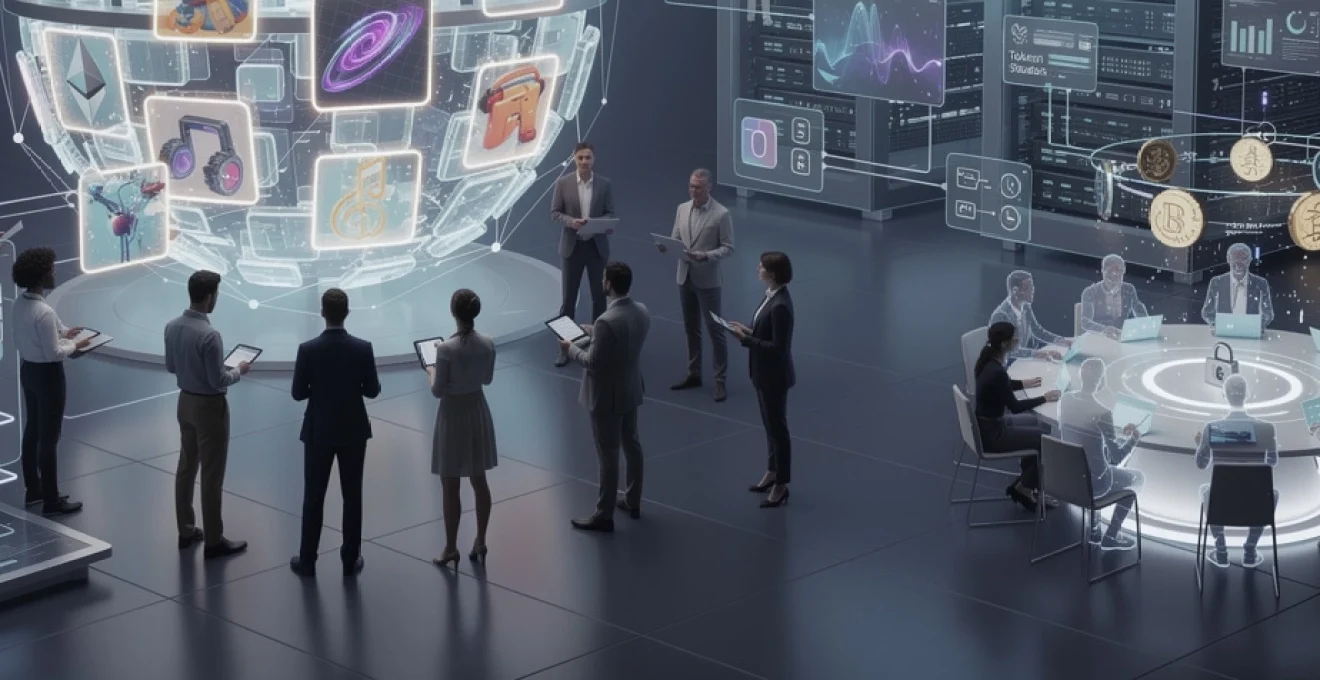
The concept of ownership has undergone a fundamental transformation in the digital age. Where traditional ownership once required physical possession and legal documentation, today’s digital landscape presents entirely new paradigms for acquiring, maintaining, and transferring rights to assets. From blockchain-powered tokenisation to sophisticated cloud-based licensing systems, the mechanisms governing digital ownership are reshaping entire industries and challenging long-established legal frameworks.
This evolution represents more than just technological advancement—it signals a complete reimagining of how value is created, stored, and exchanged in our increasingly connected world. The implications extend far beyond simple file sharing or software licensing, encompassing everything from digital art authentication to decentralised governance structures that operate without traditional corporate oversight.
Blockchain-based asset tokenisation and smart contract ownership
Blockchain technology has fundamentally altered the landscape of digital ownership by introducing verifiable scarcity and immutable proof of ownership. Unlike traditional digital assets that can be infinitely copied without degradation, blockchain-based systems create unique, tamper-proof records that establish clear ownership chains. This innovation addresses one of the most persistent challenges in digital commerce: proving authenticity and ownership in an environment where duplication is trivially easy.
The tokenisation process converts rights to both digital and physical assets into blockchain tokens, enabling fractional ownership and global liquidity. Real estate properties, intellectual property rights, and even revenue streams from creative works can now be divided into tradeable units. This democratisation of ownership has opened investment opportunities previously available only to institutional investors or high-net-worth individuals.
Non-fungible token (NFT) mechanisms in digital art and collectibles
Non-Fungible Tokens represent perhaps the most visible application of blockchain ownership technology. These unique digital certificates provide verifiable proof of ownership for digital assets, transforming how artists, collectors, and institutions approach digital art markets. The NFT mechanism creates artificial scarcity in digital environments by establishing canonical versions of otherwise infinitely reproducible content.
Beyond simple ownership verification, NFTs enable sophisticated royalty systems that automatically compensate original creators on secondary sales. This perpetual revenue stream represents a significant departure from traditional art markets, where artists typically receive compensation only on initial sales. The programmable nature of NFT smart contracts allows for complex arrangements including revenue sharing, access rights, and even governance participation.
Ethereum ERC-721 and ERC-1155 token standards implementation
The technical foundation of NFT ownership relies heavily on established token standards, with ERC-721 and ERC-1155 representing the most widely adopted protocols. ERC-721 tokens are completely unique, making them ideal for representing one-of-a-kind assets like digital artwork or virtual real estate. Each token contains distinct metadata and cannot be exchanged on a like-for-like basis with another token.
ERC-1155 offers greater flexibility by supporting both fungible and non-fungible tokens within a single smart contract. This hybrid approach reduces gas costs and enables more complex ownership structures, particularly valuable for gaming applications where both unique items and currencies coexist. The standard allows batch transfers and multi-token support, significantly improving efficiency for platforms managing diverse digital asset portfolios.
Smart contract escrow systems for decentralised ownership transfer
Smart contract escrow systems eliminate the need for trusted third parties in ownership transfers by automatically executing transactions when predetermined conditions are met. These systems encode the terms of ownership transfer directly into blockchain code, ensuring that assets change hands only when all parties fulfill their obligations. The elimination of intermediaries reduces costs whilst increasing transaction speed and transparency.
Multi-signature escrow contracts require approval from multiple parties before releasing assets, providing additional security for high-value transactions. Time-locked escrows can hold assets until specific dates, enabling complex financial instruments like vesting schedules or delayed ownership transfers. These mechanisms have proven particularly valuable in decentralised finance applications where traditional banking relationships may be impractical or impossible.
Fractional ownership through DeFi protocols and asset splitting
Decentralised Finance protocols have pioneered innovative approaches to fractional ownership that extend far beyond traditional shareholding models. By splitting valuable assets into numerous tradeable tokens, DeFi platforms enable collective ownership of everything from expensive NFTs to real estate properties. This fractionalisation dramatically lowers entry barriers whilst maintaining proportional rights and benefits for all token
holders. Because each fraction is recorded on-chain, investors can trade their portions on secondary markets, use them as collateral in lending protocols, or bundle them into index-style products. For creators and asset owners, this architecture unlocks new financing options, such as selling a percentage of future revenue streams while retaining control over the underlying asset. It also raises important governance questions: who decides when to sell, upgrade, or retire a fractionally owned asset, and how are those decisions enforced in a decentralised context?
To address these challenges, many DeFi platforms combine fractional ownership with governance tokens or on-chain voting mechanisms that give participants a say in major decisions. In practice, this means that owning a fraction is not just a passive investment; it often includes rights to propose or vote on changes to the asset’s parameters or utilisation. As regulatory clarity improves, we are likely to see more institutional-grade tokenisation of real estate, funds, and intellectual property, offering you exposure to diversified portfolios that were once reserved for large players.
Software-as-a-service (SaaS) and cloud-based digital rights management
While blockchain focuses on decentralised digital ownership, the SaaS ecosystem has been redefining ownership within centralised, cloud-based environments. Instead of buying perpetual licenses, businesses and individuals increasingly subscribe to software and content services on a monthly or annual basis. This shift from product to subscription has profound implications for how we think about ownership: access becomes the key value, while control over the underlying software remains firmly with the provider. In many ways, SaaS represents the opposite end of the spectrum from permissionless blockchains, yet both models coexist and shape the digital economy.
Cloud-based digital rights management (DRM) sits at the core of this new subscription paradigm. By tightly coupling user identities, device fingerprints, and usage policies with cloud infrastructure, providers can fine-tune who can access which features, from where, and under what conditions. For you as a user, this means a smoother experience—automatic updates, cross-device syncing, and integrated collaboration—balanced against less direct control over the software and content you rely on.
Adobe creative cloud and microsoft 365 subscription-based licensing models
Adobe Creative Cloud and Microsoft 365 are two of the most prominent examples of subscription-based digital ownership models in practice. Instead of selling boxed software with perpetual keys, both companies now license access to continuously updated application suites delivered via the cloud. Your entitlement is tied to your account, not to a physical copy or a one-time activation code, which allows you to install and use the software across multiple devices—within the limits of your plan.
This model gives vendors predictable recurring revenue and improves their ability to deliver security fixes and new features at scale. For users and organisations, the benefits include reduced upfront costs, better collaboration tools, and access to a wider range of applications and cloud storage. However, it also creates a dependency on the provider’s continued operation and policy decisions: if a subscription lapses or terms change, access can be withdrawn instantly. In this sense, “owning” productivity software today often means leasing time-limited rights rather than holding a permanent asset.
Digital rights management (DRM) integration with cloudflare and AWS services
Modern DRM systems rarely operate in isolation; instead, they are deeply integrated with cloud platforms like Amazon Web Services (AWS) and content delivery networks such as Cloudflare. These infrastructures help enforce licensing rules at scale by controlling how and where digital content is delivered. For example, streaming platforms use encrypted media extensions combined with DRM license servers hosted on AWS to ensure that only authorised users can decrypt and view content, even if the raw media files are widely cached across global edge nodes.
Cloudflare and similar providers add another layer of control by managing traffic, applying geofencing, and throttling or blocking suspicious activity in real time. From an ownership perspective, this creates a highly managed environment where your rights to view or interact with digital content are continuously validated against central policies. While this approach reduces piracy and helps rights holders protect revenue, it also illustrates how cloud-based DRM can limit the traditional notion of possession—access can be geographically restricted, time-limited, or revoked at the flick of a configuration switch.
Multi-tenant architecture and user access control lists (ACLs)
SaaS applications are typically built on multi-tenant architectures, where a single instance of the software serves many customers while logically separating their data. Ownership in this context is defined less by physical infrastructure and more by isolation guarantees and access policies. Each tenant’s resources—databases, file stores, and configurations—are segmented by design, but they all share the same codebase, deployment pipelines, and often the same hardware. This allows providers to scale efficiently while still offering customisable experiences and service-level agreements.
User access control lists (ACLs) sit at the heart of this model, dictating who can see or modify specific data or features within a tenant’s environment. Fine-grained ACLs might distinguish between administrators, editors, viewers, and external collaborators, each with different rights and responsibilities. For your organisation, effectively configuring ACLs is critical: misconfigurations can lead to either excessive restriction that hampers productivity or excessive openness that exposes sensitive data. In a very real sense, ACLs become the practical expression of digital ownership—deciding which individuals or roles “own” the ability to read, write, or delete particular resources.
Api-driven licensing verification and usage monitoring systems
Behind the scenes, most modern digital ownership models depend on APIs that continuously verify licenses and monitor usage. When you log into a SaaS platform, play a licensed video, or activate a premium plugin, the client application typically calls a licensing API to confirm your entitlements. These APIs return granular data: which features you can access, how many seats are available, and whether usage limits have been exceeded. If the checks fail—perhaps due to a cancelled subscription or suspected fraud—access can be downgraded or blocked automatically.
Usage monitoring systems extend this logic by collecting telemetry on how, when, and where digital products are consumed. For vendors, this information supports billing, capacity planning, and product development; for you, it can influence pricing tiers, personalised recommendations, or compliance audits. The trade-off is clear: richer, more adaptive services at the cost of continuous oversight. As digital ownership evolves, API-driven verification blurs the line between mere access control and ongoing behavioural analysis, raising important questions about privacy and data governance.
Decentralised autonomous organisation (DAO) governance structures
As digital assets become more complex and widely distributed, governance—who decides what—emerges as a core dimension of ownership. Decentralised autonomous organisations (DAOs) offer a radically different governance model from traditional corporations. Instead of relying on boards and executives, DAOs encode rules in smart contracts and distribute decision-making power among token holders. In effect, ownership of governance tokens translates into a direct voice in how a protocol or community treasury is managed.
This structure aligns incentives in novel ways. Contributors, users, and investors can all participate in governance according to their stake, rather than being separated into rigid categories. At the same time, DAOs face their own challenges: voter apathy, concentration of power among large holders, and regulatory uncertainty about how such entities should be classified. As we move further into a tokenised future, understanding DAO governance becomes essential for anyone participating in decentralised digital ownership.
Makerdao and compound protocol community-driven asset management
MakerDAO and Compound are two of the earliest and most influential examples of DAO-governed asset management protocols. MakerDAO oversees the DAI stablecoin, which is backed by collateral locked in smart contracts. Governance token holders propose and vote on key parameters, such as collateral types, stability fees, and risk frameworks. In practice, this means the community collectively determines how the system maintains its peg and manages risk, rather than a central bank or corporate treasury department.
Compound follows a similar model for decentralised lending and borrowing. Holders of the COMP governance token can vote on interest rate models, asset listings, and protocol upgrades. For users, this results in a financial platform whose rules are transparent and, at least in theory, responsive to community preferences. But it also illustrates the complexity of community-driven ownership: voters must understand technical, economic, and security implications, and the protocol’s health depends on informed, active participation instead of top-down directives.
Voting mechanisms through governance tokens and quadratic voting
Most DAOs rely on governance tokens as the primary mechanism for distributing voting power. In a simple “one token, one vote” system, influence scales linearly with token holdings, which can lead to plutocratic outcomes where large holders dominate decisions. To counter this, some projects experiment with alternative models like quadratic voting, where the cost of additional votes increases nonlinearly. This approach aims to give smaller stakeholders a stronger voice on issues they care deeply about, while making it expensive for wealthy participants to capture the process.
Implementing these voting systems on-chain introduces both transparency and friction. Proposals, vote counts, and outcomes are publicly verifiable, but participation requires a certain level of technical competence and willingness to manage private keys securely. To encourage engagement, many DAOs offer incentives such as token rewards for voting or delegating voting power to trusted representatives. As voting mechanisms evolve, they become a crucial component of digital ownership—governing not just who holds assets, but how those assets evolve over time.
Treasury management and multi-signature wallet implementation
A defining feature of many DAOs is the existence of a shared treasury that accumulates protocol fees, token sales proceeds, or other forms of revenue. Managing these funds securely and transparently is a central governance task. Multi-signature (multi-sig) wallets have become a standard tool for this purpose, requiring a predetermined number of authorised signers to approve any outgoing transaction. This reduces the risk of a single compromised key draining the entire treasury and introduces checks and balances among core contributors.
Advanced DAOs combine multi-sig wallets with on-chain governance, where successful votes trigger or authorise specific treasury actions. For example, a community might approve grants to developers, fund marketing initiatives, or allocate capital to yield-generating strategies, all enforced programmatically. For participants, this creates a new form of collective digital ownership: you may not “own” the treasury individually, but your governance rights influence how it is deployed. The effectiveness of this model depends heavily on transparency, robust security practices, and clear processes for onboarding and rotating signers.
Intellectual property rights in metaverse environments
As metaverse platforms and immersive virtual worlds gain traction, intellectual property (IP) law is being tested in ways that traditional frameworks never anticipated. Virtual land, digital fashion, 3D objects, and avatar identities all raise questions about who owns what and under which jurisdiction. When you purchase a virtual plot or a wearable item, are you acquiring full ownership, a limited-use license, or something in between? The answer often depends on the platform’s terms of service, rather than on any universally accepted legal standard.
In many metaverse ecosystems, IP rights are layered. The platform operator may own the underlying engine and world assets, creators may retain rights to their designs, and end users may hold usage rights tied to their accounts or wallets. Blockchain-based assets such as NFTs add another dimension by enabling provable scarcity and transferability across platforms, at least in principle. This creates tension between open, interoperable digital ownership and closed, platform-specific licensing—a tension that courts and regulators are only beginning to address.
Brands entering the metaverse are already using these environments to extend trademarks and copyrights into new digital formats. Virtual sneakers, art galleries, and branded experiences rely on existing IP protections while experimenting with new revenue models like limited-edition drops and token-gated access. At the same time, infringement risks are high: unauthorised replicas, parody items, and unlicensed uses of logos or characters can proliferate quickly in user-generated worlds. For creators and businesses alike, understanding how to register, license, and enforce IP in these spaces becomes a critical part of managing digital ownership.
From a user perspective, it is important to recognise that metaverse “ownership” is often contingent on both blockchain records and platform rules. Even if you hold an NFT representing a virtual asset, the platform could theoretically restrict its in-world functionality or visibility. This dual dependency is akin to owning a car but relying on city infrastructure for roads and parking: you control the vehicle, but the environment in which you use it is regulated by others. As standards for interoperability and digital property rights evolve, we may see stronger guarantees that your virtual assets remain usable across multiple worlds, reducing reliance on any single platform.
Regulatory frameworks and legal challenges in digital asset classification
The rapid expansion of digital assets has outpaced the development of clear, harmonised regulatory frameworks. Governments and supervisory bodies around the world are wrestling with fundamental classification questions: when is a token a security, a commodity, a payment instrument, or simply a digital collectible? The answer has profound consequences for issuers, platforms, and investors, influencing everything from disclosure requirements and taxation to consumer protection rules. Inconsistent interpretations across jurisdictions further complicate matters for global projects and users.
Regulators have begun to issue guidance, but much remains unsettled. In some regions, NFTs are treated primarily as digital memorabilia, subject to general consumer law rather than securities regulation, unless they confer profit rights or resemble investment contracts. Utility tokens that grant access to a service may be classified differently from governance tokens that influence protocol decisions, even if they are technically similar. For you as a participant in this space, staying informed about evolving legal definitions is essential to managing risk and complying with reporting obligations.
Legal challenges also arise around taxation, anti-money laundering (AML) compliance, and cross-border enforcement. Should each token trade be treated as a taxable event? How do platforms implement know-your-customer (KYC) checks without undermining the pseudonymous nature of blockchain systems? And what happens when disputes over digital ownership span multiple legal systems with conflicting rules? These questions are far from theoretical—court cases around lost keys, hacked wallets, and disputed NFT rights are already shaping precedents that will influence future regulation.
In response, many projects are proactively engaging with regulators, adopting compliance tools, and experimenting with hybrid models that blend decentralised infrastructure with regulated front-ends. We are also seeing the emergence of industry standards bodies and self-regulatory organisations aimed at defining best practices for token issuance, custody, and disclosure. Over time, a more mature legal and regulatory environment should provide greater clarity and protection, helping digital ownership move from experimental edges into the mainstream. Until then, navigating this landscape requires a cautious, well-informed approach, balancing the innovative potential of new ownership models against the realities of legal and regulatory risk.