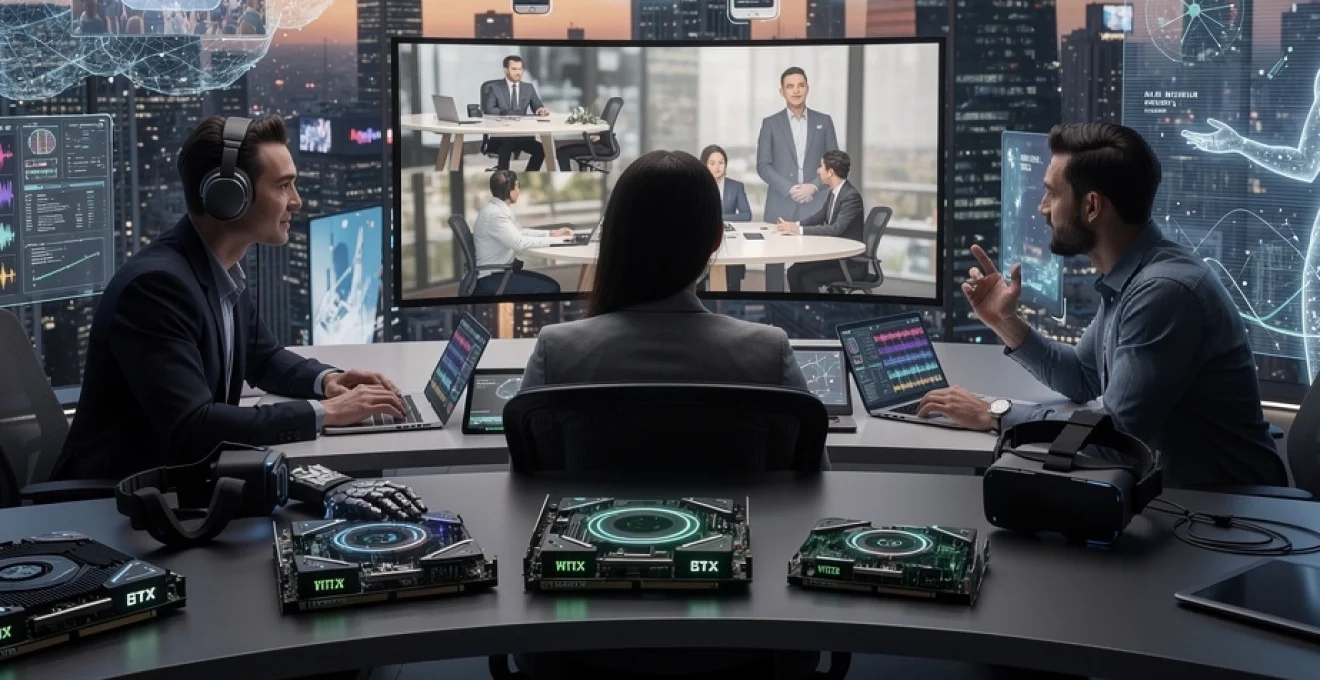
The digital content landscape stands at the precipice of a revolutionary transformation. Synthetic media, powered by sophisticated artificial intelligence algorithms, is reshaping how we conceive, produce, and consume visual and auditory content across industries. From Hollywood blockbusters featuring entirely AI-generated backgrounds to corporate training videos with virtual presenters speaking dozens of languages, this technology is moving beyond experimental curiosity into mainstream adoption.
The convergence of advanced machine learning architectures, powerful computing infrastructure, and growing market demand has created an unprecedented opportunity for content creators. As traditional production workflows face increasing cost pressures and time constraints, synthetic media offers a compelling alternative that promises to democratise high-quality content creation while opening entirely new creative possibilities.
Deep learning architectures powering synthetic media generation
The foundation of modern synthetic media rests upon sophisticated neural network architectures that have evolved dramatically over the past decade. These deep learning frameworks serve as the computational backbone enabling machines to generate increasingly realistic and contextually appropriate content across multiple media types.
The advancement of these architectures represents more than mere technological progress; it signifies a fundamental shift in how machines understand and replicate human creativity. Each neural network type brings unique strengths to the synthetic media ecosystem, contributing to different aspects of content generation from visual fidelity to temporal coherence.
Generative adversarial networks (GANs) in video synthesis
Generative Adversarial Networks have emerged as the cornerstone technology for creating realistic synthetic video content. These dual-network systems pit a generator against a discriminator in a continuous adversarial process, resulting in progressively more convincing synthetic content. The generator creates fake content whilst the discriminator attempts to identify artificial elements, driving both networks towards higher performance levels.
Modern video synthesis applications leverage StyleGAN3 and its derivatives to produce face-swapped content with remarkable temporal consistency. The architecture’s ability to maintain identity features across video frames whilst adapting facial expressions and movements has revolutionised applications ranging from film post-production to personalised marketing content. Recent implementations achieve frame rates of up to 30fps on consumer-grade hardware, making real-time video synthesis increasingly accessible.
Variational autoencoders (VAEs) for audio content creation
Variational Autoencoders excel in generating synthetic audio content by learning compressed representations of sound patterns and reconstructing them with controlled variations. Unlike GANs, VAEs provide more stable training processes and better control over the generated output’s characteristics, making them particularly suitable for applications requiring precise audio manipulation.
Contemporary VAE implementations in synthetic media focus on voice synthesis and music generation. WaveNet-based VAE architectures can now generate human speech that is virtually indistinguishable from natural recordings, whilst musical VAEs create compositions across various genres with controllable style parameters. The technology’s ability to interpolate between different audio characteristics enables smooth voice morphing and style transfer applications.
Transformer models and GPT-4 integration for Text-to-Media conversion
Transformer architectures have revolutionised the bridge between textual descriptions and visual content generation. These attention-based models excel at understanding complex relationships within sequential data, making them ideal for interpreting nuanced text prompts and translating them into visual or auditory outputs.
The integration of GPT-4 capabilities with image and video generation pipelines has created unprecedented opportunities for natural language-driven content creation. Users can now describe complex scenes, emotional contexts, and stylistic preferences in plain English, with the system generating corresponding visual content. This text-to-media conversion capability has reduced the technical barriers to content creation, enabling non-technical users to produce sophisticated multimedia content through conversational interfaces.
Diffusion models: DALL-E 2 and stable diffusion applications
Diffusion models represent the latest breakthrough in synthetic media generation, offering superior image quality and more controllable generation processes compared to earlier architectures. These models work by gradually adding noise to training data and then learning to reverse this process, resulting in highly detailed and contextually appropriate synthetic content.
DALL-E 2 and Stable Diffusion have demonstrated remarkable capabilities in generating photorealistic images from textual
DALL-E 2 and Stable Diffusion have demonstrated remarkable capabilities in generating photorealistic images from textual prompts, style references, or even rough sketches. For content creators, this means that mood boards, storyboards, and full production assets can be generated on demand without traditional photoshoots or illustration cycles. Advanced diffusion workflows now support inpainting and outpainting, enabling seamless object removal, background extension, and iterative refinement of creative concepts.
These diffusion-based systems are increasingly being embedded into mainstream creative tools and synthetic media platforms. Marketers can rapidly A/B test dozens of visual variations for a single campaign, while film and game studios use diffusion models for concept art, environment design, and pre-visualisation. As open-source ecosystems around Stable Diffusion mature, we are also seeing fine‑tuned models for specific industries—fashion, architecture, product design—allowing highly specialised image generation that aligns with brand guidelines and regulatory constraints.
Real-time synthetic media production workflows and pipelines
While model architectures define what synthetic media can generate, production workflows determine how quickly and reliably that content can be delivered at scale. Modern synthetic media pipelines blend high-performance hardware, optimised software stacks, and orchestration layers that manage everything from asset versioning to compliance checks. The result is a shift from batch-style rendering to near real-time synthetic content creation, where iterations can be tested and deployed within minutes.
In practice, this evolution mirrors the move from film to digital video production. Where creators once waited hours or days for rendering, they can now preview deepfake overlays, AI-generated avatars, and dynamic backgrounds synchronously with live capture. This real-time capability is especially important for interactive experiences such as virtual events, live commerce, and personalised learning, where latency and responsiveness directly impact user engagement and commercial outcomes.
GPU acceleration with NVIDIA RTX 4090 for live deepfake generation
At the heart of many advanced synthetic media workflows lies GPU acceleration, with consumer and prosumer cards like the NVIDIA RTX 4090 setting new performance benchmarks. With over 16,000 CUDA cores and dedicated Tensor cores, the 4090 can run complex GANs, diffusion models, and transformer pipelines at frame rates suitable for live deepfake generation and interactive avatars. This brings studio-grade capabilities into small production houses and even high-end home setups.
For example, a typical live face-swap pipeline might include facial landmark detection, real-time encoding and decoding, and neural rendering of expressions, all processed in under 30–50 milliseconds per frame. Leveraging mixed precision (FP16) and model quantisation techniques further boosts throughput without noticeably degrading visual quality. For content teams, this means you can host live webinars, virtual keynotes, or influencer streams where synthetic presenters respond to audiences in real time, rather than relying solely on pre-rendered assets.
Edge computing infrastructure for mobile synthetic content
As synthetic media experiences move onto smartphones, AR glasses, and IoT devices, edge computing becomes crucial. Running inference as close to the user as possible reduces bandwidth needs and latency, which is essential for mobile synthetic content such as AR filters, real-time translation overlays, or personalised advertising in retail environments. Smaller, optimised models—often distilled versions of larger networks—are deployed on edge accelerators like mobile GPUs or dedicated NPUs.
This edge-first strategy also has privacy and compliance benefits. Sensitive biometric data, such as facial features or voiceprints, can be processed locally rather than sent to central servers. For brands building future content creation workflows, a hybrid approach is emerging: heavy training and fine‑tuning in the cloud, with lean inference models pushed to edge devices for real-time interaction. The result is a consistent synthetic media experience that travels with the user across devices and contexts.
Cloud-based rendering services: AWS EC2 and google cloud AI platform
For more compute-intensive tasks—training custom models, generating large video batches, or running multi-camera virtual productions—cloud-based rendering services remain the backbone of synthetic media operations. AWS EC2 instances with A10G, A100, or H100 GPUs, and Google Cloud AI Platform with its TPU and GPU offerings, allow teams to scale generation capacity up or down based on campaign needs. Instead of investing in on-premise render farms, studios can rent thousands of GPU hours for peak production windows.
These cloud services increasingly provide managed ML pipelines, model registries, and MLOps features tailored to synthetic media. Automated deployment, versioning, and rollback enable rapid experimentation while maintaining governance over which models are authorised for commercial use. For enterprises, this translates into predictable costs, robust security controls, and the ability to integrate synthetic media generation directly into existing content management and digital asset management systems.
Latency optimisation techniques for interactive synthetic avatars
Interactive synthetic avatars—virtual presenters, customer service agents, or game characters—place tight constraints on end-to-end latency. To maintain a natural conversational flow, the full pipeline from user input to avatar response must often stay below 200 milliseconds. Achieving this involves a combination of model optimisation, smart caching, and network engineering techniques such as WebRTC and low-latency streaming protocols.
Developers compress avatar meshes, precompute common gesture sequences, and use streaming-friendly codecs to minimise bandwidth without sacrificing perceived quality. On the model side, techniques like knowledge distillation, pruning, and ONNX runtime optimisation reduce inference time. For content teams, the key takeaway is that realistic, responsive avatars are no longer a research novelty—they can be integrated into customer journeys today, from interactive FAQs to personalised onboarding experiences.
Industry applications and commercial implementation strategies
As synthetic media tools mature, we are seeing rapid adoption across film, streaming, corporate communications, e-learning, and social platforms. The most successful implementations share a common pattern: they focus on augmenting, not replacing, existing content creation workflows, and they pair technical innovation with clear business objectives. Whether the goal is to reduce production costs, localise content at scale, or unlock new formats, synthetic media is becoming a strategic asset rather than a side experiment.
For decision-makers, the question is no longer whether synthetic media will impact their industry, but how quickly they can build sustainable capabilities. This involves selecting the right platforms, designing ethical guardrails, and training creative teams to collaborate effectively with AI systems. Let’s look at how leading organisations are already deploying these technologies in production.
Netflix and disney+ utilising AI-generated background actors
Streaming giants such as Netflix and Disney+ are actively exploring AI-generated background actors and crowd simulations to streamline large-scale productions. Instead of hiring hundreds of extras for every crowd scene, studios can capture a smaller group of performers and then use GAN- and diffusion-driven pipelines to populate scenes with diverse, photorealistic digital doubles. This approach reduces logistical complexity and opens creative possibilities for scenes that would be impractical or unsafe to film in the real world.
Commercially, synthetic crowds also support rapid localisation and content repurposing. Background actors can be re-dressed, re-posed, or re-aged to fit different markets and narrative contexts without re-shooting. However, these innovations have triggered active negotiations with unions and guilds, pushing studios to adopt transparent consent, compensation, and usage agreements for scanned performers. Any brand considering synthetic humans in its content strategy must address similar labour and reputation implications from day one.
Meta’s horizon workrooms virtual presenter technology
In the enterprise collaboration space, Meta’s Horizon Workrooms illustrates how synthetic media can reshape remote meetings and events. Virtual presenter technology allows speakers to appear as expressive avatars that mirror facial expressions and gestures captured from VR headsets or webcams. This blend of real-time motion capture and neural rendering aims to reduce “Zoom fatigue” and create a more immersive sense of presence for distributed teams.
From a content creation standpoint, this means that presentations, training sessions, and town halls can be recorded once and repurposed as interactive assets. Avatars can be updated with new scripts, languages, or branding without re-recording the original performance. As we move toward more persistent virtual workspaces, you can expect synthetic presenters to become a standard element of internal communication strategies, particularly for onboarding, compliance training, and executive messaging.
Synthesia and hour one: enterprise video production platforms
Dedicated synthetic video platforms like Synthesia and Hour One have become central to many organisations’ content operations. These services offer AI avatars, multilingual voice synthesis, and browser-based editing, enabling teams to create professional training modules, product explainers, and HR announcements without cameras or studios. For companies producing hundreds of videos per year, the cost and time savings can be substantial—often reducing production cycles from weeks to hours.
Strategically, these tools shift the bottleneck from filming to scripting and distribution. Teams that previously struggled with “camera shyness” or dispersed subject matter experts can now iterate on scripts and instantly preview updated videos. To maximise impact, leading organisations create modular content templates, define brand-approved avatar and voice combinations, and integrate platform APIs into their LMS, CRM, or marketing automation stacks for automated, personalised video creation.
Adobe after effects integration with AI content generation tools
For professional post-production, synthetic media is increasingly embedded directly into existing creative suites. Adobe After Effects, for instance, now integrates with AI content generation tools for tasks such as rotoscoping, object removal, background replacement, and motion graphics generation. Through plugins and cloud services, editors can call diffusion models to generate textures, sky replacements, or stylised overlays without leaving their timeline.
This tight integration means that synthetic elements can be treated like any other layer in a composition, with full control over blending, keyframing, and colour grading. For agencies and studios, the practical advantage is clear: repetitive, time-consuming tasks are automated, freeing artists to focus on higher-level creative decisions. When implemented thoughtfully, these AI assistive features enhance, rather than diminish, the role of human editors and VFX artists in the content creation pipeline.
Ethical frameworks and regulatory compliance in synthetic media
The rapid proliferation of synthetic media has triggered intense debate about misinformation, privacy, and the future of trust online. Regulators in the EU, US, and beyond are moving toward stricter oversight of AI-generated content, while industry bodies publish voluntary codes of conduct. For organisations investing in synthetic content, building an ethical framework is not optional—it is a prerequisite for long-term viability and audience trust.
Effective governance typically spans four pillars: transparency, consent, accountability, and security. Transparency covers clear labelling of AI-generated or heavily manipulated content. Consent addresses how biometric data—faces, voices, and likenesses—are captured, stored, and re-used. Accountability defines who is responsible when synthetic media causes harm, while security focuses on preventing model theft, prompt injection, or dataset tampering. By codifying these principles into internal policies and vendor contracts, you can reduce legal risk and align with emerging regulatory norms.
Quality assurance and authenticity detection technologies
As synthetic media becomes more convincing, robust quality assurance and authenticity detection are essential to maintain both artistic standards and public trust. On the production side, QA teams evaluate visual and auditory fidelity, checking for artefacts, temporal inconsistencies, or uncanny valley effects that might undermine audience engagement. Automated testing frameworks can flag common issues such as lip‑sync mismatches, flickering textures, or distorted audio before assets go live.
On the verification side, a new generation of detection technologies is emerging to distinguish synthetic content from authentic footage. Techniques range from analysing subtle biological signals, such as micro‑variations in skin tone caused by blood flow, to examining inconsistencies in lighting, reflections, or speech patterns across frames. While no method is foolproof, combining multiple classifiers and maintaining up‑to‑date detection models significantly raises the bar for malicious actors attempting to spread deceptive deepfakes at scale.
Future market trajectories and investment opportunities in synthetic content
The synthetic media market is forecast to grow rapidly over the next decade, fuelled by demand for scalable content, hyper-personalised experiences, and cost-efficient production. Analysts project that spending on generative AI for media and entertainment alone will reach tens of billions of dollars annually by the early 2030s, with adjacent sectors such as education, healthcare, and e-commerce following closely. For investors and executives, the opportunity lies not just in core model providers, but in the application layers and vertical solutions built on top.
We can expect consolidation around key platforms that offer end-to-end synthetic content pipelines, alongside a vibrant ecosystem of niche providers specialising in areas like synthetic training data, AI localisation, or avatar customisation. At the same time, regulatory scrutiny and ethical expectations will reward companies that embed responsible AI practices into their products from the outset. For content-driven organisations, the strategic move is clear: start experimenting with synthetic media today, build internal literacy and governance, and position your teams to take advantage of a future where the boundary between “real” and “synthetic” content is increasingly fluid—but no less powerful.