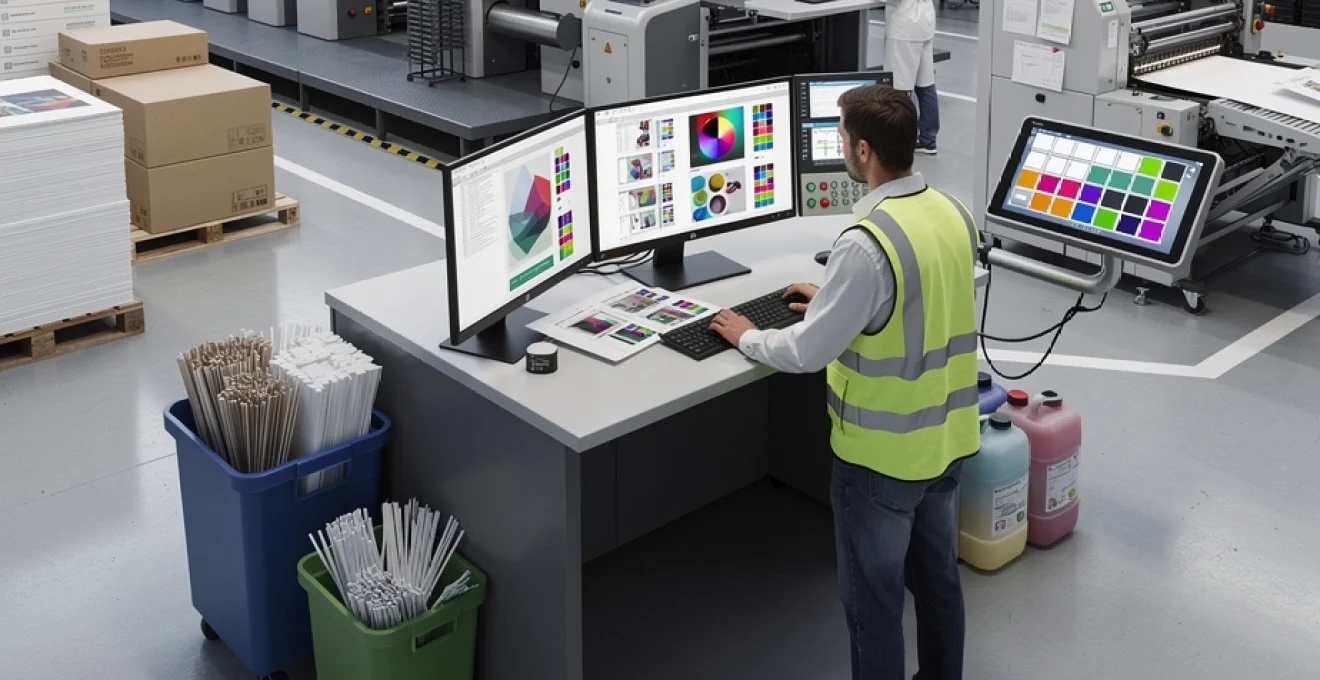
Print production facilities face mounting pressure to reduce waste while maintaining exacting quality standards. Rising substrate costs, environmental regulations, and client demands for sustainability have transformed operational priorities across the industry. Yet cutting waste need not mean compromising output quality—in fact, the most successful print operations demonstrate that efficiency improvements often enhance consistency and precision. Modern print businesses achieve remarkable waste reduction through strategic workflow optimisation, intelligent substrate procurement, advanced press configuration, and data-driven process control. The challenge lies not in choosing between economy and excellence, but in implementing systems that deliver both simultaneously.
Understanding the true cost of print waste extends beyond material expenses. Every spoiled sheet represents energy consumption, labour hours, machine wear, delivery delays, and environmental impact. Industry analysis indicates that typical commercial print operations waste between 12-18% of substrate during production runs, with smaller facilities often experiencing even higher loss rates. When you factor in ink, coating materials, plate remakes, and operator time, waste becomes one of the largest controllable expense categories. Addressing these inefficiencies requires systematic approaches that target waste at every production stage—from file preparation through bindery finishing.
Pre-press workflow optimisation through digital proofing systems
Pre-press operations represent the critical foundation where most production errors originate. Traditional proof-and-correct cycles consume substantial resources, generating repeated plate outputs, proof prints, and revision rounds that multiply waste throughout downstream processes. Digital workflow transformation eliminates much of this inefficiency through automated validation and remote collaboration tools that catch errors before they reach the press floor. Forward-thinking print facilities have reduced makeready waste by 40-60% through comprehensive pre-press standardisation.
Remote soft proofing with fogra39 and GRACoL colour standards
Calibrated soft proofing systems enable clients and production teams to evaluate colour accuracy on properly calibrated monitors rather than requiring physical proofs for every revision. Fogra39 (for European coated papers) and GRACoL (for North American standards) provide internationally recognised colour spaces that ensure predictable output when properly implemented. When your clients view PDFs through colour-managed applications on profiled displays, they see accurate representations of final printed appearance—eliminating multiple proof cycles that traditionally generated substantial substrate waste. Remote proofing also accelerates approval timelines, reducing rush charges and schedule pressure that often force premature press runs with inadequate preparation.
Implementing effective soft proofing requires investment in calibration hardware (typically £800-2,500 for quality spectrophotometers) and training stakeholders on colour-managed workflows. However, facilities report that eliminating just three contract proof cycles per week typically recovers this investment within four to six months. The environmental benefits prove equally compelling—a mid-sized commercial printer producing 50 proofs weekly saves approximately 2,600 sheets annually through soft proofing adoption, alongside associated ink, chemistry, and energy consumption.
Implementing automated preflight using enfocus PitStop and FlightCheck
Automated preflight software examines incoming files against defined specifications, identifying problems like missing fonts, incorrect colour spaces, insufficient bleed, and resolution issues before files enter production workflows. Enfocus PitStop and FlightCheck represent industry-standard solutions that can automatically correct many common problems whilst flagging issues requiring human intervention. These systems dramatically reduce the « oops moments » that generate waste—the découverte of a missing font halfway through a press run, or the realisation that supplied images won’t reproduce cleanly at the specified size.
Preflight automation integrates with modern job management systems, creating checkpoints that prevent problematic files from advancing until issues resolve. This systematic validation eliminates the traditional reactive approach where problems surface during plate output or press makeready. Facilities using comprehensive preflight report 65-75% reductions in plate remakes and a 40-50% decrease in customer service interventions for file-related issues. The time savings prove equally significant—automated preflight handles in minutes what might require hours of manual inspection, freeing skilled operators for higher-value tasks.
PDF/X-4 standards for transparent workflow efficiency
The PDF/X-4 standard supports transparency effects and layered content whilst maintaining predictable output characteristics. Unlike earlier PDF/X variants that required flattening
during export, PDF/X-4 allows you to retain live transparency right through to the RIP stage. This reduces the risk of artefacts, unexpected knockouts, or colour shifts that commonly arise from early flattening in design applications. By standardising on PDF/X-4 for all incoming and internally generated files, you maintain a consistent, device-independent workflow that behaves predictably across different RIPs and presses. The result is fewer test plates, fewer on-press surprises, and significantly less makeready waste.
From a waste reduction perspective, PDF/X-4 simplifies troubleshooting because you can focus on a single, well-understood standard rather than juggling multiple legacy file types. Many RIP vendors now optimise their engines around PDF/X-4, improving processing speeds and reducing RIP failures that previously led to aborted jobs and re-impositions. For clients, the requirement is simple: supply press-ready PDFs to a defined PDF/X-4 job ticket. For your team, the payoff is a streamlined, transparent workflow that keeps errors out of the pressroom and preserves high-quality print production without excess waste.
Reducing plate remakes through computer-to-plate calibration
Computer-to-plate (CtP) systems eliminated film, but they did not eliminate the need for careful calibration. Uncalibrated or drifting CtP devices are one of the most common causes of plate remakes and prolonged makeready, as tonal values on plate no longer match your target curves on press. By implementing regular linearisation and curve calibration—typically using plate control strips and a spectrophotometer—you ensure that the dots you image are the dots you expect. This tight control directly translates into faster colour attainment on press and fewer wasted sheets while chasing density and balance.
Best practice is to treat CtP calibration as a scheduled maintenance task, not an occasional rescue operation when colour issues arise. Weekly verification and monthly recalibration are common intervals in high-volume environments, with additional checks after chemistry changes or major service interventions. Shops that formalise this regime report plate remake reductions of 50% or more, alongside smoother press runs and fewer client-visible variations between reprints. In other words, robust CtP calibration is one of the simplest ways to cut waste and protect consistency across your entire print production workflow.
Substrate selection and procurement strategies for cost-effective production
Once files are stable, the next major lever for cutting waste without cutting quality is substrate strategy. Paper and board account for a substantial portion of total job cost, so every skid that ends up in the waste bay erodes your margin. Yet simply buying cheaper paper is rarely the answer; inconsistent stock can drive up makeready and rejection rates. The goal is to match substrate performance and sustainability credentials to each application while using procurement strategies that minimise both cost and obsolescence. Done well, this approach reduces offcuts, spoilage, and inventory write-offs without compromising print quality.
Fsc-certified paper grades: balancing environmental compliance with budget
Many brand owners now specify FSC-certified grades as a minimum requirement for marketing collateral and packaging. At first glance these substrates can appear more expensive than non-certified alternatives, but a closer look often tells a different story. When you standardise on a defined range of FSC-certified paper and board grades, you simplify press characterisation, reduce colour variability, and minimise the trial-and-error waste that accompanies constant stock changes. Consistent substrates also make it easier to hit ISO 12647-2 targets, which in turn reduces on-press adjustment and spoilage.
The key is to work with your merchants to identify a core portfolio of FSC-certified grades that cover 80–90% of your commercial work. By concentrating volume, you can negotiate pricing that closes much of the gap with non-certified stocks, while fulfilling customers’ environmental compliance requirements. In many cases, the reduction in waste and makeready time more than offsets any remaining price premium. You also gain a marketing advantage: you can position your print operation as a sustainability-focused partner without asking clients to compromise on visual quality or budget.
Bulk purchasing agreements with merchants like antalis and PaperCo
For most print businesses, substrate spend is fragmented across multiple grades, suppliers, and order cycles. This fragmentation increases administrative overhead and weakens your negotiating position. Structured bulk purchasing agreements with major merchants such as Antalis or PaperCo bring order to this chaos. By committing forecast volumes across a defined SKU list, you can secure better pricing, preferential availability, and sometimes vendor-managed inventory that reduces the risk of last-minute substitutions—the kind of substitutions that often lead to unexpected waste in print production.
Bulk agreements do not mean holding excessive stock on your own floor. Many merchants offer call-off arrangements or just-in-time deliveries from their own warehouses, enabling you to benefit from bulk pricing while maintaining lean on-site inventory. The payback is twofold: fewer emergency substrate swaps that force rapid recalibration on press, and fewer partial pallets of odd grades that linger in the warehouse and eventually become obsolete. As a result, you cut both direct paper waste and the hidden costs tied to poor inventory utilisation.
Alternative substrates: synthetic papers and recycled stock performance testing
As clients push for durability and sustainability, synthetic papers and recycled stocks are increasingly part of the substrate mix. However, these materials behave very differently from conventional coated woodfree papers, and treating them as interchangeable is a recipe for waste. Synthetic substrates often require different ink densities, drying times, and finishing parameters, while high-recycled-content stocks can vary in stiffness, porosity, and shade. Without controlled performance testing, you may encounter unexpected issues on live jobs—curling, cracking, excessive dot gain—that lead to reprints and remakes.
A structured testing programme removes the guesswork. Before approving any new synthetic or recycled grade for general use, run controlled trials on representative presses and finishing lines. Record ink laydown behaviour, drying or curing times, and finishing performance, then build calibrated profiles and recommended settings into your production standards. You can think of this like a “flight manual” for each substrate: once written, operators know exactly how to handle the material to avoid waste. Over time, this library of proven alternatives lets you offer clients sustainable or high-durability options with confidence, without turning every job into an experiment at your expense.
Press configuration and makeready time reduction techniques
Press time is the most visible arena where waste appears—a stack of makeready sheets beside the delivery is a daily reminder of efficiency losses. But much of that waste is avoidable when presses are configured around consistent standards and supported by intelligent planning tools. Modern litho and digital presses offer extensive automation capabilities that, when correctly harnessed, can reduce makeready sheets by 30–50% and compress job changeover times dramatically. The question becomes: how do you configure your pressroom so that “good colour” is the default outcome rather than a target you have to chase?
Standardised ink profiles using ISO 12647-2 specifications
ISO 12647-2 provides a colourimetric framework for process control on sheetfed and heatset web offset presses. By adopting this standard across your operation—defining target solid ink densities, tone value increase (TVI) curves, and grey balance—you create a common language between pre-press, press, and quality control. Standardised ink profiles allow you to move from subjective judgement (“that blue feels a bit dull”) to objective measurement (“cyan density is 0.10 too low”). This shift reduces the back-and-forth adjustments that consume hundreds of sheets during every makeready.
Implementing ISO 12647-2 typically involves characterising each press–paper–ink combination, then embedding the resulting ICC profiles into your pre-press workflow. When combined with calibrated CtP and consistent substrates, operators can achieve sellable colour in far fewer pulls because the press is already in the right ballpark before the first sheet is printed. Facilities that fully embrace this model often report that colour-critical jobs can be brought up to standard in under 150 sheets, compared to 300–500 sheets for non-standardised operations. The result is not just less waste, but more predictable, repeatable quality that reassures your most demanding clients.
Gang running and imposition software: preps and metrix automation
Every unused corner of a sheet is wasted potential. Gang running—combining multiple jobs on a single form—reduces this waste by improving sheet utilisation and spreading makeready overhead across several jobs at once. The challenge, of course, lies in the complexity: manually planning ganged forms to balance formats, colours, quantities, and delivery dates can quickly become unmanageable. This is where imposition and planning tools such as Preps and Metrix come into play. These systems automate the creation of efficient impositions, factor in press constraints, and help you identify ideal gang combinations.
By feeding accurate job data into these tools—run lengths, formats, colour requirements, due dates—you can automatically generate impositions that maximise utilisation while respecting each client’s needs. Many printers find that even a modest increase in average sheet utilisation (for example, from 82% to 88%) leads to substantial annual savings in substrate and ink. On top of that, fewer separate makereadies mean less press downtime and lower energy usage per finished unit. Think of gang running as carpooling for print jobs: more passengers per journey, less fuel per person, without sacrificing comfort or safety.
Inline quality control with spectrophotometric monitoring systems
Traditional press control relies on periodic pulls and manual densitometer readings. While this approach can produce good results, it introduces lag: by the time an issue is spotted, dozens or hundreds of sheets may already be out of tolerance. Inline spectrophotometric systems transform this dynamic by measuring colour bars in real time and feeding continuous data back to the press console. When colour drifts, the system can alert the operator or even adjust ink keys automatically, keeping the run within defined tolerances and drastically reducing waste caused by unnoticed deviations.
These systems also support closed-loop control strategies, where colour targets linked to ISO 12647-2 or house standards are maintained throughout the run. The practical impact is twofold. First, you reduce the risk of large batches requiring partial or full reprints due to colour inconsistencies. Second, operators gain confidence to run at optimal speeds rather than slowing presses “just to be safe.” As a result, you protect both waste levels and throughput, cutting the cost per good sheet without compromising visual quality.
Press wash interval optimisation for reduced downtime
Press washing is essential for quality, but excessive or poorly timed washes waste solvent, rags, and valuable production minutes. Many shops follow rigid wash schedules that ignore the actual condition of blankets and rollers, leading to unnecessary downtime and material use. A more effective approach is to base wash intervals on measurable factors: ink type, coverage levels, substrate characteristics, and observed performance thresholds where toning or scumming begins to appear. By tracking these variables, you can refine wash intervals for each press and job type, striking a balance between cleanliness and continuous production.
Some operations implement visual or sensor-based inspection checkpoints—at defined sheet counts or time intervals—rather than automatic full washes. Minor build-up can often be addressed with quick blanket cleanings instead of full system washes, preserving print quality while avoiding lengthy stops. Over a month, shaving just two minutes from each unnecessary wash can recapture hours of press time and reduce solvent consumption significantly. Those reclaimed minutes can then be used for productive printing rather than non-value-adding maintenance, boosting both efficiency and sustainability.
Ink management systems for reduced consumption and consistent colour
Ink is a double-edged sword in print production: essential to quality, but a major contributor to waste and cost when poorly controlled. Excessive ink film thickness leads to drying problems, set-off, and extended wait times in finishing, all of which increase spoilage risk. Inconsistent ink handling across shifts can cause colour drift and rework. A structured ink management system tackles these issues head-on by standardising formulations, integrating data-driven presetting, and controlling the interaction between ink, water, and substrate. The outcome is leaner ink usage and more consistent colour, sheet after sheet.
Vegetable-based and UV-LED curing inks: comparative material costs
From a sustainability standpoint, vegetable-based and UV-LED curing inks both offer compelling advantages over traditional mineral-oil or conventional UV systems. Vegetable-based inks typically feature higher renewable content and improved de-inkability, making them attractive for recyclability-conscious brands. UV-LED systems, meanwhile, cure instantly, eliminating spray powder, reducing energy consumption, and enabling immediate finishing. But how do these options affect your real-world cost per job and waste profile? The answer depends heavily on your applications and throughput.
Vegetable-based inks often carry a modest price premium per kilogram, yet they can reduce ink mileage variability thanks to more predictable behaviour on standard coated stocks. UV-LED inks may appear expensive upfront, but the elimination of infra-red dryers, reduced makeready sheets (due to instant curing), and lower energy bills frequently offset the difference. Additionally, UV-LED curing dramatically cuts the risk of marking and set-off in long runs, which in turn lowers spoilage rates. When you calculate total cost of ownership—including energy, waste, and throughput—it is common to find that these “premium” ink systems either match or undercut the cost of legacy formulations while simultaneously supporting high-quality print production.
Ink key presetting with CIP3/JDF data integration
One of the fastest ways to reduce on-press waste is to avoid starting from a “flat” ink profile. CIP3 and JDF workflows bridge the gap between pre-press and press by using image analysis from imposed PDFs to calculate ink coverage across the sheet. This data is then used to preset ink keys and sometimes dampening parameters before the first plate is even loaded. Instead of operators spending several hundred sheets edging each zone up or down, the press begins its run already close to the required density, often within a few pulls.
To make the most of CIP3/JDF integration, you’ll want to ensure that your pre-press RIP, workflow server, and press console are properly configured and sharing accurate calibration data. Think of this as giving your press a detailed map before it starts a journey, rather than asking it to navigate by trial and error. Facilities that fully exploit ink key presetting regularly report makeready sheet reductions of 20–40%, especially on complex, high-coverage forms. Less ink is wasted, less substrate is consumed in adjustment pulls, and operators gain more time to focus on fine-tuning and monitoring quality instead of wrestling with initial setup.
Fountain solution chemistry control for reduced blanket piling
The balance between ink and water in lithographic printing is delicate. Poor fountain solution control—whether in pH, conductivity, or temperature—can lead to emulsification, toning, and blanket piling. These issues manifest as dirty backgrounds, colour instability, and an increasing need for blanket washes during the run, all of which generate waste. By implementing precise fountain solution monitoring and standardising on low-alcohol or alcohol-free formulations, you can stabilise the inking system and dramatically reduce the incidence of these problems.
Modern dosing systems allow you to maintain fountain chemistry within narrow tolerance bands, automatically adjusting concentrate levels based on continuous measurements. Regular lab checks and documented standards complete the picture, ensuring that what worked well on a successful job last week is repeatable today. The payoff is fewer stops for cleaning, fewer defective sheets caused by scumming or toning, and a more predictable window of stable running. In effect, good fountain solution control acts like preventative medicine for your presses, keeping them healthy and productive rather than allowing small issues to escalate into major, waste-generating breakdowns.
Post-press efficiency through bindery automation and finishing
Even when the pressroom runs flawlessly, poor post-press control can still undermine your efforts to reduce waste. Mis-trimmed booklets, cracked folds, and mis-collated sections transform good printed sheets into expensive waste. Bindery and finishing operations are often where manual handling and variability creep back into the process. Investing in automation and standardised set-up procedures can have an outsized impact on both quality and yield, especially as run lengths shrink and job variety grows.
Modern folding, stitching, and perfect-binding lines increasingly feature automated set-ups driven by job tickets or barcodes. By storing proven settings for common formats, you reduce the reliance on operator “feel” and shorten the time needed to reach stable production. Inline camera systems can verify sequence and integrity, catching missing or duplicated sections before they reach the pallet. This is similar to quality control at the press: early detection prevents entire pallets of finished goods from being rejected by the client. In many operations, bringing bindery under the same data-driven discipline as pre-press and press yields double-digit reductions in rework and remakes.
Finishing is also a prime area to tackle material waste directly. Optimised cutting patterns, accurate grain direction planning, and carefully chosen spine widths on perfect-bound work reduce offcuts and the need for multiple trim passes. Simple measures—such as standardising on a set of “house” formats that nest efficiently on your guillotines and folders—can reduce paper waste and set-up complexity simultaneously. When you combine these mechanical improvements with staff training and clear work instructions, post-press transforms from a frequent source of hidden waste into a reliable extension of your lean print production workflow.
Continuous improvement methodologies: lean manufacturing in print facilities
Underlying all these technical measures is a broader mindset: continuous improvement. Lean manufacturing principles, long established in automotive and electronics, apply just as effectively in print production. At their core, these principles ask a simple question: which activities add value for the customer, and which are pure waste? Once you view every spoilage sheet, unnecessary move, and repeated adjustment through this lens, opportunities for improvement become much easier to spot. The challenge is embedding this thinking into daily routines rather than treating it as a one-off project.
Many successful printers begin with straightforward lean tools such as 5S (sort, set in order, shine, standardise, sustain) to bring order to press and bindery areas. Clear labelling, visual controls, and standardised tool locations reduce time wasted searching for the right items and minimise the risk of errors such as incorrect plates or tools being used. From there, techniques like value stream mapping help you see the entire print production workflow from quote to delivery, highlighting bottlenecks, queue times, and rework loops. When teams map these processes together, they often discover that a small change upstream—such as a revised proofing protocol—can eliminate significant waste downstream.
Crucially, lean in print is not about pushing people to work faster; it is about designing systems that make the right way the easy way. Daily or weekly stand-up meetings around simple KPIs—waste percentage per job, makeready sheets per form, rework incidents—keep everyone focused on the same goals. When operators are encouraged to suggest improvements and see those ideas implemented, engagement rises and waste naturally falls. Over time, incremental changes compound, much like compound interest in a bank account. A one-percent improvement in waste levels each month quickly becomes a transformative shift in both profitability and sustainability, proving that cutting waste and maintaining high-quality print production are not opposing goals but complementary outcomes of a well-run, continuously improving operation.