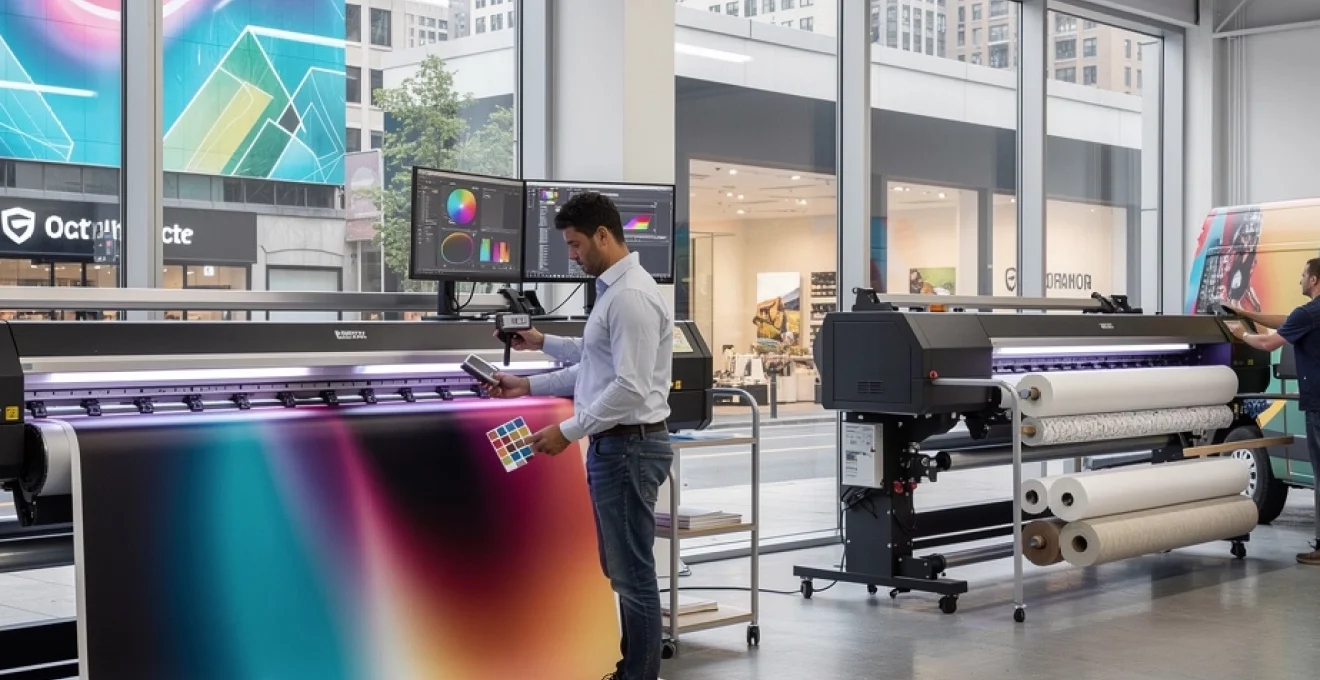
Large format printing has revolutionised the visual communication landscape, transforming how businesses connect with their audiences across industries. From towering building wraps that command attention from miles away to intricate architectural blueprints that guide construction projects, wide format printing technology has become an indispensable tool for modern commerce. The evolution from simple blueprinting techniques to sophisticated digital printing systems represents one of the most significant technological leaps in the printing industry, with 76 percent of consumers reportedly influenced by business signage when making purchasing decisions.
Today’s large format printing capabilities extend far beyond traditional poster production, encompassing everything from vehicle fleet branding to interactive retail displays. The technology’s versatility in handling diverse substrates, combined with advanced colour management systems and automated production workflows, has created new revenue streams for print service providers while enabling businesses to achieve unprecedented visual impact. Understanding the technical foundations and strategic applications of large format printing is crucial for organisations seeking to maximise their marketing investments and operational efficiency.
Large format printing technology fundamentals and equipment specifications
Modern large format printing systems operate on sophisticated digital principles that have largely replaced traditional analogue methods. These printers utilise precision inkjet technology combined with advanced media handling systems to produce graphics ranging from desktop-sized prints to massive 16-foot-wide installations. The fundamental architecture includes high-capacity ink delivery systems, precision print heads capable of microscopic droplet placement, and robust media transport mechanisms designed to handle diverse substrate weights and textures.
The core specifications that define large format printer performance include maximum print width, resolution capabilities, ink type compatibility, and substrate handling versatility. Professional-grade systems typically offer print widths ranging from 24 inches to 16 feet, with some specialised industrial printers exceeding these dimensions. Print speeds vary significantly based on quality settings, with production environments often achieving 15-30 A1 prints per hour at standard quality levels, whilst fine art applications may require substantially longer processing times to achieve museum-quality results.
UV-LED curing systems in roland VersaUV and mimaki UCJV series printers
UV-LED curing technology represents a significant advancement in large format printing, offering instant ink curing capabilities that dramatically reduce production times whilst expanding substrate compatibility. The Roland VersaUV series integrates UV-LED lamps directly into the print carriage system, enabling immediate polymerisation of UV-reactive inks as they contact the substrate surface. This instant curing process eliminates drying time requirements and prevents ink bleeding, resulting in sharper image quality and enhanced colour saturation across diverse media types.
Mimaki’s UCJV series builds upon this foundation with advanced multi-layer printing capabilities, allowing for unique textural effects through raised ink deposits and selective gloss applications. The UV-LED system operates at significantly lower temperatures than traditional UV mercury lamps, enabling printing on heat-sensitive substrates such as thin plastics and specialty films. Energy consumption is reduced by approximately 70 percent compared to conventional UV curing systems, whilst lamp life extends beyond 10,000 operational hours, substantially reducing maintenance costs and environmental impact.
Latex ink technology applications in HP DesignJet Z series production
HP’s latex ink technology revolutionises large format printing through water-based formulations that deliver exceptional durability without compromising environmental safety. The DesignJet Z series employs heated printing zones that activate latex polymers within the ink, creating durable prints that resist fading, scratching, and water damage. This process eliminates the need for lamination in many outdoor applications, reducing material costs and production time whilst maintaining print longevity exceeding three years in unprotected outdoor environments.
The latex ink system operates at printing temperatures ranging from 60-90°C, enabling immediate print finishing without outgassing concerns. This characteristic makes latex-printed materials suitable for indoor applications immediately after production, including healthcare environments and educational facilities where air quality standards are stringent. Colour gamut coverage approaches 90 percent of the Pantone spectrum, ensuring accurate brand colour reproduction across diverse applications from retail graphics to architectural visualisations.
Solvent-based printing capabilities for outdoor durability requirements
Solvent-based printing systems excel in applications demanding maximum outdoor durability, util
Solvent-based printing systems excel in applications demanding maximum outdoor durability, utilising chemically aggressive inks that bite into the surface of PVC and vinyl media. These inks form a permanent bond with the substrate, delivering exceptional resistance to UV exposure, abrasion, and moisture, which is why solvent and eco-solvent printers remain a staple for long-term outdoor signage, billboards, and vehicle wraps. Typical outdoor lifespans of five to seven years are achievable without lamination under moderate conditions, although additional protective films are often specified for high-traffic or harsh environments. Production speeds are also competitive, with many mid- to high-range solvent printers capable of sustained output suitable for high-volume campaigns.
However, solvent-based large format printing carries operational considerations that must be managed carefully. Traditional solvent inks release volatile organic compounds (VOCs), requiring adequate ventilation, fume extraction, and, in some regions, compliance with strict environmental regulations. Eco-solvent formulations reduce VOC content and odour, making them more suitable for indoor production spaces, but still demand proper handling and maintenance practices. When evaluating solvent-based systems, you should weigh the superior outdoor durability and adhesion against drying time, environmental impact, and any local health and safety requirements that may affect your production environment.
Substrate compatibility analysis: PVC, vinyl, canvas, and rigid media handling
One of the defining advantages of large format printing is its flexibility across substrates, allowing you to choose the right material for each application. PVC and flexible vinyl remain the dominant choices for outdoor banners, vehicle wraps, and building signage due to their durability, conformability, and cost-effectiveness. Solvent and latex printers, in particular, offer excellent ink adhesion on these materials, ensuring graphics withstand weathering and mechanical stress. When combined with cast or calendared films of varying thicknesses, PVC and vinyl can be tailored to everything from short-term promotions to long-term architectural graphics.
Canvas and textile substrates open up a different set of possibilities, especially for interior décor, fine art reproduction, and retail environments seeking a softer, more premium aesthetic. Latex and aqueous pigment printers are commonly used for canvas due to their broad colour gamut, smooth gradients, and low odour characteristics, making them ideal for hospitality, healthcare, and residential spaces. Rigid media handling, by contrast, introduces technical demands on the printer’s transport system; flatbed UV-LED printers are purpose-built to print directly onto substrates such as foam board, acrylic, aluminium composite panels, and corrugated plastics. This direct-to-substrate capability eliminates mounting steps, reducing labour and material costs while enabling creative applications like custom furniture panels and wayfinding signage.
Strategic applications transforming commercial signage and retail environments
As large format printing technology has matured, its role in commercial signage and retail has expanded from simple posters to fully integrated environmental branding solutions. Brands are no longer satisfied with static visuals; they expect adaptable, campaign-driven graphics that can be updated quickly and rolled out consistently across multiple locations. Large format printers make this possible by combining high print speeds, reliable colour management, and support for a wide range of materials used in-store and out-of-store. When deployed strategically, these systems help retailers increase dwell time, drive impulse purchases, and reinforce brand identity at every customer touchpoint.
The most successful retail implementers treat large format printing as part of a broader experience design strategy rather than a standalone production capability. This means aligning point-of-purchase displays, window graphics, floor decals, and wayfinding signage with seasonal campaigns, data-driven merchandising decisions, and localised offers. By integrating print production with marketing calendars and inventory management systems, businesses can ensure that every square metre of printed graphics is working as hard as possible to support commercial objectives. In this context, the true game changer is not just the printer itself, but how you orchestrate its output across the retail ecosystem.
Point-of-purchase display manufacturing for major retail chains
Point-of-purchase (POP) displays are one of the most powerful applications of large format printing in retail environments. These displays transform otherwise neutral shelf space into high-impact brand real estate, often at the critical last metre of the customer journey. Modern POP manufacturing relies heavily on UV flatbed printers, latex roll-to-roll systems, and digital cutting tables to produce customised units at scale. Corrugated board, fluted polypropylene, and rigid foam are common POP substrates, each chosen for a balance of strength, weight, and print quality suited to campaign duration and budget.
For national or international retail chains, the key challenge is standardisation and speed: how can you deliver thousands of displays to hundreds of stores, all with consistent branding and fit-for-purpose construction? Automated imposition, nesting, and finishing workflows allow POP producers to minimise waste and optimise sheet usage, cutting both cost per square metre and lead times. Variable data printing adds another layer of value, enabling localisation of offers, languages, or store-specific pricing without redesigning the entire display. When you combine these capabilities, large format printing becomes a strategic enabler for agile retail campaigns that can be launched, tested, and refined within weeks rather than months.
Building wraps and architectural graphics implementation projects
Building wraps and large-scale architectural graphics represent the most dramatic face of large format printing, turning entire façades into temporary or semi-permanent communication platforms. These projects typically use perforated one-way vision films, mesh banners, or high-tensile PVC and polyester fabrics, printed with solvent, UV, or latex technologies depending on environmental exposure and required lifespan. Print resolutions in the 600–1000 DPI range are usually sufficient at these scales, as viewing distances are measured in tens of metres, allowing production teams to prioritise speed and ink efficiency.
However, the true complexity of building wrap projects lies in the planning, engineering, and installation phases. Accurate site surveys, structural load calculations, and compliance with local regulations are as essential as the print itself. Files must be carefully tiled, with bleed, overlap, and alignment marks built into the RIP to ensure seamless assembly on-site. Working closely with specialist installers, you must consider wind loading, attachment systems, and safe access to high elevations. When executed correctly, building wraps can turn construction sites, renovation projects, or underused façades into high-value media, delivering millions of impressions over the life of the campaign.
Trade show exhibition graphics production workflows
Trade show environments demand large format printing that combines portability, durability, and striking visual impact. Exhibitors increasingly rely on modular systems such as fabric tension frames, pop-up walls, and portable lightboxes, all of which depend on high-quality printed graphics. Dye-sublimation onto polyester fabrics and latex printing onto blockout films are particularly popular, as they produce lightweight, foldable graphics that resist creasing and can be reused across multiple events. For rigid elements like counters and product plinths, UV-printed panels provide robust surfaces that stand up to frequent handling and transport.
Efficient exhibition graphics workflows hinge on meticulous prepress and colour management, especially when you are supplying multiple components that must visually align under varied lighting conditions. Creating master templates for common stand sizes, standardising substrate choices, and using consistent ICC profiles across devices all help streamline production. Many print service providers now integrate online ordering portals, allowing exhibitors to configure stands, upload artwork, and reorder graphics from previous shows with minimal manual intervention. In such a deadline-driven environment, the ability to move from approved artwork to packed and labelled shipments within 48–72 hours often becomes a decisive competitive advantage.
Vehicle fleet branding and mobile advertising campaign execution
Vehicle fleet branding is a prime example of how large format printing turns everyday assets into mobile advertising platforms. From small car fleets to hundreds of delivery trucks, fully wrapped or partially branded vehicles generate thousands of impressions per day, often at a lower cost per view than many digital channels. High-performance cast vinyl films printed with solvent, eco-solvent, or latex inks are the industry standard, chosen for their conformability over complex curves, long-term durability, and ease of removal at the end of the lease or campaign. Laminates with UV and abrasion protection are typically applied to extend lifespan and maintain visual quality.
Executing a fleet branding programme demands more than just excellent print quality. Precise vehicle templating, panel layout optimisation, and coordinated installation schedules are all critical to overall project success. RIP software is used to tile artwork logically, reducing seams and ensuring that key design elements avoid door gaps, handles, and high-wear areas. For multi-site deployments, centralised project management and detailed install guides help maintain consistency across installers and regions. When planned strategically, a fleet wrap rollout can be phased to coincide with product launches or rebrands, ensuring that every vehicle on the road reinforces your latest visual identity.
Print resolution optimisation and colour management protocols
While it is tempting to assume that higher resolution always equals better quality, effective large format printing demands a more nuanced approach. Different substrates, viewing distances, and ink technologies all influence what resolution is truly necessary for a given application. Over-specifying resolution not only increases RIP and print times, but can also raise ink consumption and production costs without any visible benefit to the end user. By contrast, a well-optimised combination of resolution, screening method, and ink laydown can deliver crisp, vibrant graphics that are perfectly matched to their environment.
Colour management plays an equally critical role, particularly for brand-conscious clients who expect consistent reproduction across campaigns and locations. Proper calibration and profiling ensure that what you see on screen closely matches what emerges from the printer, reducing the need for costly test prints and reworks. When combined with disciplined file preparation and RIP configuration, robust colour management protocols turn large format printing from a trial-and-error process into a predictable, controllable production workflow. In many businesses, this is the point where large format truly becomes a scalable, profitable service rather than an occasional add-on.
1440 DPI vs 2880 DPI output quality analysis for different media types
Choosing between 1440 DPI and 2880 DPI settings is less about a simple “better or worse” decision and more about aligning technical output with real-world viewing conditions. On materials such as PVC banners, self-adhesive vinyl, and mesh used for outdoor signage, 1440 DPI is typically more than sufficient because audiences view these graphics from several metres away. At these distances, the human eye cannot resolve the additional detail offered by 2880 DPI, meaning the extra time and ink spent yield little perceptible improvement. Production environments therefore often reserve ultra-high resolutions for niche applications rather than everyday jobs.
Conversely, close-view applications on smoother substrates—such as fine art papers, photographic prints, and backlit films—can benefit visibly from 2880 DPI output. Here, subtle tonal transitions, skin tones, and fine text may appear cleaner and more refined at higher resolutions, particularly under bright or directional lighting. However, you should also consider the diminishing returns curve: doubling the DPI does not necessarily double perceived quality, but it can significantly increase print time. A practical strategy is to define standard resolution presets by application type and substrate, then validate them with side-by-side test prints so clients can judge whether the difference justifies the extra cost.
ICC profile creation and calibration using X-Rite i1pro spectrophotometers
Consistent, accurate colour in large format printing starts with device calibration and reliable ICC profiles tailored to each printer, ink set, and substrate combination. Tools such as the X-Rite i1Pro spectrophotometer allow you to measure printed colour charts and generate custom profiles that reflect the unique behaviour of your equipment under specific conditions. The process typically begins with linearising the printer, ensuring that each ink channel produces a predictable response across the tone scale. Once linearisation is complete, a profiling target is printed and measured, and specialised software calculates an ICC profile that maps source colours (for example, from Adobe RGB or sRGB) to the printer’s gamut.
Regular calibration is essential because environmental factors, head wear, and even new ink batches can cause drift over time. Many production environments schedule weekly or monthly checks, depending on volume and quality requirements, to keep devices within acceptable tolerances. By embedding the resulting ICC profiles into your RIP workflow, you ensure that colour conversions and ink limiting are handled optimally for each media type. The outcome is fewer surprises on press, reduced proofing cycles, and the confidence to promise repeatable colour to demanding clients such as retail brands, designers, and agencies.
RIP software configuration: onyx ProductionHouse and caldera GrandRIP+
RIP software is the control centre of any professional large format printing operation, translating design files into precise instructions for the printer. Platforms such as Onyx ProductionHouse and Caldera GrandRIP+ offer advanced tools for colour management, nesting, tiling, and automated workflows that can dramatically improve productivity. Correct configuration starts with importing accurate media profiles, setting appropriate ink limits, and selecting screening algorithms that balance smooth gradients with crisp detail. From there, you can define presets for common job types—such as outdoor banners, backlit displays, or vehicle wraps—so operators can apply optimal settings quickly and consistently.
Both Onyx and Caldera also support features that directly impact cost control and throughput. Automated nesting minimises media waste by arranging multiple jobs on a roll or sheet with minimal gaps, while step-and-repeat functions streamline the production of repeated graphics. Tiling tools handle oversized prints that exceed the maximum width of your device, adding overlaps, registration marks, and panel labels to simplify installation. By connecting the RIP to hot folders, MIS software, or web-to-print platforms, you can build end-to-end workflows that reduce manual touchpoints, lower error rates, and provide real-time visibility into job queues and device status.
Pantone colour matching accuracy in large format production environments
Pantone colour matching is a critical requirement in brand-heavy segments such as retail, FMCG, and corporate communications. While large format printers typically work with CMYK or extended-gamut ink sets rather than spot inks, well-managed systems can still achieve very close matches to many Pantone colours. The key lies in using up-to-date Pantone libraries within your design and RIP software, combined with accurate ICC profiles for each printer-media combination. Many RIPs include Pantone lookup tables that specify the optimal CMYK or CMYKcm, or CMYK+OGRB builds for specific devices and substrates, providing a solid starting point for accurate reproduction.
In practice, not every Pantone can be reproduced perfectly, particularly highly saturated oranges, greens, and blues that fall outside the printable gamut of a given ink set. This is where communication and proofing become vital. Producing labelled colour swatch charts on the target media allows clients to approve the closest achievable match before full production begins. For mission-critical brand colours, some PSPs invest in printers with expanded ink channels, such as orange, green, and violet, to widen the gamut. By setting clear expectations and using objective measurement tools like spectrophotometers and delta E metrics, you can deliver Pantone fidelity that satisfies brand owners while staying within the real-world limits of large format devices.
Production workflow automation and cost-per-square-metre analysis
As demand for large format printing grows, manual, labour-intensive workflows quickly become a bottleneck. Automation—across prepress, printing, and finishing—allows you to handle higher volumes with fewer errors and more predictable turnaround times. This can include everything from web-to-print portals that capture orders and artwork, to automated preflight checks that flag low-resolution images or missing fonts, to barcoded job tickets that drive cutting tables and finishing equipment. By standardising common job types and using templates, you free operators from repetitive tasks and reduce the risk of costly reprints caused by human error.
Accurate cost-per-square-metre analysis underpins profitable pricing strategies in this environment. Rather than relying on broad estimates, leading PSPs track ink consumption, media costs, labour time, and overhead allocation at a granular level, often using MIS software integrated with their RIP and accounting systems. This data-driven approach reveals which applications deliver the highest margins, where discounts are sustainable, and which process improvements genuinely reduce costs. For example, you may discover that slightly lower resolution settings or more efficient nesting strategies can cut ink and media usage without sacrificing visible quality. Over time, these incremental gains compound, turning automation and careful cost analysis into powerful levers for competitive advantage.
Industry case studies: successful large format implementation strategies
Real-world implementations show how diverse organisations harness large format printing to solve specific challenges and unlock new revenue streams. A regional supermarket chain, for instance, might centralise production of in-store signage and POS materials, replacing a patchwork of local suppliers with a single automated hub. By standardising substrates, implementing strict colour management, and integrating their marketing calendar with print production, they can roll out weekly promotions across dozens of stores with consistent branding and reduced waste. The result is faster campaign deployment, clearer pricing communication, and measurable uplift in promotional sales.
In another scenario, an architectural firm invests in a high-resolution aqueous or latex plotter to produce detailed plans, elevations, and presentation boards in-house. This reduces their reliance on external reprographic services, shortens feedback loops during design iterations, and gives them tighter control over the confidentiality of sensitive projects. The firm may also leverage the same device for client-facing visuals—such as rendered 3D perspectives or site graphics—enhancing their presentations without incurring additional outsourcing costs. In both cases, the strategic adoption of large format printing is less about owning a machine and more about integrating its capabilities into core business processes.
Future technologies reshaping wide format printing markets
The future of large format printing is being shaped by converging trends in materials science, automation, and digital integration. Sustainable substrates and inks are advancing rapidly, with PVC-free films, recyclable fabrics, and water-based ink systems gaining traction as brands set ambitious environmental targets. At the same time, printers are becoming more connected and intelligent, with built-in sensors, usage analytics, and cloud-based fleet management tools that enable predictive maintenance and remote diagnostics. These developments reduce downtime, optimise consumable usage, and give decision-makers better insight into capacity planning and investment priorities.
On the application side, we are seeing increasing crossover between print and digital experiences, driven by technologies such as QR codes, NFC tags, and augmented reality overlays embedded in large format graphics. Imagine a building wrap that triggers a 3D product demo on a passer-by’s phone, or a retail wall graphic that launches personalised offers when scanned—these hybrids turn static surfaces into interactive touchpoints. Advances in textile printing and soft signage are also blurring the lines between décor, branding, and architecture, as designers specify printed fabrics for acoustic control, light diffusion, and modular space division. As these innovations mature, businesses that treat large format printing as a strategic, integrated medium—not just a production cost—will be best placed to capitalise on the next wave of opportunities.